

Entrepreneurial Decision Process: Stages, Cognitive Logics & Effectuation Framework
Entrepreneurial Decision Process: Stages, Cognitive Logics & Effectuation Framework
An authoritative MBA study note investigating how venture founders make existential choices under conditions of acute uncertainty. Systematically analyzes the 5-stage venture decision sequence, cognitive heuristics, Simon's bounded rationality, and the radical divergence between corporate Causation and entrepreneurial Effectuation.
30-Second Quick Revision Snapshot
The Psychological Context of Entrepreneurial Decision Making
Corporate managerial decision-making operates in environments with historical accounting data, predictable consumer trends, and established corporate guidelines. In contrast, entrepreneurial decision-making occurs in conditions of extreme information asymmetry, severe time pressure, and uninsurable Knightian uncertainty.
According to Nobel laureate Herbert Simon (Bounded Rationality), human cognitive bandwidth cannot process all potential outcomes. Founders compensate by deploying fast cognitive heuristics:
Generalizing massive market opportunities from small, vivid personal experiences or early customer signals.
Possessing an inflated subjective probability of success—vital psychological armor that prevents paralysis in high-risk environments.
Focusing intensely on what could be created rather than brooding over potential downside career regrets.
The 5-Stage Sequential Decision Architecture
The journey from an initial mental spark to a self-sustaining corporation advances through five sequential, iterative decision stages:
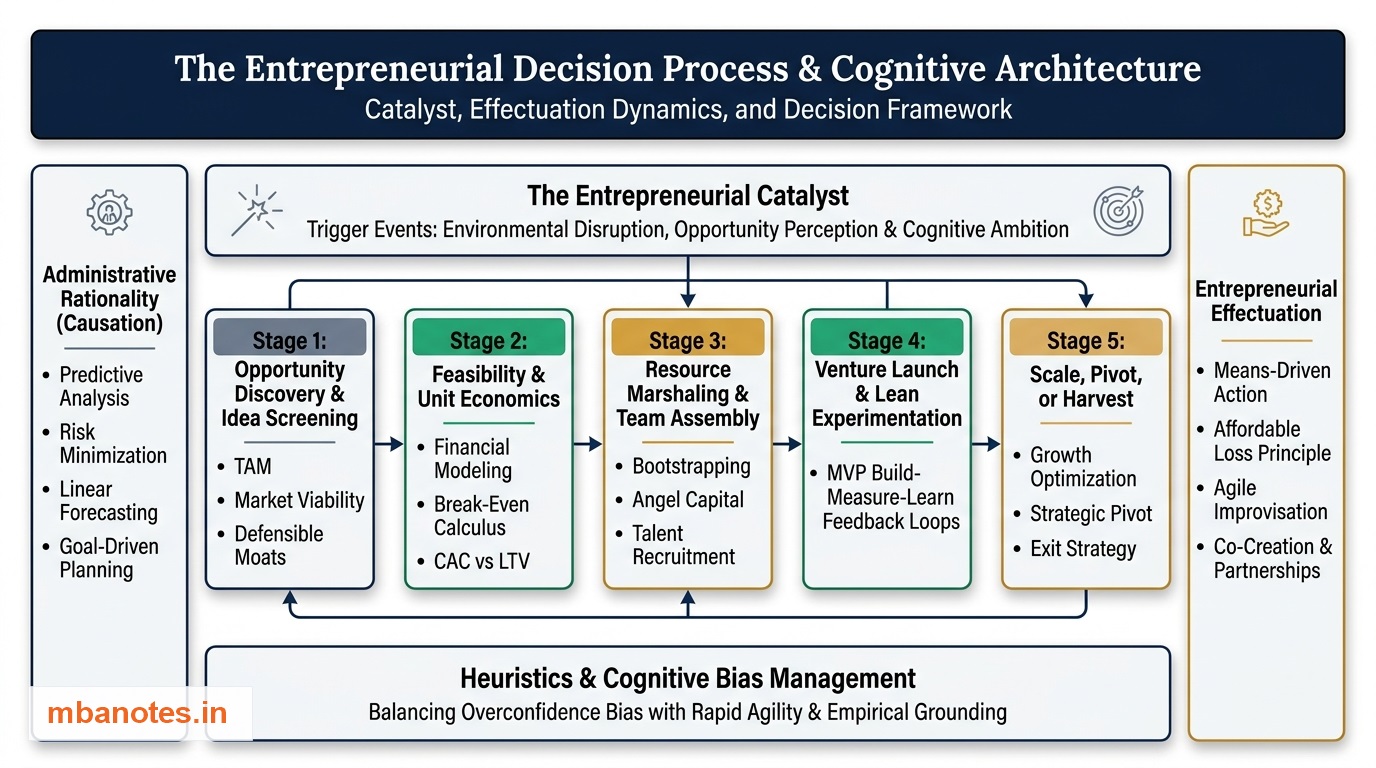
The decision process is initiated by an internal or external trigger: technological discontinuity, regulatory reform, personal job dissatisfaction (push factor), or an acute consumer pain-point. The entrepreneur decides to actively investigate whether a latent market gap exists.
Conducting rigorous multi-dimensional screening: Total Addressable Market (TAM), competitive moat analysis (Porter's Five Forces), technical feasibility, regulatory obstacles, and basic unit economics (Customer Acquisition Cost vs. Lifetime Value). The founder faces the critical Go / No-Go decision.
The entrepreneur crosses the point of no return: resigning from corporate employment, assembling founding co-founders, securing seed angel capital or bootstrapping lines, signing intellectual property agreements, and incorporating the legal corporate entity.
Deploying Eric Ries' Lean Startup methodology: building a Minimum Viable Product (MVP), shipping it to vanguard early adopters, measuring behavioral usage metrics, and testing commercial willingness-to-pay rather than relying on vanity survey answers.
Upon achieving Product-Market Fit (PMF), the founder chooses between three distinct trajectories: (1) Scale (aggressive venture expansion), (2) Pivot (radically altering strategy/monetization while retaining overarching mission), or (3) Harvest (exiting via trade sale, M&A, or IPO).
Cognitive Decision Logics: Effectuation vs. Causation (Saras Sarasvathy)
Professor Saras Sarasvathy (Darden School of Business) revolutionized entrepreneurial decision theory by demonstrating that expert entrepreneurs invert standard managerial logic:
"To the extent that we can predict the future, we can control it."
- Starts with a predetermined, fixed target (e.g., capture \$50M market share).
- Focuses on calculating maximum expected return on capital.
- Conducts extensive market surveys to minimize unexpected surprises.
- Views competing firms as adversaries to be defeated.
"To the extent that we can control the future, we do not need to predict it."
- Bird-in-Hand: Starts with current means: Who I am, What I know, Whom I know.
- Affordable Loss: Evaluates downside risk; limits bets strictly to what can be lost without bankruptcy.
- Crazy Quilt: Builds self-selecting stakeholder commitments and pre-commitments.
- Lemonade Principle: Embraces surprises and pivots contingencies into competitive advantages.
The Entrepreneurial Decision Process Architecture (Visual Framework)
The master infographic below models the complete entrepreneurial decision architecture: tracing the 5-stage sequential decision gates, contrasting Causation and Effectuation mental models, and illustrating the cognitive heuristics that govern high-growth venture launches.
Analytical Matrix: Rational Administrative vs. Entrepreneurial Decision Making
| Analytical Dimension | Rational Administrative Decision-Making | Entrepreneurial Effectual Decision-Making |
|---|---|---|
| Environmental Assumption | Measurable risk; stable historical trends; predictable markets. | Knightian uncertainty; non-existent historical data; fluid markets. |
| Starting Point | Predetermined organizational goals and annual targets. | Available personal means (traits, knowledge, network contacts). |
| Risk Evaluation Criterion | Net Present Value (NPV) & Expected Return Maximization. | Affordable Loss Criterion (What can we afford to lose?). |
| Attitude to Contingencies | Avoidance; variance regarded as procedural defect or failure. | Leverage; surprises embraced as novel input for strategic pivots. |
| Competitive Posture | Zero-sum competitive warfare; protecting market share. | Pre-commitments, strategic alliances, and open co-creation. |
Real-World Indian Case: Deepinder Goyal & The Blinkit Acquisition Decision
How Zomato's \$568 Million Bet on Quick-Commerce Defied Wall Street Analysts
In mid-2022, Zomato founder Deepinder Goyal faced an existential decision: food delivery growth was maturing, and instant 10-minute grocery delivery ("quick-commerce") was incinerating hundreds of millions in venture cash across India. Most traditional financial analysts condemned quick-commerce as economically unviable.
Strategic Takeaway: Entrepreneurial decision-making is defined by bold, non-linear pivots when empirical reality disproves orthodox forecasts.
AKTU MBA Exam Strategy & Question Blueprints
Q1: What is an "Affordable Loss" in entrepreneurial decision-making?
Model Answer: In Saras Sarasvathy's effectuation framework, the affordable loss principle dictates that an entrepreneur evaluates opportunities not by expected upside return, but by calculating the absolute downside risk they are personally and financially willing to lose without jeopardizing survival.
Q2: What is meant by a "Strategic Pivot" in the Lean Startup methodology?
Model Answer: Formulated by Eric Ries, a pivot is a structured course correction designed to test a new fundamental hypothesis about the product, business model, or engine of growth, while keeping the venture's overarching vision unchanged.
Master Exam Question: "Critically explain the entrepreneurial decision-making process from opportunity identification to venture scaling. How does Saras Sarasvathy's Effectuation framework distinguish entrepreneurial choices from corporate managerial decisions? Illustrate with a contemporary Indian startup example."
Always draw the cyclical 5-stage flowchart with a return loop showing how feedback from Stage 4 (MVP) triggers either Stage 5 scaling or returns to Stage 2 for a pivot. Mentioning the distinction between Herbert Simon's bounded rationality and Sarasvathy's Effectuation guarantees top-tier evaluator marks.