
Brand Equity: Meaning & Importance
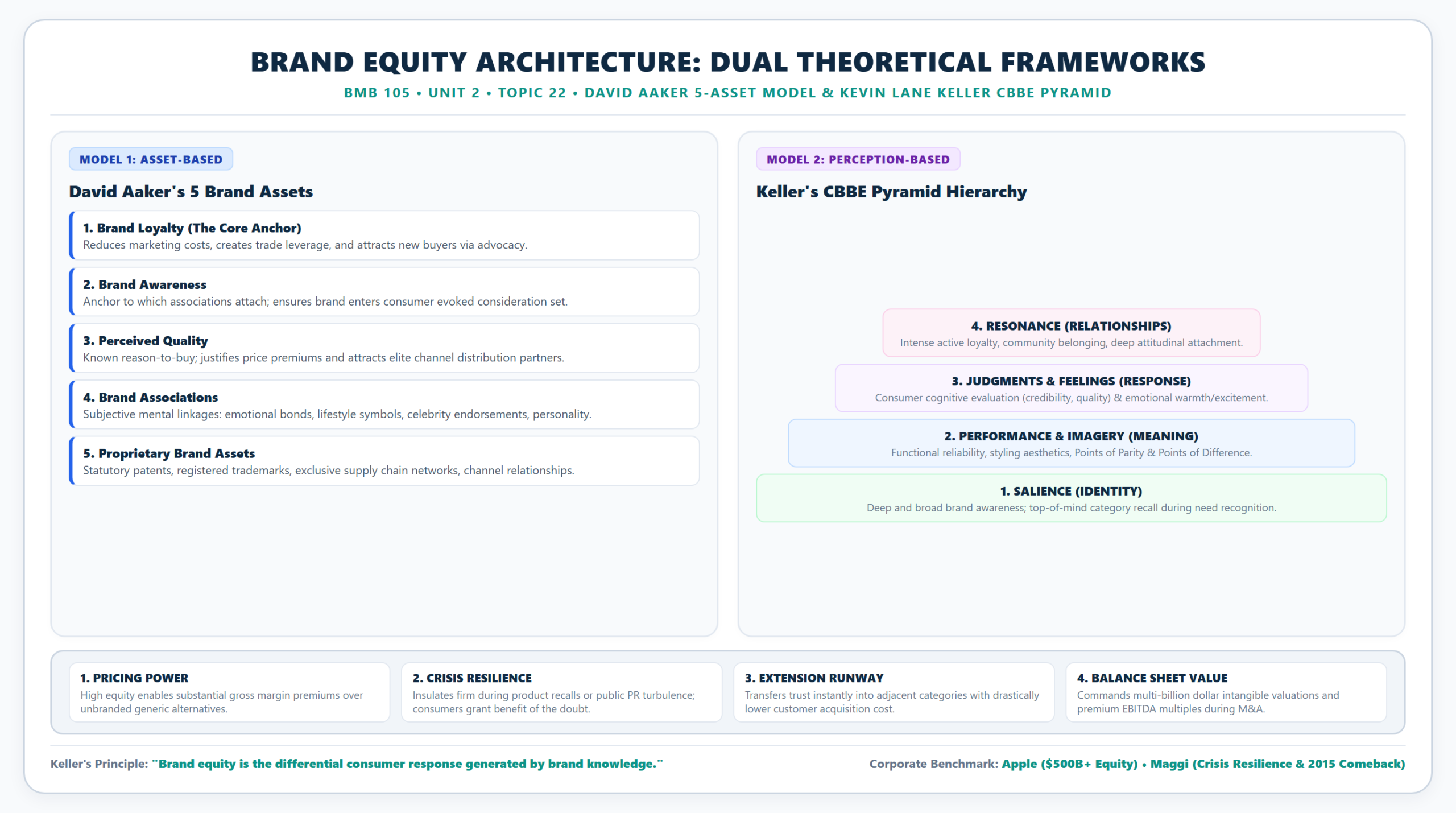
01 Brand Equity: Conceptual Definition & Economic Rationale
In modern business strategy, Brand Equity is the commercial value that accrues to a firm solely from the customer's perception of the brand name, rather than from the physical product or service itself. It represents the psychological goodwill, positive associations, and behavioral loyalty that enable a branded product to earn higher revenue, wider margins, and greater customer retention than a generic commodity offering.
From an accounting perspective, brand equity manifests as a formidable intangible asset on the corporate balance sheet. From a marketing science perspective, Kevin Lane Keller defines Customer-Based Brand Equity (CBBE) as "the differential effect that brand knowledge has on consumer response to the marketing of that brand." When a consumer reacts more favorably to a product feature, price change, or advertisement simply because of the brand name attached to it, positive brand equity exists.
The Differential Effect
Measures the tangible performance gap when identical goods are presented under a generic label versus an iconic brand name.
Brand Knowledge Architecture
Composed of Brand Awareness (node in memory) and Brand Image (perceptual associative network of emotions, feelings, and beliefs).
Consumer Response Elasticity
High equity insulates against price increases and advertising clutter while accelerating word-of-mouth advocacy and brand extensions.
Aaker's 5 Assets
Loyalty, Awareness, Perceived Quality, Associations, and Proprietary Brand Assets.
Keller's CBBE Ladder
Sequential ascent: Identity (Salience) → Meaning → Response → Resonance.
Strategic Dividends
Unlocks pricing power, crisis resilience, extension velocity, and multi-billion M&A balance sheet value.
03 David Aaker's Five Assets of Brand Equity
In his 1991 book "Managing Brand Equity," UC Berkeley Professor David Aaker established the premier asset-based model of brand equity, categorizing it into five distinct assets:
1. Brand Loyalty (The Core Asset)
The probability that a customer will switch to another brand, especially when that brand makes a change in price or product features. Loyalty represents the core of brand equity: acquiring new buyers is 5x to 7x more expensive than retaining existing loyal advocates.
2. Brand Awareness
The ability of a potential buyer to recognize or recall that a brand is a member of a certain product category. Moves along a continuum from Brand Recognition (aided recall) to Brand Recall (unaided top-of-mind) to Dominant Brand (the only brand remembered, e.g., Band-Aid, Xerox, Google).
3. Perceived Quality
The customer's subjective judgment about a product's overall excellence or superiority relative to alternatives. Perceived quality cannot be determined objectively; it directly justifies price premiums, incentivizes retail channel partnerships, and supports brand extensions.
4. Brand Associations
Anything "linked" in human memory to a brand. Includes celebrity endorsers (Michael Jordan with Nike), emotional memories (family gatherings with Cadbury Dairy Milk), user lifestyles, functional attributes, and corporate citizenship (Tata's philanthropic trusts).
5. Other Proprietary Brand Assets
Competitive advantages legally or commercially anchored to the brand: registered trademarks, proprietary technological patents, and exclusive channel distribution arrangements that prevent competitors from degrading the brand's customer base.
04 Kevin Lane Keller's Customer-Based Brand Equity (CBBE) Pyramid
Dartmouth Professor Kevin Lane Keller formulated the CBBE Model, structuring brand building as a sequential four-step hierarchy that ascends from foundational awareness to ultimate customer resonance:
Step 1: Brand Identity • Salience (Who Are You?)
Pyramid BaseEnsures deep and broad brand awareness. Measures how easily and often the brand is evoked under various purchase or consumption situations. Target: Top-of-mind unprompted category recall.
Step 2: Brand Meaning • Performance & Imagery (What Are You?)
Pyramid Tier 2Establishes what the brand characterizes. Bifurcates into Brand Performance (functional attributes, reliability, speed, design) and Brand Imagery (intangible user profile, personality, heritage, social standing).
Step 3: Brand Response • Judgments & Feelings (What About You?)
Pyramid Tier 3What customers think or feel about the brand. Judgments are cognitive evaluations (quality, credibility, consideration, superiority). Feelings are emotional reactions (warmth, fun, excitement, security, social approval).
Step 4: Brand Relationships • Resonance (What About You & Me?)
Pyramid PinnacleThe ultimate pinnacle of brand equity. Characterized by intense, active psychological loyalty, attitudinal attachment, a sense of shared community (e.g., Harley Owners Group, Apple fan communities), and active brand ambassadorship.
05 Strategic & Financial Importance of Brand Equity
Pricing Power Premium
Insulates the firm against price increases in raw materials and allows commanding sustainable gross margin premiums.
Crisis Resiliency Moat
When public crises or recalls occur, consumers give high-equity brands the benefit of the doubt, preventing long-term brand death.
Extension Velocity
Enables the brand to enter adjacent product categories with dramatically reduced marketing costs and high trial rates.
M&A Balance Sheet Value
Commands multi-billion dollar intangible valuations and premium EBITDA multiples during mergers and acquisitions.
06 Comparative Synthesis: David Aaker's Model vs. Kevin Lane Keller's CBBE Model
| Comparison Dimension | David Aaker's Brand Equity Model | Kevin Lane Keller's CBBE Pyramid |
|---|---|---|
| Core Theoretical Orientation | Strategic & Managerial Asset Portfolio perspective | Cognitive & Psychological Consumer Perception perspective |
| Structural Organization | Five interconnected standalone asset categories | Sequential 4-stage ascending hierarchical pyramid |
| Ultimate Measure of Equity | Brand Loyalty & Net Asset Value generated | Brand Resonance (Active communal engagement & advocacy) |
| Legal / IP Protection Inclusion | Explicitly includes Patents, Trademarks, & Channel power | Focuses strictly on customer mindshare and perception |
| Primary Strategic Application | Corporate portfolio valuation and brand extension audits | Designing advertising communications & brand experiences |
07 Real-World Corporate Applications & Case Studies
Apple Inc.: The Pinnacle of Customer-Based Brand Equity ($500B+)
Apple consistently ranks as the world's most valuable brand. By ascending all four levels of Keller's CBBE pyramid, Apple has transformed ordinary hardware buyers into passionate brand evangelists.
Nestle Maggi: How 30 Years of Brand Equity Saved an Instant Noodle Icon
In June 2015, food safety regulators banned Maggi noodles in India due to alleged lead contamination, forcing Nestle to incinerate 38,000 tonnes of inventory and causing market share to crash from 75% to zero.
08 AKTU Previous Years High-Frequency Exam Questions & Solutions
Q1. Define 'Brand Equity' and mention two major advantages it provides to an enterprise.
Model Answer: Brand Equity is the commercial value that derives from consumer perception of the brand name of a particular product or service, rather than from the product or service itself (Kevin Lane Keller / David Aaker).
Two Major Advantages:
- Pricing Power: Allows the firm to command premium pricing and wider margins without losing customers to cheaper competitors.
- Crisis Resilience: Protects the business during negative publicity, as loyal consumers grant the brand the benefit of the doubt.
Q2. Critically examine Kevin Lane Keller's Customer-Based Brand Equity (CBBE) Pyramid. How does it differ from David Aaker's Brand Equity Model? Illustrate with industry examples.
Step-by-Step Scoring Structure for Exam:
- Introduction: Define Brand Equity and Customer-Based Brand Equity (CBBE).
- Keller's CBBE Pyramid (Draw the 4-Tier Pyramid):
- Level 1: Salience (Identity): Deep, broad awareness (Who are you?).
- Level 2: Performance & Imagery (Meaning): Functional & abstract psychological meaning (What are you?).
- Level 3: Judgments & Feelings (Response): Cognitive evaluations & emotional reactions (What about you?).
- Level 4: Resonance (Relationships): Intense loyalty, community, and advocacy (What about you & me?).
- David Aaker's 5 Brand Assets: Brand Loyalty, Brand Awareness, Perceived Quality, Brand Associations, and Proprietary Brand Assets.
- Comparative Table: Aaker vs Keller across Theoretical Focus, Structure, Key Outcome, and IP inclusion.
- Strategic Importance of Brand Equity: Pricing power, crisis protection, extension leverage, balance sheet valuation.
- Real-World Corporate Applications: Apple's high brand resonance and Maggi's miraculous recovery from the 2015 ban.
- Conclusion: Brand equity requires decades of consistent cross-functional nurturing across all customer touchpoints.
Discussion & Questions
0 CommentsAcademic insights, questions, and conceptual clarifications from students & faculty.
No questions or comments yet
Have a doubt about this topic, an exam tip, or a conceptual perspective? Start the discussion below!
Leave a Comment / Ask a Question
Your email address will not be published. Required fields are marked *