
External Environment: Micro Factors (Suppliers, Customers, Competitors & Intermediaries)
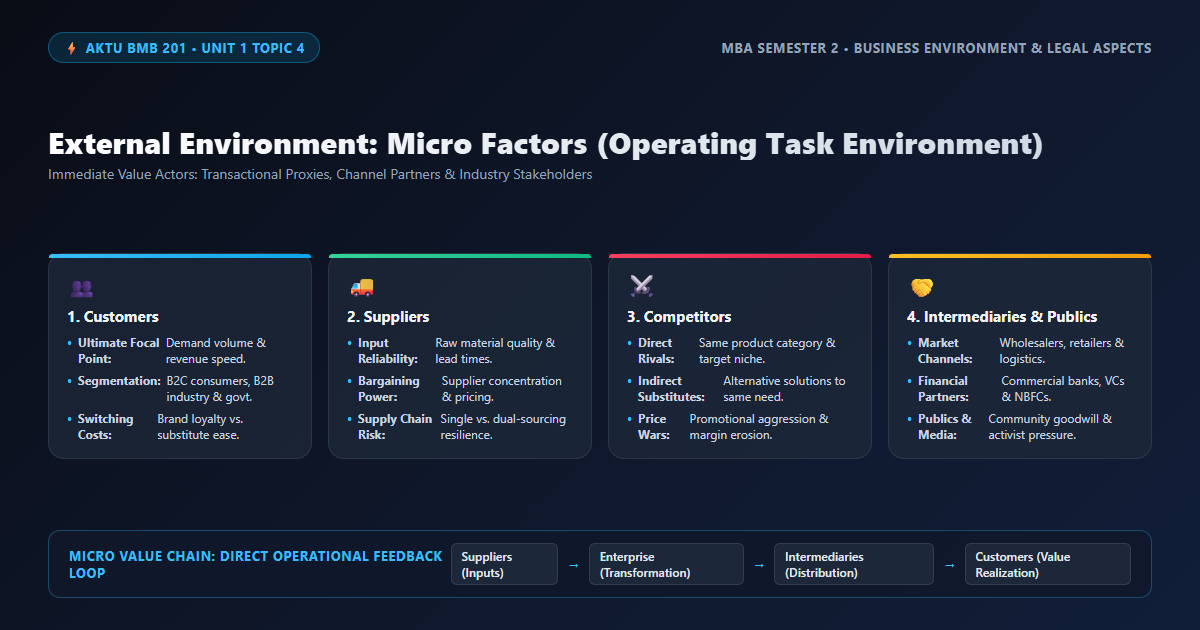
1. Conceptual Scope: Understanding the Micro Task Environment
In business environment classification, the micro-environment (frequently termed the operating environment or task environment by management scholars like William Glueck and Philip Kotler) represents the proximate external sphere of an organization. Micro actors directly interact with the firm's day-to-day conversion processes—supplying inputs, channeling outputs, financing operations, or competing for consumer wallet share.
Distinguishing Features of the Micro Environment
2. The Customer Dimension: Demand Dynamics & Market Segmentation
Peter Drucker famously stated: “There is only one valid definition of business purpose: to create a customer.” Customers represent the lifeblood and ultimate justification for any commercial enterprise. Modern marketing recognizes that customer requirements are not monolithic:
B2C Consumers: Buy finished goods for personal or household consumption. Purchasing behavior is governed by disposable income, emotional branding, lifestyle aspirations, and instant gratification.
B2B Buyers: Procure raw materials, machinery, and business services for value addition. Driven by formal procurement committees, Return on Investment (ROI), technical SLAs, and credit payment terms.
Government Agencies: Central, state, and defense departments procuring goods via formal tendering portals (e.g., GeM in India). Prioritize lowest quoted bid (L1), national security norms, and statutory certifications.
International Markets: Global buyers requiring adherence to ISO standards, export documentation, foreign exchange fluctuations, and cultural consumption nuances.
3. The Supplier & Competitor Nexus: Supply Chain Power & Industry Rivalry
Suppliers and competitors determine the fundamental profitability boundaries of an industry. The balance of power between input suppliers and market rivals dictates operating margins:
- Supplier Concentration: If an industry depends on a few monopoly vendors (e.g., TSMC for advanced semiconductor chips), suppliers dictate pricing and delivery schedules.
- Switching Costs: The financial and technical penalty incurred when shifting from one supplier to another. High switching costs lock in manufacturers.
- Single vs. Dual-Sourcing Strategy: Relying on a single supplier offers volume rebates but catastrophic vulnerability if the plant faces strikes or natural disasters. Resilient firms maintain dual or multi-vendor ecosystems.
- Direct Competitors (Brand Rivalry): Enterprises offering virtually identical products to the same target segment (e.g., Indigo vs. Air India; Swiggy vs. Zomato). Competition centers on price wars, delivery speed, and service quality.
- Indirect Competitors (Product Form Rivalry): Products that satisfy the same generic need using different technologies (e.g., Railways vs. Commercial Airlines; Video Conferencing vs. Business Travel).
- Generic Competitors: All consumer goods competing for the limited disposable income of the consumer (e.g., choosing whether to buy a new smartphone or take a weekend vacation).
4. Market Intermediaries, Financial Institutions & Publics
In modern complex markets, few manufacturers deliver goods directly to the end-consumer. A network of auxiliary intermediaries and public constituencies facilitates the physical and financial flow:
6. Real-World Corporate Example: Maruti Suzuki’s Micro-Ecosystem in India
Orchestrating 50%+ Passenger Car Market Share for Decades: When Maruti Udyog began producing cars in the 1980s, India had no reliable automotive component ecosystem. Maruti systematically co-created its own micro-environment:
Managerial Takeaway: Market leadership is not solely determined by product design; building deep symbiotic partnerships with suppliers and distributors (micro actors) creates insurmountable competitive barriers.
7. High-Frequency AKTU Previous Year Exam Questions (PYQs)
Review these standard examination questions frequently asked in AKTU MBA Business Environment papers:
Section A: Short Conceptual Questions (2 Marks Each)
Answer: The Micro Environment (or task environment) comprises the immediate external forces and entities that have a direct, daily transactional impact on a firm's operational and marketing capabilities. Four key components are: 1) Customers, 2) Suppliers, 3) Competitors, and 4) Marketing Intermediaries.
Answer: Marketing intermediaries (wholesalers, retailers, logistics partners, and warehousing agents) bridge the gap of time, place, and possession between production facilities and end-consumers, absorbing inventory storage costs, extending market reach, and providing credit facilities.
Answer: Direct competitors offer identical products in the same category (e.g., Pepsi vs. Coca-Cola). Indirect substitutes satisfy the same underlying consumer need through a different product form (e.g., packaged fruit juice or coconut water substituting for carbonated cola).
Section B & C: Long Conceptual Questions (7 & 10 Marks)
- Concept & Task Environment Scope (1.5 Marks): Define micro environment; explain its proximity and transactional nature compared to macro forces.
- Detailed Analysis of Core Micro Actors (4 Marks):
- Customers: B2C consumer psychology, B2B purchasing committees, institutional and international demand.
- Suppliers: Raw material reliability, vendor concentration power, switching cost barriers, and multi-sourcing.
- Competitors: Direct brand rivalry, product form substitutes, generic wallet share competition.
- Intermediaries & Publics: Wholesale/retail channels, physical logistics, media scrutiny, and NGO watchdogs.
- Strategic Micro Management Framework (2.5 Marks): Delineate proactive tactics: supplier co-location/joint ventures, long-term procurement SLAs, CRM programs, and multi-channel dealer incentives.
- Corporate Benchmark (1 Marks): Cite Maruti Suzuki's localized vendor parks and massive dealership network as a model micro-ecosystem.
- Summary & Conclusion (1 Mark): Emphasize that while micro forces cannot be commanded, they can be negotiated and shaped into a durable competitive advantage.
Discussion & Questions
0 CommentsAcademic insights, questions, and conceptual clarifications from students & faculty.
No questions or comments yet
Have a doubt about this topic, an exam tip, or a conceptual perspective? Start the discussion below!
Leave a Comment / Ask a Question
Your email address will not be published. Required fields are marked *