
External Environment: Macro Environmental PESTLE Framework & Economic Forces
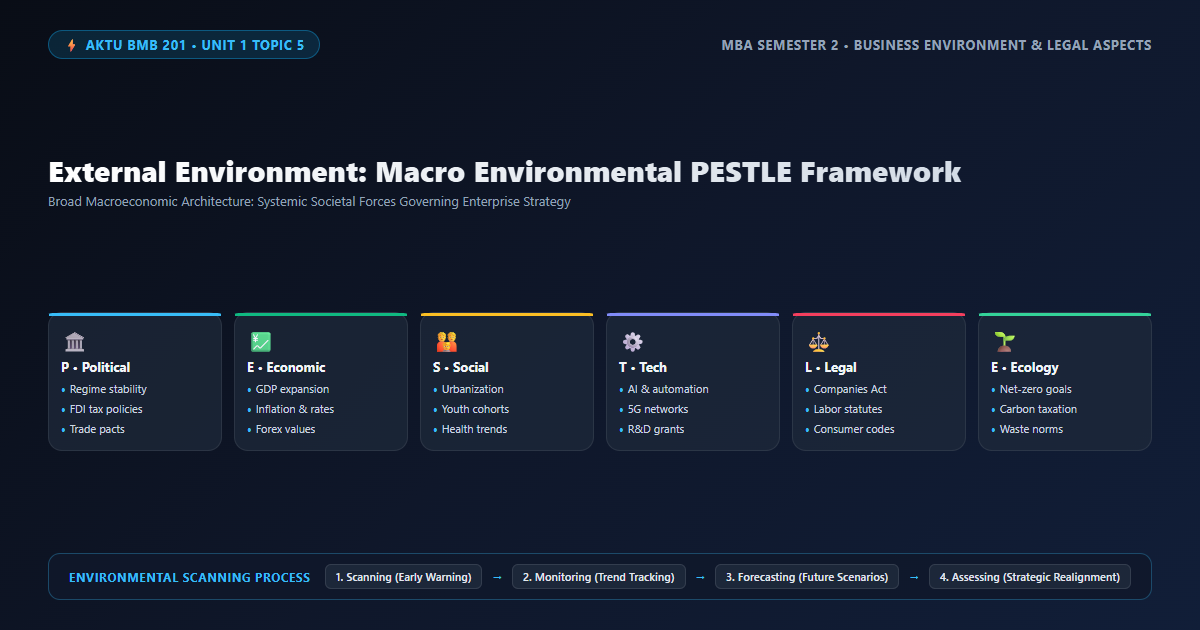
1. Conceptual Scope: Understanding the Macro Environment
In business environment theory, the macro environment (also referred to as the general environment or remote environment) encompasses broad societal and institutional forces that originate beyond the operating boundaries of any single industry. Macroeconomic conditions impact all market participants simultaneously, though their specific business ramifications vary across different industrial sectors.
Salient Invariants of Macro Forces
2. Political & Economic Environmental Dimensions
The political and economic environments constitute the institutional infrastructure within which corporate investments take place. Political stability ensures policy continuity, while economic health dictates consumer purchasing power:
- Government Stability & Ideology: Stable governments instill long-term capital confidence; volatile coalition regimes create policy uncertainty and deferred corporate CapEx.
- Fiscal & Industrial Policy: Incentives such as Production-Linked Incentives (PLI), Special Economic Zones (SEZs), and export subsidies that stimulate targeted manufacturing.
- Foreign Direct Investment (FDI) Norms: Automatic approval routes versus restricted government approvals dictate foreign equity caps across retail, insurance, and defense.
- Geopolitical Stance & Trade Agreements: Bilateral Free Trade Agreements (FTAs) open export frontiers, while trade embargoes and protectionist tariffs restrict import flows.
- GDP Growth & National Income: Rising GDP expands aggregate consumer demand, stimulating business sales, factory utilization, and employment.
- Monetary Policy & Interest Rates: RBI repo rate shifts directly alter borrowing costs for corporate expansion and home/auto loan EMIs for retail buyers.
- Inflation & Price Indices (CPI/WPI): Spiraling inflation erodes household purchasing power, escalates raw material input costs, and squeezes operating margins.
- Foreign Exchange Fluctuations: Rupee depreciation inflates import bills (crude oil, machinery) while enhancing profit margins for export-oriented IT and pharma firms.
4. Legal & Ecological Dimensions: PESTLE Strategic Matrix
In AKTU MBA examinations, synthesizing the complete PESTLE Framework into an integrated comparative matrix is a proven high-scoring strategy:
| PESTLE Dimension | Key Environmental Variables | Strategic Business Impact |
|---|---|---|
| Political (P) | Tax policy, trade restrictions, political stability, privatization mandates. | Determines country risk rating and long-term capital investment viability. |
| Economic (E) | GDP growth, inflation, interest rates, disposable income, currency exchange rates. | Directly impacts product demand elasticity, cost of capital, and pricing flexibility. |
| Social (S) | Age demographics, urbanization, lifestyle trends, literacy, work-life expectations. | Dictates consumer preference shifts, brand positioning, and human talent recruitment. |
| Technological (T) | R&D incentives, digital connectivity, robotics, automated logistics, cloud computing. | Creates industry-disrupting product innovations and slashes unit manufacturing costs. |
| Legal (L) | Companies Act 2013, Competition Act 2002, labor codes, intellectual property laws. | Erects regulatory entry barriers and mandates statutory compliance governance. |
| Ecological (E) | Carbon emission norms, renewable energy quotas, waste disposal, climate risks. | Forces transition to sustainable green manufacturing and ESG compliance audits. |
6. Real-World Corporate Example: Tata Motors & the Indian EV Revolution
Capturing 70%+ of India's Electric Passenger Vehicle Market: For years, Indian automakers dismissed electric vehicles as economically unfeasible. Tata Motors recognized multiple converging macro PESTLE tailwinds:
Managerial Takeaway: Enterprises that anticipate macro PESTLE shifts gain first-mover monopolies; those that ignore macro signals face obsolescence.
7. High-Frequency AKTU Previous Year Exam Questions (PYQs)
Review these standard examination questions frequently asked in AKTU MBA Business Environment papers:
Section A: Short Conceptual Questions (2 Marks Each)
Answer: PESTLE stands for: Political, Economic, Socio-Cultural, Technological, Legal, and Ecological / Environmental factors.
Answer: 1) Scanning (identifying early warning signals), 2) Monitoring (tracking identified trends over time), 3) Forecasting (projecting future outcomes), and 4) Assessing (evaluating strategic implications for the enterprise).
Answer: 1) An aging population expands demand for healthcare, pharmaceuticals, and retirement financial services; 2) A youth bulge expands demand for smartphones, fast-fashion apparel, and higher education loans.
Section B & C: Long Conceptual Questions (7 & 10 Marks)
- Concept & Macro Nature (1.5 Marks): Define macro/general environment; explain its pervasive, uncontrollable, and interdependent characteristics.
- Comprehensive PESTLE Breakdown (4 Marks):
- Political: FDI reforms, political stability, trade pacts.
- Economic: GDP trajectory, inflation, interest rate shifts, forex fluctuations.
- Social & Demographic: Youth population, urbanization, health and wellness trends.
- Technological: AI automation, UPI fintech infrastructure, short product life cycles.
- Legal: Companies Act 2013, labor codes, consumer protection.
- Ecological: Carbon tax mandates, renewable energy targets, ESG auditing.
- The Environmental Scanning Cycle (2 Marks): Explain Scanning, Monitoring, Forecasting, and Assessing with a flow diagram.
- Corporate Benchmark (1.5 Marks): Cite Tata Motors' proactive capitalization on FAME subsidies and consumer EV demand.
- Strategic Synthesis & Conclusion (1 Mark): Conclude that macro scanning transforms environmental uncertainty into actionable corporate foresight.
Discussion & Questions
0 CommentsAcademic insights, questions, and conceptual clarifications from students & faculty.
No questions or comments yet
Have a doubt about this topic, an exam tip, or a conceptual perspective? Start the discussion below!
Leave a Comment / Ask a Question
Your email address will not be published. Required fields are marked *