
Credit Analysis Process: Underwriting Workflow, Due Diligence, and Loan Documentation Framework
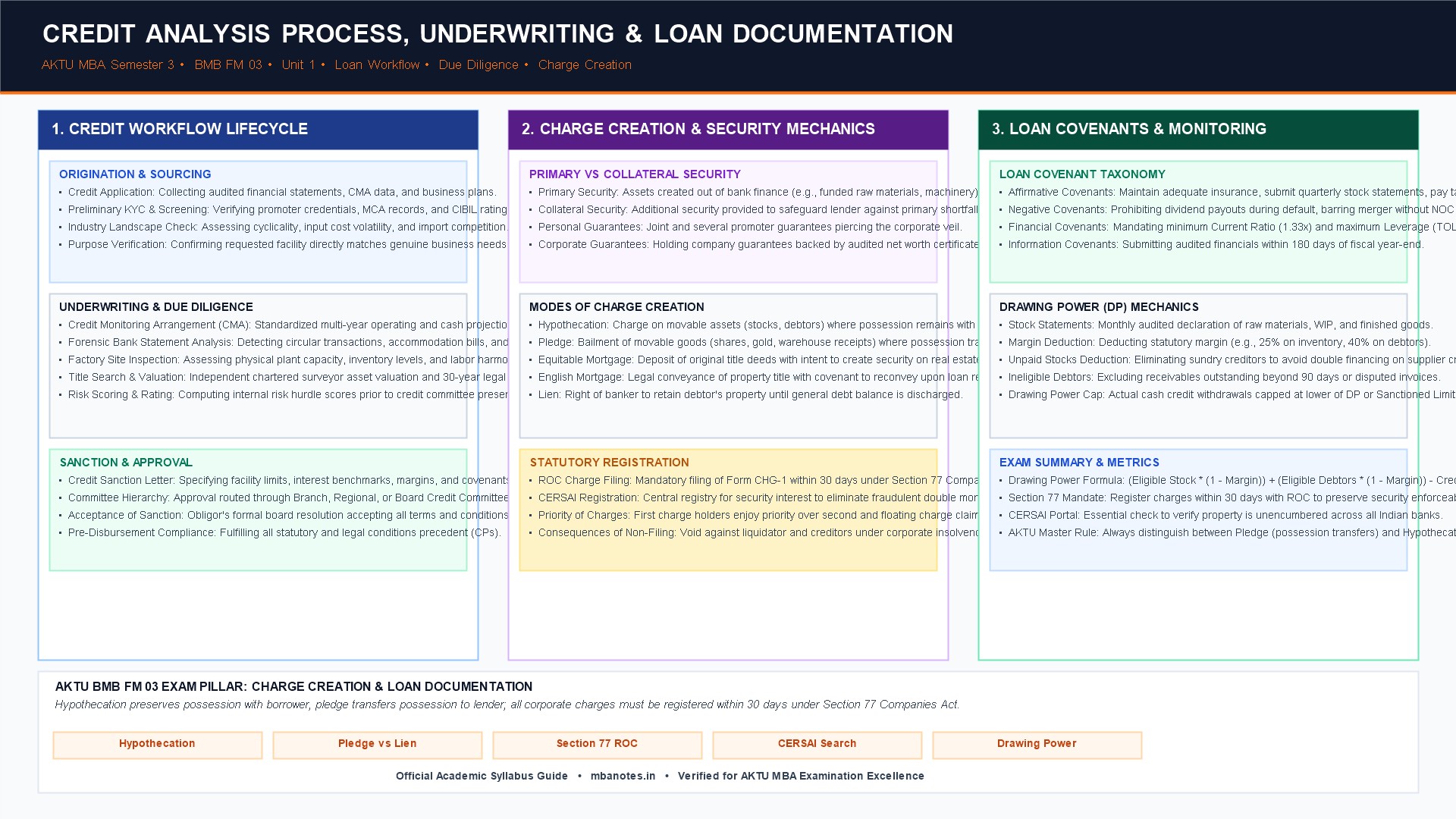
Figure 1.2: Credit Workflow Architecture - Origination, Underwriting, Due Diligence, and Legal Charge Creation.
1. The Credit Underwriting Lifecycle: Sourcing to Sanction
The commercial credit process is a structured, institutional sequence designed to convert raw corporate credit requests into legally enforceable, self-liquidating bank advances. This lifecycle spans five sequential stages:
- Sourcing & Preliminary Screening: Evaluating borrower credentials against bank lending policies, checking promoter CIBIL/Experian credit reports, verifying MCA corporate status, and screening RBI willful defaulter lists.
- Credit Appraisal & Financial Due Diligence: Scrutinizing the Credit Monitoring Arrangement (CMA) data. The underwriter analyzes past audited financial statements, past 12 months' bank account statements (forensic check for cheque returns, circular transactions), tax compliance records (Form 26AS, GSTR-3B reconciliations), and project cash flow models.
- Field Inspection & Technical Due Diligence: Conducting physical plant inspections to evaluate manufacturing capacity, inventory stockpiles, labor relations, and machinery condition. Independent chartered engineers certify asset valuations, while bank-empanelled advocates conduct a 30-year search of property title deeds.
- Credit Sanction & Terms Structuring: Submitting a formal Credit Appraisal Note (CAN) to the appropriate sanctioning committee (Branch, Regional, or Management Committee). The sanction letter defines facility limits, pricing benchmarks, margin percentages, and contractual loan covenants.
- Pre-Disbursement Documentation & Perfection: Execution of loan agreements, demand promissory notes, guarantees, and creation of legal charges prior to initial fund disbursement.
2. Security Architecture: Primary vs Collateral Security & Modes of Charge
To insulate the lender against obligor default, bank documentation structures security into two distinct legal classes:
- Primary Security: Assets created directly through bank financial assistance (e.g., raw materials, inventory, and book debts financed via Cash Credit; plant and machinery acquired via Term Loans).
- Collateral Security: Additional unencumbered security pledged by the borrower or promoters to cover deficiencies in primary security (e.g., commercial real estate mortgage, fixed deposit receipts, personal/corporate guarantees).
Modes of Charge Creation
| Mode of Charge | Subject Matter | Possession Status | Legal Framework & Characteristics |
|---|---|---|---|
| Hypothecation | Movable assets (Raw materials, WIP, Finished Goods, Debtors). | Remains with Borrower. | Defined under Section 2(n) of SARFAESI Act. Borrower holds goods in trust for the bank; bank holds equitable charge and right to inspect. |
| Pledge | Movable goods, gold, shares, warehouse receipts. | Transfers to Lender (Pledgee). | Governed by Section 172 of Indian Contract Act, 1872. Actual or constructive bailment of goods; bank has right to sell upon default after reasonable notice. |
| Equitable Mortgage | Immovable property (Land and buildings). | Physical possession with Borrower. | Section 58(f) Transfer of Property Act, 1882. Created by deposit of original title deeds in notified towns with intent to create security; zero stamp duty in many states. |
| English Mortgage | Immovable property. | Ownership conveyed to Lender. | Section 58(e) Transfer of Property Act. Borrower binds himself to repay debt and transfers mortgaged property absolutely, subject to re-conveyance upon full payment. |
| Banker's Lien | Movable goods and securities in bank's custody. | In Lender's legal possession. | Section 171 Contract Act. General right of banker to retain securities as collateral for general balance of account; acts as an implied pledge. |
3. Statutory Enforceability: Section 77 ROC & CERSAI Central Registry
The creation of security documents is legally incomplete without statutory perfection. Under the Indian corporate legal framework, two centralized registries protect lender priority:
3.1 ROC Charge Registration under Section 77 of Companies Act, 2013
Section 77(1) mandates that every company creating a charge on its assets (tangible or intangible, movable or immovable) must register the particulars of the charge with the Registrar of Companies (ROC) in Form CHG-1 within 30 days of charge creation.
- Consequence of Default (Section 77(3)): If a charge is not registered with the ROC, it is completely void against the liquidator and any subsequent creditor in the event of corporate insolvency under the IBC. The lender is stripped of secured creditor status and relegated to an unsecured creditor in the Section 53 liquidation waterfall.
- Condonation: Delays up to 60 days can be regularized by the Registrar on payment of additional fees.
3.2 CERSAI Central Registry Perfection
The Central Registry of Securitisation Asset Reconstruction and Security Interest of India (CERSAI), established under Chapter IV of the SARFAESI Act, acts as an online public registry for all security interests created over immovable and movable properties. Registering charges on CERSAI prevents fraudulent borrowers from securing multiple loans from different banks against the same underlying real estate.
4. Mathematical Model, Drawing Power Formulation & Worked Problem
Mathematical Formulation: Drawing Power (DP) Engine
Where:
- $S_{\text{Eligible}}$: Eligible paid stock (Raw Materials + WIP + Finished Goods), excluding obsolete or damaged goods.
- $M_s$: Prescribed margin on stock (typically 25% or 0.25).
- $D_{\text{Eligible}}$: Eligible trade debtors outstanding for less than 90 days, excluding disputed invoices.
- $M_d$: Prescribed margin on book debts (typically 40% or 0.40).
- $C_{\text{Trade}}$: Sundry trade creditors for raw materials (deducted to avoid double financing on supplier credit).
Actual Permissible Drawdown:
\[ \text{Permissible Advance} = \min(\text{Sanctioned Credit Limit},\ DP) \]Step-by-Step Worked Numerical Calculation
Case Problem: Dynamic Forgings Ltd. holds a sanctioned Cash Credit (CC) limit of Rs. 80,00,000 with Bank of Baroda. The sanction terms mandate a 25% margin on inventory and a 40% margin on approved book debts. The monthly stock statement submitted on October 31, 2026 reveals:
- Raw Material Inventory: Rs. 45,00,000 (includes obsolete steel stock valued at Rs. 5,00,000).
- Work-in-Progress (WIP): Rs. 20,00,000.
- Finished Goods Inventory: Rs. 25,00,000.
- Sundry Creditors for raw material purchases: Rs. 18,00,000.
- Total Book Debts / Receivables: Rs. 50,00,000 (breakdown: Rs. 38,00,000 are aged under 90 days; Rs. 12,00,000 are aged over 90 days).
- Current Ledger Debit Balance on CC Account: Rs. 72,00,000.
- Required: Compute the eligible inventory, eligible debtors, net Drawing Power, determine permissible drawdown, and state whether the account is overdrawn.
Step 1: Compute Eligible Inventory & Net Stock Value
- Total Raw Materials = Rs. 45,00,000 minus Obsolete Stock (Rs. 5,00,000) = Rs. 40,00,000.
- WIP Inventory = Rs. 20,00,000.
- Finished Goods = Rs. 25,00,000.
- Total Eligible Inventory ($S_{\text{Eligible}}$) = $\text{Rs. } 40,00,000 + 20,00,000 + 25,00,000 = \mathbf{Rs.\ 85,00,000}$.
- Less: Sundry Trade Creditors ($C_{\text{Trade}}$) = Rs. 18,00,000.
- Net Paid Inventory = $\text{Rs. } 85,00,000 - 18,00,000 = \mathbf{Rs.\ 67,00,000}$.
- Inventory Drawing Power (at 25% margin): \[ DP_{\text{Stock}} = \text{Rs. } 67,00,000 \times (1 - 0.25) = \text{Rs. } 67,00,000 \times 0.75 = \mathbf{Rs.\ 50,25,000} \]
Step 2: Compute Eligible Debtors & Receivables Drawing Power
- Total Receivables = Rs. 50,00,000.
- Less: Ineligible Debtors aged > 90 days = Rs. 12,00,000.
- Eligible Debtors ($D_{\text{Eligible}}$) = $\mathbf{Rs.\ 38,00,000}$.
- Debtors Drawing Power (at 40% margin): \[ DP_{\text{Debtors}} = \text{Rs. } 38,00,000 \times (1 - 0.40) = \text{Rs. } 38,00,000 \times 0.60 = \mathbf{Rs.\ 22,80,000} \]
Step 3: Compute Total Net Drawing Power (DP)
\[ \text{Total DP} = DP_{\text{Stock}} + DP_{\text{Debtors}} = \text{Rs. } 50,25,000 + 22,80,000 = \mathbf{Rs.\ 73,05,000} \]Step 4: Determine Permissible Limit & Operational Account Status
- Sanctioned Limit = Rs. 80,00,000.
- Drawing Power (DP) = Rs. 73,05,000.
- Maximum Permissible Utilization: $\min(80,00,000,\ 73,05,000) = \mathbf{Rs.\ 73,05,000}$.
- Account Status: Current balance is Rs. 72,00,000. Since outstandings (Rs. 72,00,000) are within the Drawing Power (Rs. 73,05,000), the account is in order with available drawing headroom of Rs. 1,05,000.
6. Corporate Case Vignette: Steel Rolling Mill Charge Perfection
Commercial Case: Punjab National Bank & Bhushan Power Charge Dispute
During the insolvency proceedings of a major steel re-rolling corporate borrower in Punjab, Punjab National Bank (PNB) claimed first-charge secured creditor status over hot-rolling mill machinery worth Rs. 140 Crores. The Resolution Professional (RP) discovered that while PNB held executed hypothecation deeds, the branch had failed to submit Form CHG-1 to the Registrar of Companies (ROC) within the statutory 30-day window under Section 77.
Legal & Financial Repercussions: The NCLT ruled that under Section 77(3) of the Companies Act, an unregistered charge is void against the liquidator and competing creditors. Consequently, PNB was stripped of its secured status and demoted to an unsecured financial creditor, suffering an 82% haircut in the final resolution plan, whereas consortium partners with registered charges recovered 94% of their exposure.
Strategic Lesson: Legal documentation without timely ROC and CERSAI charge registration nullifies lender security perfection during corporate distress.
7. AKTU Exam Drill: 2-Mark & 10-Mark University Questions
Section A: Short Conceptual Questions (2 Marks Each)
- Distinguish between Hypothecation and Pledge.
Model Answer: In hypothecation, legal possession of the movable asset remains with the borrower, whereas in pledge, physical or constructive possession of the goods is delivered to the lending bank. - What is the statutory time limit for registering a charge under Section 77 of the Companies Act?
Model Answer: The charge must be registered with the Registrar of Companies (ROC) in Form CHG-1 within 30 days of its creation. - What is the consequence of failing to register a corporate charge with the ROC?
Model Answer: Under Section 77(3), an unregistered charge is void against the liquidator and creditors, stripping the bank of secured creditor status in corporate insolvency. - How is Drawing Power (DP) calculated in working capital cash credit accounts?
Model Answer: DP is computed by applying prescribed margins on eligible paid stocks and eligible book debts \( aged < 90 days \), after deducting sundry trade creditors. - What is an Equitable Mortgage under the Transfer of Property Act?
Model Answer: An equitable mortgage (mortgage by deposit of title deeds under Section 58(f)) is created by physically depositing original property title deeds with the bank with the intent to create security.
Section B & C: Comprehensive Long Questions (10 Marks Each)
Question 1: Detail the end-to-end credit analysis process in commercial banking. Discuss the various modes of charge creation and explain the significance of Section 77 ROC registration and CERSAI. (10 Marks)
Structure of Comprehensive Model Answer:
- Underwriting Workflow: Sourcing, KYC screening, CMA financial appraisal, site inspection, CAN preparation, and credit committee approval.
- Modes of Charge Creation: Contrast Hypothecation, Pledge, Equitable Mortgage, English Mortgage, and Banker's Lien.
- Section 77 Statutory Perfection: Registration timelines, Form CHG-1, condonation rules, and voidability against liquidator under IBC Section 53.
- CERSAI Role: Public central registry, preventing multiple mortgages on identical real estate.
Question 2: Explain the concept of Drawing Power in Cash Credit facilities. Formulate the mathematical equation and provide a comprehensive numerical example showing calculation of DP with inventory, creditors, and aged book debts. (10 Marks)
Structure of Comprehensive Model Answer:
- Concept of Drawing Power: Revolving credit mechanism, paid stock concept, and role of security margins.
- Mathematical Formula: Write the full DP equation incorporating inventory margins, debtor margins, and creditor subtractions.
- Comprehensive Numerical Problem: Create a multi-item balance sheet with raw materials (including obsolete items), WIP, finished goods, sundry creditors, and debtors split into < 90 days and > 90 days.
- Step-by-Step Execution: Calculate net stock DP, debtor DP, total DP, compare with sanctioned limit, and assess account solvency.
Discussion & Questions
0 CommentsAcademic insights, questions, and conceptual clarifications from students & faculty.
No questions or comments yet
Have a doubt about this topic, an exam tip, or a conceptual perspective? Start the discussion below!
Leave a Comment / Ask a Question
Your email address will not be published. Required fields are marked *