
Juran's Quality Trilogy, PDCA Continuous Improvement Cycle & Kaizen Philosophy
Quality Planning, Control & Breakthrough, Shewhart PDCA/SDCA Cycles & Shop-Floor Gemba Kaizen
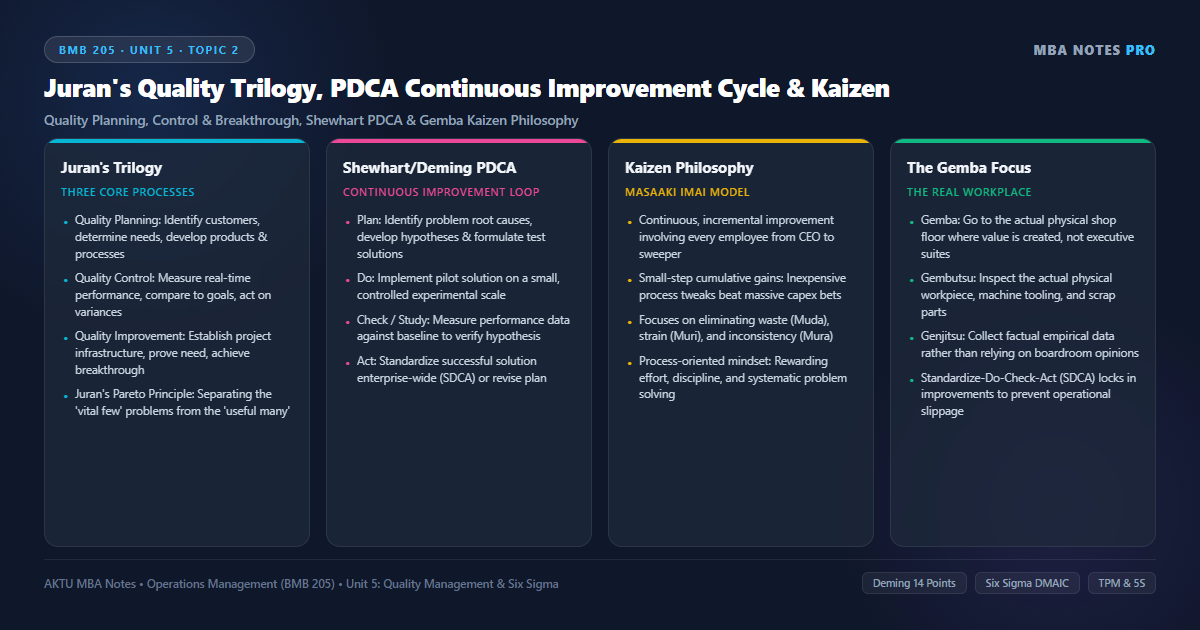
1. Juran’s Quality Trilogy: Planning, Control, and Breakthrough Improvement
Dr. Joseph M. Juran, alongside Deming, was instrumental in shaping modern industrial quality management. Juran defined quality as ‘fitness for use’, emphasizing that products must fulfill customer requirements throughout their operational operational life. To manage quality systematically, he introduced Juran’s Quality Trilogy, dividing quality management into three interrelated processes analogous to financial budgeting, cost control, and profit improvement.
1. Quality Planning
Quality Planning establishes the foundation for future operations. It entails designing products, services, and manufacturing processes capable of meeting operating goals under normal operating conditions:
- Identify External & Internal Customers: Determine every party impacted by the product lifecycle.
- Discover Customer Needs: Translate raw voice-of-the-customer inputs into concrete engineering specifications.
- Develop Product Features: Create functional designs that satisfy identified customer requirements.
- Develop Capable Processes: Design manufacturing systems whose natural variance falls safely within product tolerance limits.
- Transfer to Operations: Validate process capability and transfer operating responsibility to shop-floor technicians.
2. Quality Control
Quality Control is the day-to-day operational routine of monitoring performance, comparing actual results against planned targets, and acting on variances to prevent performance degradation:
- Choose Control Subjects: Select critical quality characteristics (dimensions, cycle times, temperature).
- Establish Measurement Systems: Deploy reliable sensors, gauges, and inspection protocols.
- Establish Operating Standards: Define acceptable control limits and standard operating procedures (SOPs).
- Measure Actual Performance: Gather real-time production data using statistical process control charts.
- Compare & Act on Variances: Correct sporadic spikes in defect rates caused by operator errors, broken tooling, or defective raw material batches.
3. Quality Improvement (Breakthrough)
While Quality Control maintains the current baseline, Quality Improvement takes aim at chronic waste—inherent process defects that have been accepted as ‘normal’ operating losses:
- Prove the Need for Breakthrough: Translate chronic waste into annual financial losses to gain executive buy-in.
- Identify Project Teams: Appoint dedicated cross-functional task forces for specific quality projects.
- Diagnose Root Causes: Distinguish between chronic systemic causes and temporary sporadic variations.
- Formulate Remedies: Re-engineer workflows, modify tooling, or redesign components to eliminate chronic defects permanently.
- Institute Controls (Holding Gains): Standardize improved processes to ensure performance does not regress to historical defect levels.
Comparative Matrix: Radical Innovation (Kaikaku) vs. Continuous Incremental Kaizen
| Operational Feature | Radical Innovation (Kaikaku / Breakthrough) | Continuous Improvement (Kaizen) |
|---|---|---|
| Pace of Change | Abrupt, radical, step-function leaps | Continuous, gradual, incremental small steps |
| Time Horizon | Long-term development followed by sudden deployment | Immediate, daily, ongoing shop-floor refinement |
| Employee Involvement | Select group of specialized R&D scientists and elite engineers | 100% of workforce from shop-floor assemblers to CEO |
| Capital Investment | High capital expenditure (Capex) in new machinery and tech | Negligible to low cost; focused on rearranging existing assets |
| Driver of Change | Breakthrough technological inventions and patents | Frontline ingenuity, discipline, and standard work adherence |
| Operational Risk | High risk of project failure or disruptive implementation | Extremely low risk; tested rapidly on small controlled scale |
| Cultural Orientation | Individualistic brilliance and patent ownership | Collective teamwork, shared pride, and mutual problem solving |
| Sustainability Method | Requires periodic massive injections of replacement capex | Maintained continually via SDCA standardization cycles |
2. The Shewhart-Deming PDCA Cycle and the SDCA Standardization Standard
Originally conceptualized by Walter Shewhart at Bell Laboratories and refined by Deming, the PDCA Cycle (Plan-Do-Check-Act) serves as the universal scientific engine for problem-solving, quality engineering, and organizational learning.
The Four Phases of the PDCA Cycle
- Plan (P): Identify the specific performance gap. Analyze current operational data using Pareto analysis and Ishikawa diagrams. Formulate root cause hypotheses and develop an actionable corrective plan with measurable targets.
- Do (D): Execute the planned improvement on a pilot scale or controlled test environment. Document all procedural modifications, worker feedback, and unanticipated side effects.
- Check / Study (C): Measure the pilot results against baseline performance metrics. Evaluate whether the corrective action achieved the hypothesized improvement. Identify deviations and evaluate root causes of test discrepancies.
- Act (A): If the pilot succeeded, standardize the new procedure enterprise-wide by updating SOPs, training manuals, and machine tooling. If the pilot fell short, analyze root causes and initiate a revised Plan phase.
Holding the Gains: The SDCA Standardization Wedge
A common failure in continuous improvement is operational regression—where shop-floor practices slip back to legacy habits after project completion. To prevent this, Kaizen couples PDCA with SDCA (Standardize-Do-Check-Act):
- Standardize (S): Lock in the improved method by publishing foolproof standard operating procedures.
- Do (D): Train operators strictly to follow standardized work instructions.
- Check (C): Regularly audit operations to verify compliance with the standardized baseline.
- Act (A): Correct procedural deviations or initiate the next PDCA cycle to elevate performance higher.
In quality visual diagrams, SDCA acts as a mechanical wedge placed behind the wheel of continuous improvement, preventing it from rolling backward down the operational slope.
3. Kaizen Philosophy & Eliminating the 3M Framework (Muda, Muri, Mura)
Kaizen (derived from the Japanese words Kai meaning ‘change’ and Zen meaning ‘good’ or ‘for the better’) is an operational philosophy emphasizing ongoing, small-scale improvements without requiring massive capital investments. Popularized globally by Masaaki Imai in his seminal work Kaizen: The Key to Japan’s Competitive Success, it posits that daily micro-improvements accumulate into formidable strategic advantages over time.
The 3M Waste Framework
Kaizen systematically targets three interrelated forms of operational inefficiency:
- 1. Muda (Wasteful Non-Value-Adding Activities): Any human effort, machine time, or material expenditure that consumes resources without adding value in the eyes of the paying customer. Toyota categorizes Muda into the 7 Classic Wastes (TIMWOOD):
- Transportation: Unnecessary movement of parts between workstations.
- Inventory: Excess raw materials, work-in-progress (WIP), or finished goods tying up cash.
- Motion: Inefficient operator physical movements, bending, or searching for tools.
- Waiting: Idle machine time or operator delays waiting for materials, tools, or approvals.
- Overproduction: Producing goods ahead of demand or in excess of actual orders.
- Overprocessing: Performing unnecessary finishes or tolerances exceeding customer requirements.
- Defects: Scrapped parts, rework, inspection time, and customer returns.
- 2. Muri (Overburden and Physical Strain): Subjecting operators, machines, or logistical systems to loads beyond their designed capacity, leading to ergonomic injuries, equipment breakdowns, and safety hazards.
- 3. Mura (Unevenness and Fluctuation): Irregularities in production scheduling, volume swings, or erratic worker pacing that generate bottlenecks, inventory buildups, and machine wear.
Target Costing & Kaizen Costing Reduction Equation
Variables & Notation:
- Actual Prior Cost: Baseline manufacturing cost recorded in the previous operating period
- r_k: Kaizen Cost Reduction Ratio (Target percentage reduction for the current period)
- Target Kaizen Cost: Budgeted operational cost ceiling for the current production run
- Kaizen Cost Variance: Actual Current Cost – Target Kaizen Cost (Negative variance = successful cost reduction)
Step-by-Step Solved Problem Illustration:
- A consumer electronics assembly facility manufactures smart home thermostats. In Q1, the baseline manufacturing cost per unit was ₹1,200. The Kaizen committee establishes a continuous improvement reduction ratio \( r_k \) of 4% for Q2 by eliminating packaging waste, re-routing component placement, and reducing solder dwell time.
- Step 1: Calculate Target Kaizen Cost for Q2 = ₹1,200 – (₹1,200 × 0.04) = ₹1,200 – ₹48 = ₹1,152 per unit.
- Step 2: At the end of Q2, the plant’s actual audited manufacturing cost per unit achieved is ₹1,146.
- Step 3: Calculate Kaizen Cost Variance = Actual Cost – Target Kaizen Cost = ₹1,146 – ₹1,152 = -₹6 per unit.
- Step 4: Operational Interpretation: The negative variance of -₹6 indicates that the shop-floor Kaizen teams exceeded their cost reduction target. Across 2,50,000 units produced in Q2, the plant realized net operational savings of ₹13,50,000 without requiring new capital equipment.
4. Gemba Kaizen: The Shop-Floor Realities and Teian Suggestion Systems
The term Gemba literally translates to ‘the real place’—the physical shop floor where raw materials are transformed into finished goods, or the customer service desk where client interactions take place. Gemba Kaizen mandates that executives and industrial engineers step away from computerized dashboards and visit the actual operational arena.
The 3 Realities of Gemba
- Gemba (The Actual Place): Go directly to the physical shop floor where the problem occurred rather than discussing assumptions in conference rooms.
- Gembutsu (The Actual Object): Examine the physical workpiece, machine spindle, cutting die, or broken assembly component directly to inspect physical evidence.
- Genjitsu (The Actual Facts / Data): Collect empirical, quantitative operational data at the scene of the problem rather than relying on hearsay or opinions.
The 5 Gemba Management Golden Rules
- When an operational anomaly or breakdown occurs, go to the Gemba immediately.
- Check the physical equipment, materials, and workpiece (Gembutsu).
- Take temporary containment countermeasures on the spot to halt defect propagation.
- Find the systemic root cause by asking ‘Why?’ five times (5-Why Analysis).
- Standardize the solution into standard work procedures to permanently prevent recurrence.
Kaizen Teian (Employee Suggestion Systems)
A vital catalyst of Gemba Kaizen is the Kaizen Teian system. Unlike Western suggestion boxes where ideas were collected periodically and reviewed by distant committees, Kaizen Teian encourages frontline workers to implement minor improvements immediately at their own workstations, accompanied by simple one-page before-and-after reports. Successful suggestions are rewarded with immediate peer recognition, small monetary stipends, and management praise, driving continuous workforce engagement.
Juran’s Trilogy
Quality Planning, Quality Control, and Quality Improvement separating sporadic spikes from chronic waste.
PDCA / SDCA Engine
Scientific problem-solving (Plan-Do-Check-Act) secured with Standardize-Do-Check-Act wedges.
The 3M Framework
Eliminating Muda (7 Wastes), Muri (Workforce Overburden), and Mura (Process Unevenness).
Gemba Realities
Go to the actual workplace (Gemba), inspect the physical object (Gembutsu), and verify facts (Genjitsu).
6. Corporate Case Vignette: Corporate Case Vignette: Maruti Suzuki’s Frontline Kaizen Suggestion Engine
Background: Maruti Suzuki India Limited’s manufacturing complexes at Gurgaon and Manesar operate with high assembly speeds, producing over 1.5 million vehicles annually. With fierce competition from global automotive brands, maintaining cost leadership while meeting stringent safety and finish tolerances demanded constant operational refinement.
The Kaizen Intervention: Maruti Suzuki institutionalized a robust Gemba Kaizen and suggestion engine across its press shops, weld lines, paint facilities, and final assembly lines:
- Empowerment Through Small Group Activities (SGA): Frontline operators were organized into shop-floor quality circles and encouraged to submit kaizen suggestions aimed at eliminating motion waste, reducing cycle times, and improving ergonomics.
- Low-Cost Intelligent Automation (Karakuri Kaizen): Assembly technicians designed gravity-fed parts feeders and counterweight bin tippers that deliver components directly to the operator’s fingertips without requiring electric motors or pneumatic lines.
- Standardization via SDCA: Every validated Kaizen improvement was converted into a standard visual One-Point Lesson (OPL) displayed at the workstation, ensuring uniform execution across all three operating shifts.
- Leadership Gemba Walks: Plant directors and senior general managers conducted weekly Gemba walks to review operator-led improvements on the line, providing on-the-spot recognition.
Strategic Results: Maruti Suzuki receives over 1.8 million Kaizen suggestions annually from its shop-floor workforce, with an implementation rate exceeding 90%. This relentless frontline Kaizen culture has generated over ₹250 Crores in annual operational cost savings, elevated first-time assembly yield to 99.4%, and established Maruti Suzuki as the undisputed benchmark for lean, cost-efficient automotive manufacturing in India.
7. AKTU Previous Years Questions & Model Solutions
The following questions reflect the standard question patterns, marks distribution, and evaluation criteria of Dr. A.P.J. Abdul Kalam Technical University (AKTU) MBA Semester Examinations.
The three core processes of Juran’s Quality Trilogy are: 1. Quality Planning (identifying customers and creating capable processes), 2. Quality Control (monitoring performance and preventing sporadic spikes), and 3. Quality Improvement (diagnosing root causes to achieve breakthrough chronic waste reduction).
While the PDCA cycle creates new improvements through experimentation, the SDCA (Standardize-Do-Check-Act) cycle locks in those improvements by establishing standardized procedures. SDCA acts as a mechanical wedge, preventing operational performance from slipping back to legacy habits.
Muda refers to any non-value-adding waste of resources; Muri refers to the physical overburden or excessive strain placed on workers or equipment; and Mura refers to operational unevenness, inconsistency, or irregular scheduling across processes.
Model Answer Structure:
1. Introduction & Definition: Juran’s definition of quality as ‘fitness for use’, and introduction to the Quality Trilogy as an operational framework.
2. Detailed Examination of Juran’s Trilogy: Explain Quality Planning, Quality Control, and Quality Improvement (Breakthrough). Illustrate with Juran’s Trilogy Diagram showing sporadic spikes versus chronic waste.
3. The PDCA Problem-Solving Loop: Break down Plan, Do, Check/Study, and Act phases with sequential operational tasks. Explain how SDCA maintains the baseline.
4. Kaizen & 3M Elimination: Define Kaizen principles (incremental, low capex, workforce involvement). Contrast Kaizen with Kaikaku (radical innovation). Detail Muda (TIMWOOD 7 wastes), Muri, and Mura.
5. Gemba Realities & Practical Tools: Explain Gemba, Gembutsu, Genjitsu, 5-Why analysis, and visual management boards.
6. Industrial Case Vignette: Cite Maruti Suzuki or Toyota’s suggestion systems.
7. Conclusion: Highlight that sustainable quality requires balancing technical standards with disciplined human culture.
Discussion & Questions
0 CommentsAcademic insights, questions, and conceptual clarifications from students & faculty.
No questions or comments yet
Have a doubt about this topic, an exam tip, or a conceptual perspective? Start the discussion below!
Leave a Comment / Ask a Question
Your email address will not be published. Required fields are marked *