
Portrait of the Individual Investor: Heuristics, Psychological Biases, and the Shefrin-Statman Disposition Effect
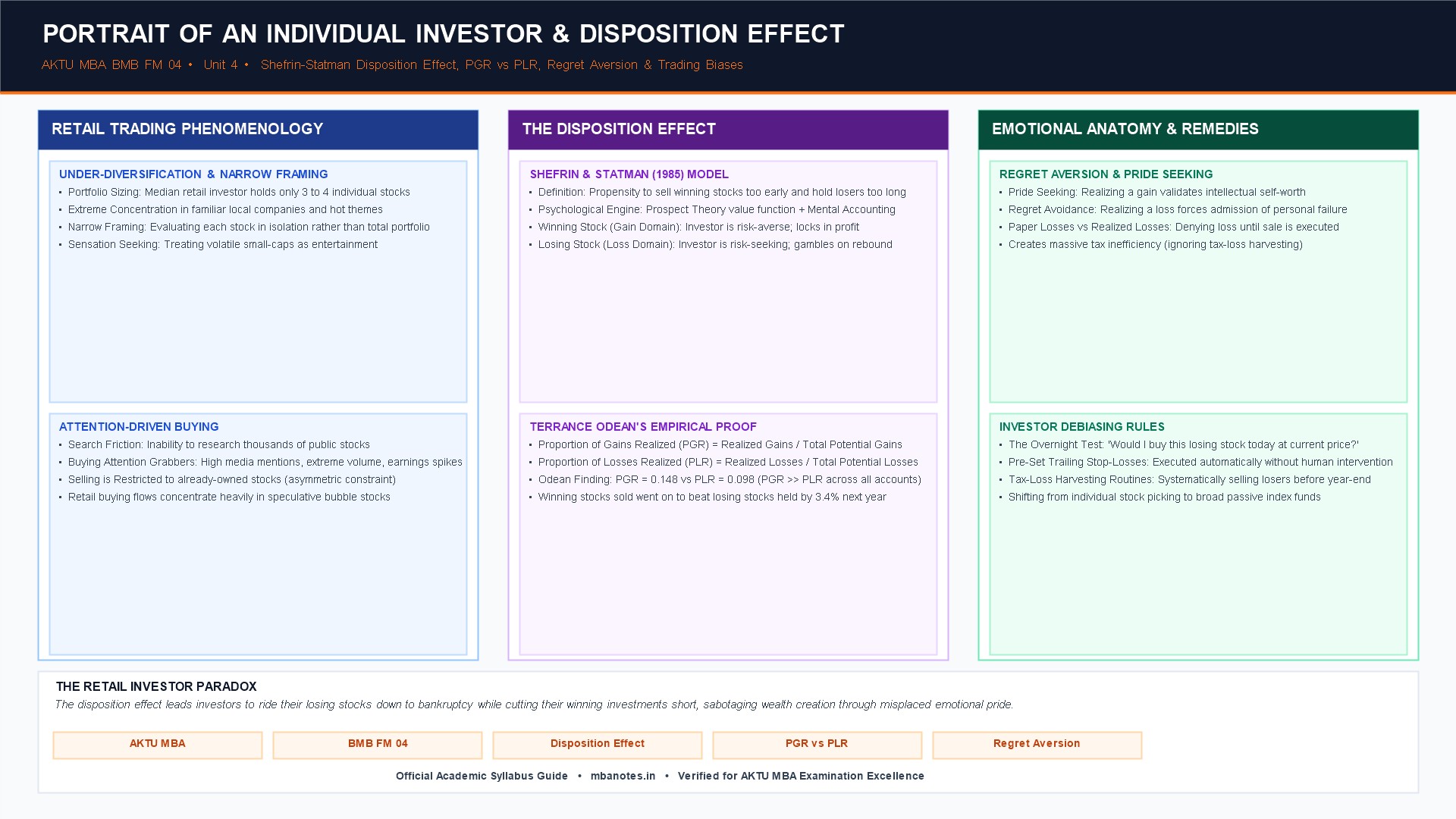
Figure 4.1: Retail Behavioral Dynamics – The Disposition Effect (PGR vs PLR), Narrow Framing, Attention Buying, and Regret Aversion.
1. The Behavioral Portrait: Characterizing the Individual Retail Investor
In classical finance textbooks, the individual investor is modeled as a miniature institutional endowment: a disciplined, rational economic agent who measures risk via standard deviation, diversifies across global asset classes, rebalances systematically, and remains immune to emotional mood swings.
In contrast, four decades of empirical behavioral research (Barber & Odean, Statman, Grinblatt & Keloharju) reveal a dramatically different Portrait of the Individual Investor:
- Chronic Under-Diversification: The average retail Demat account in India holds fewer than 4 stocks, concentrating exposure in a single sector or corporate group.
- Attention-Driven Buying: Individual investors do not search through thousands of stocks; they buy securities that catch their attention via sensational media headlines, extreme single-day returns, or high trading volume.
- Excessive Turnover & Gambling Tendencies: Retail traders trade hyperactively, paying heavy brokerage and taxes that severely degrade their compounded capital.
- Performance Chasing: Flooding money into mutual funds or stocks that performed well over the past 6-12 months at market peaks, and redeeming in panic during cyclical bottoms.
2. The Disposition Effect: Theoretical Foundations & Psychological Drivers
Identified by Hersh Shefrin and Meir Statman in their classic 1985 paper “The Disposition to Sell Winners Too Early and Ride Losers Too Long,” the Disposition Effect is one of the most robust and ubiquitous empirical facts in financial markets.
Shefrin and Statman integrated four psychological concepts to explain this behavior:
| Psychological Driver | Cognitive Mechanism | Trading Manifestation |
|---|---|---|
| Prospect Theory Value Function | Concave in gains (risk-averse), convex in losses (risk-seeking). | Once a stock rises, the investor seeks certainty, selling to lock in the gain. Once a stock drops, the investor becomes risk-seeking, holding to gamble on recovery. |
| Mental Accounting | Each stock is tracked in an isolated mental account opened at purchase price. | The account remains open until sold. Selling at a gain closes a winning account; selling at a loss closes a losing account. |
| Regret Aversion & Pride Seeking | Muellbauer & Loomes: Regret is the emotional pain of realizing a past decision was wrong. | Realizing a gain generates immediate pride (“I picked a winner!”). Realizing a loss forces the investor to admit failure, inflicting severe ego trauma. |
| Self-Control Deficits | Inability to execute painful, disciplined rules (like stop-losses). | Investors invent post-hoc rationalizations (“It is now a long-term value investment”) to justify holding depreciating assets. |
3. Regret Aversion, Cognitive Dissonance & Tax-Loss Optimization
The disposition effect represents a profound violation of rational taxation and momentum principles:
- Tax Inefficiency: Rational tax management dictates Tax-Loss Harvesting: selling depreciated stocks before fiscal year-end (March 31 in India) to offset taxable capital gains and lower income tax liability, while letting winners run to defer long-term capital gains tax. The disposition effect reverses this: investors realize taxable gains early and refuse to harvest deductible losses!
- Momentum Violation: Jegadeesh and Titman (1993) proved that stocks that performed well over past 3-12 months tend to continue outperforming, while losing stocks continue underperforming. By selling winners and holding losers, retail investors systematically dump their highest-momentum winners and hoard their toxic laggards.
4. Mathematical Model, Odean PGR/PLR Metric & Worked Numerical Problem
In his landmark 1998 paper “Are Investors Reluctant to Realize Their Losses?”, Terrance Odean formalized the mathematical methodology to measure the disposition effect across trading accounts.
Mathematical Formulation: Odean’s PGR, PLR & Disposition Ratio
Where:
- Realized Gains: Number of winning positions sold for a profit.
- Paper Gains: Number of winning positions held in the portfolio that could have been sold.
- Realized Losses: Number of losing positions sold for a loss.
- Paper Losses: Number of losing positions held in the portfolio that were not sold.
- $PGR$: Proportion of Gains Realized ($0 \le PGR \le 1$).
- $PLR$: Proportion of Losses Realized ($0 \le PLR \le 1$).
- Disposition Ratio (DR): Under standard rational finance, $DR \le 1.0$ (due to tax-loss selling). A $DR > 1.0$ proves the existence of the Disposition Effect.
Step-by-Step Worked Numerical Problem: Computing the Disposition Ratio
Problem Statement: An investment research team analyzes the trading records of 1,000 retail equity accounts over a 12-month period. Across all trading days, the audit logs reveal the following portfolio opportunities and executions:
- Number of winning positions liquidated for a profit (Realized Gains): $1,800$
- Number of winning positions held overnight in profit (Paper Gains): $10,200$
- Number of losing positions liquidated for a loss (Realized Losses): $950$
- Number of losing positions held overnight in loss (Paper Losses): $8,550$
Required:
- Calculate the Proportion of Gains Realized ($PGR$).
- Calculate the Proportion of Losses Realized ($PLR$).
- Compute the Disposition Ratio ($DR = PGR / PLR$).
- Interpret the findings and determine whether these retail investors display a statistically significant Disposition Effect.
Step 1: Compute Proportion of Gains Realized ($PGR$)
\[ PGR = \frac{\text{Realized Gains}}{\text{Realized Gains} + \text{Paper Gains}} = (1,800 / 1,800 + 10,200) = (1,800 / 12,000) = \mathbf{0.1500\ (15.00\%)} \]Investors realize 15 out of every 100 winning opportunities available to them.
Step 2: Compute Proportion of Losses Realized ($PLR$)
\[ PLR = \frac{\text{Realized Losses}}{\text{Realized Losses} + \text{Paper Losses}} = (950 / 950 + 8,550) = (950 / 9,500) = \mathbf{0.1000\ (10.00\%)} \]Investors realize only 10 out of every 100 losing opportunities available to them.
Step 3: Compute the Disposition Ratio ($DR$)
\[ \text{Disposition Ratio (DR)} = (PGR / PLR) = (0.1500 / 0.1000) = \mathbf{1.500} \]Step 4: Behavioral Interpretation
The Disposition Ratio of $1.50$ indicates that these investors are 50% more likely to realize a profitable position than an unprofitable position ($15.0\%$ vs $10.0\%$). Under rational wealth maximization and tax-loss harvesting incentives, $PLR$ should exceed $PGR$ ($DR < 1.0$). A ratio of $1.50$ decisively confirms the Shefrin-Statman Disposition Effect, demonstrating that investors systematically prioritize emotional pride over economic wealth.
6. Corporate Case Vignette: Retail Trading Behavior in Indian Demat Accounts
Corporate Case Vignette: The Post-COVID Indian Demat Surge and Portfolio Stagnation
Between 2020 and 2024, active Demat accounts in India surged from 4 Crore to over 15 Crore, driven by mobile broker platforms. A research study tracking 50,000 first-time retail accounts during the 2021-2023 cycle revealed a fascinating portfolio dichotomy:
When high-growth tech platform stocks rallied (such as Zomato recovering from INR 50 to INR 120), retail investors rapidly booked profits at INR 70-80, completely missing the subsequent climb to INR 250+. Meanwhile, in legacy retail favorites that cratered (such as Paytm post-IPO or Vodafone Idea), retail investors held onto positions down 60-80%, refusing to sell.
The Behavioral Diagnostic: Retail portfolios became “graveyards of losing stocks.” By prematurely cashing out winning stocks to enjoy quick dopamine hits (pride), retail investors stripped their portfolios of secular compounding winners. By holding depressed laggards to avoid admitting error (regret aversion), their capital became permanently frozen in non-performing assets, illustrating the devastating compounding drag of the disposition effect.
7. AKTU Exam Drill: 2-Mark & 10-Mark University Questions
Short-Answer Conceptual Checkpoints
Q1: Define the Disposition Effect in one concise sentence.
Answer: The Disposition Effect is the irrational behavioral tendency of investors to sell winning investments too quickly to secure a gain, while holding losing investments too long to avoid realizing a loss.
Q2: State the mathematical formulas for Odean’s PGR and PLR.
Answer: $PGR = rac{ ext{Realized Gains}}{ ext{Realized Gains} + ext{Paper Gains}}$ and $PLR = rac{ ext{Realized Losses}}{ ext{Realized Losses} + ext{Paper Losses}}$.
Q3: Why does the Disposition Effect violate rational tax planning?
Answer: Because rational investors should sell losing stocks before fiscal year-end to harvest capital losses and reduce taxes, whereas the disposition effect leads them to realize taxable gains and hold losses.
Q4: How does Regret Aversion drive the refusal to sell losing stocks?
Answer: Selling a stock at a loss turns an abstract ‘paper loss’ into an irrevocable, realized failure, inflicting psychological pain and damaging the investor’s self-esteem.
Q5: What is the typical Disposition Ratio (DR) observed in retail markets?
Answer: Empirical studies by Odean and international researchers observe a Disposition Ratio between 1.50 and 2.00, proving investors are 50% to 100% more prone to sell winners than losers.
In-Depth Analytical & Long-Answer Questions
Q6: Detailed Exposition of the Shefrin-Statman Disposition Effect. Explain its four underlying psychological mechanisms and its detrimental impact on portfolio wealth.
Model Answer Outline:
- Introduction: Define the Disposition Effect and attribute it to Hersh Shefrin and Meir Statman (1985).
- The Four Psychological Foundations:
- Prospect Theory S-shaped Value Function (concave in gains, convex in losses).
- Mental Accounting (opening and closing independent mental investment books).
- Regret Aversion vs Pride Seeking (Muellbauer & Loomes emotional theory).
- Self-Control & Escalation of Commitment.
- Contradiction with Finance Principles: Detail how the disposition effect destroys tax efficiency (violating tax-loss harvesting) and fights equity momentum (selling top performers).
- Remedial Strategies: Automated stop-loss orders, mechanical trailing stops, target allocation rebalancing, and behavioral coaching.
Q7: What is Terrance Odean’s methodology for measuring the Disposition Effect? Formulate PGR, PLR, and Disposition Ratio, and solve a step-by-step numerical example.
Model Answer Outline:
- Theoretical Origin: Review Odean’s 1998 empirical breakthrough using 10,000 brokerage accounts.
- Mathematical Definitions: Define $PGR = rac{ ext{Realized Gains}}{ ext{Realized Gains} + ext{Paper Gains}}$, $PLR = rac{ ext{Realized Losses}}{ ext{Realized Losses} + ext{Paper Losses}}$, and $DR = rac{PGR}{PLR}$.
- Full Worked Numerical: Walk through the 4-step numerical example with 1,800 realized gains, 10,200 paper gains, 950 realized losses, and 8,550 paper losses, calculating $PGR = 15.0%$, $PLR = 10.0%$, and $DR = 1.50$.
- Interpretation of Empirical Results: Explain why a ratio of $1.50$ refutes neoclassical rationality and how it creates momentum drift in equity markets.
Discussion & Questions
0 CommentsAcademic insights, questions, and conceptual clarifications from students & faculty.
No questions or comments yet
Have a doubt about this topic, an exam tip, or a conceptual perspective? Start the discussion below!
Leave a Comment / Ask a Question
Your email address will not be published. Required fields are marked *