
Steps in Formation of Company: MOA, AOA & Prospectus
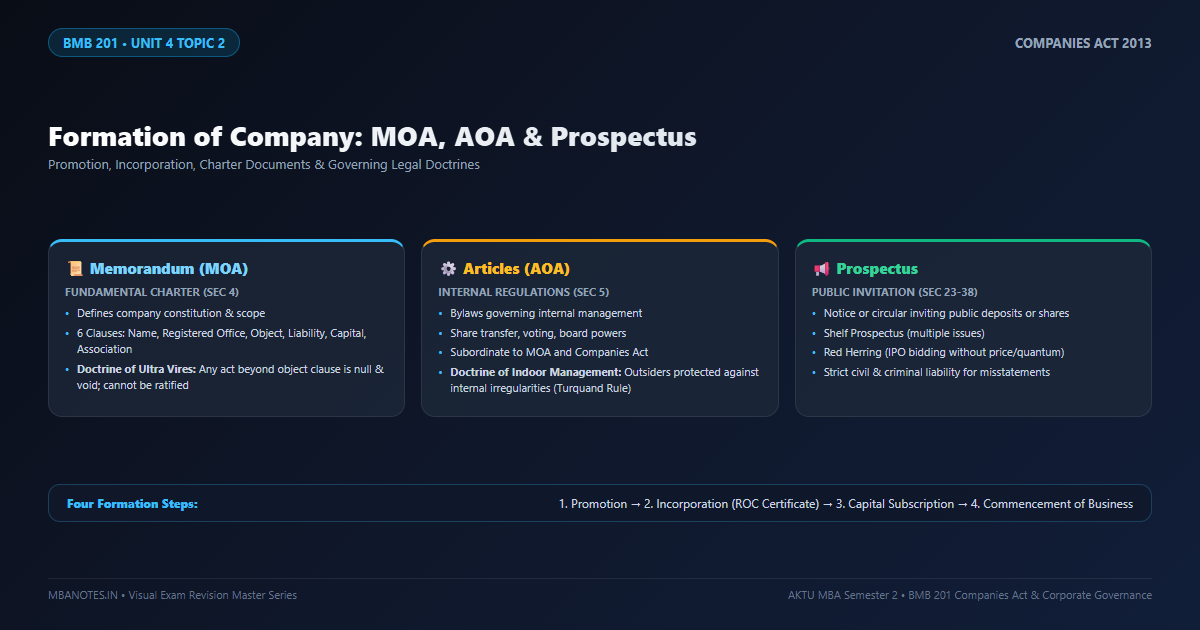
1. The Four Progressive Stages in Formation of a Company
2. Memorandum of Association (MOA - Section 4) & Ultra Vires
The MOA is the supreme constitutional charter of a company defining the boundary of its permitted corporate activities. It contains six compulsory clauses:
- Name Clause: Company name ending with "Limited" (public) or "Private Limited" (private).
- Registered Office (Situation) Clause: The state where the corporate registered office is situated.
- Object Clause: The specific commercial activities for which the company is incorporated.
- Liability Clause: Declares liability of members as limited by shares or guarantee.
- Capital Clause: States authorized nominal share capital and face value per share.
- Association/Subscription Clause: Signatures of original subscribers agreeing to take shares.
Doctrine of Ultra Vires (Beyond Powers)
Any corporate transaction entered into beyond the scope of the Object Clause is ultra vires the company. Such acts are wholly null, void, and incapable of ratification even if 100% of shareholders assent (Ashbury Railway Carriage and Iron Co. v. Riche).
3. Articles of Association (AOA - Section 5) & Indoor Management
The AOA contains internal regulations and bylaws governing management operations, board powers, voting rights, calls on shares, transfer/forfeiture of shares, and dividend payments. The AOA is completely subordinate to the MOA.
MOA and AOA are registered public documents. Every outsider dealing with the company is legally presumed to have read and understood them.
An exception to constructive notice: Outsiders dealing with a company in good faith are entitled to assume that internal managerial procedures and board resolutions have been complied with.
4. Prospectus: Types & Legal Liabilities (Sections 23 to 38)
A Prospectus is any document described or issued as a prospectus and includes any notice, circular, advertisement, or other document inviting offers from the public for the subscription or purchase of securities.
- Shelf Prospectus (Sec 31): A prospectus in respect of which securities are issued for subscription in one or more issues over a period of 1 year without issuing a fresh prospectus each time.
- Red Herring Prospectus (Sec 32): A prospectus which does not include complete particulars of the quantum or price of securities being offered (used during IPO book building).
- Abridged Prospectus (Sec 33): A memorandum containing salient features of a prospectus accompanying every share application form.
6. Landmark Legal Precedent: Royal British Bank v. Turquand (1856)
Facts: The directors of a company were authorized by the Articles to borrow money on bond, subject to a resolution passed in a general meeting. The directors gave a bond of £2,000 to Royal British Bank without passing such a shareholder resolution. When the company became insolvent, it pleaded that the bond was unauthorized and void.
Held by Court of Exchequer Chamber: The bank was entitled to sue and recover on the bond. The court established that outsiders reading the public articles could ascertain that directors had power to borrow subject to a resolution, and were entitled to infer that the internal resolution had been properly passed.
7. Solved AKTU Previous Years Questions (PYQs)
Q1: What is the Doctrine of Ultra Vires in relation to MOA?
Answer: The Doctrine of Ultra Vires ('beyond powers') states that any act done or contract entered into by a company that falls outside the scope of the Object Clause of its Memorandum of Association (MOA) is null, void ab initio, and incapable of legal enforcement. Even unanimous consent of all shareholders cannot ratify an ultra vires act.
Q2: Distinguish between Memorandum of Association (MOA) and Articles of Association (AOA). Explain the Doctrine of Indoor Management with its exceptions.
Model Answer Structure for Full 10 Marks:
- MOA vs. AOA Distinction Table: Compare nature (charter vs internal bylaws), scope (relationship with outside world vs internal members), hierarchy (supreme vs subordinate), alteration procedure (special resolution + approval vs special resolution alone), and validity of acts beyond scope (ultra vires void vs intra vires company).
- Doctrine of Constructive Notice: Explain presumption of knowledge of public documents.
- Doctrine of Indoor Management (Turquand Rule):
- State facts and ratio of Royal British Bank v. Turquand.
- Explain that outsiders cannot inspect internal boardroom workings.
- Exceptions to Indoor Management:
- Knowledge of irregularity by the outsider.
- Suspicion of irregularity (failure to make reasonable inquiries).
- Forgery (forged instrument is a nullity - Ruben v. Great Fingall).
- Acts outside apparent authority.
Discussion & Questions
0 CommentsAcademic insights, questions, and conceptual clarifications from students & faculty.
No questions or comments yet
Have a doubt about this topic, an exam tip, or a conceptual perspective? Start the discussion below!
Leave a Comment / Ask a Question
Your email address will not be published. Required fields are marked *