
Sampling Concepts: Population, Sampling Frame & Sample Plan Architecture
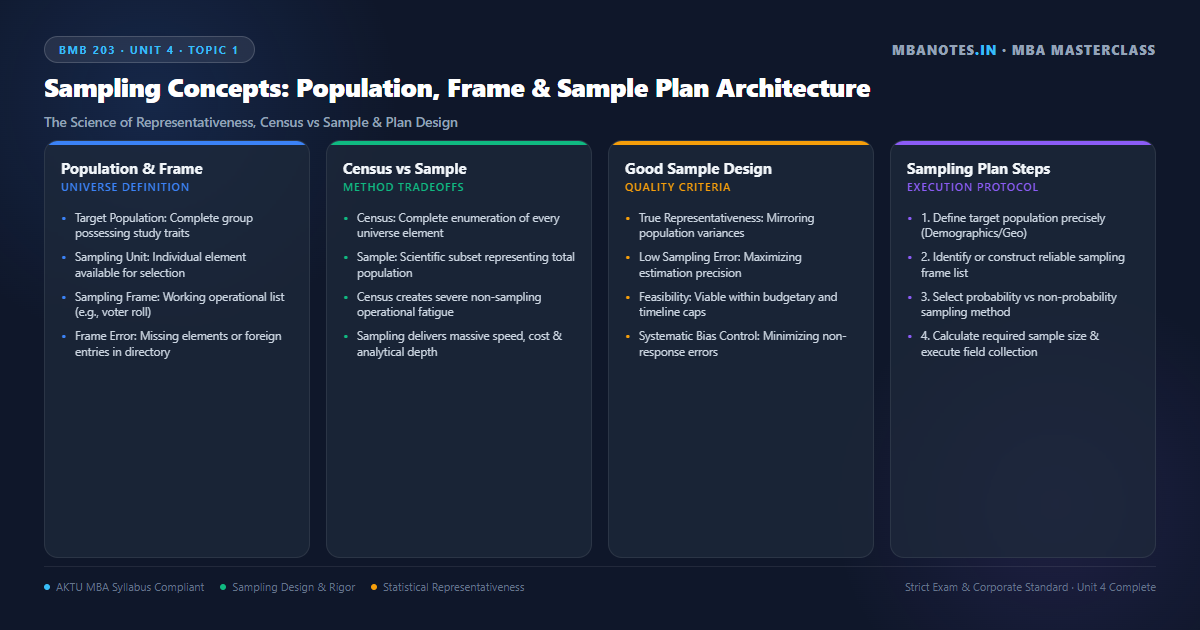
1. The Foundational Concepts: Population, Element & Sampling Frame
In business research, Sampling is the process of selecting a sufficient number of elements from a larger population so that studying the sample and understanding its properties makes it possible to generalize those properties to the population elements (Sekaran & Bougie). Making valid inferences requires precise definitions of the structural hierarchy of sampling concepts.
1. Element: The individual object about which information is desired (e.g., a single retail consumer, an active credit card holder).
2. Sampling Unit: An element or a unit containing the element available for selection at some stage of the sampling process (e.g., a household, a retail store, a corporate branch).
3. Target Population: The entire collection of elements or objects that possess the information sought by the researcher.
4. Sampling Frame: A physical or digital representation of the elements of the target population (e.g., a subscriber database, telephone directory, corporate payroll roster).
Core Managerial Dimensions of the Sampling Frame:
- Sampling Frame Error: Discrepancy between the target population and the operational list. Occurs when valid elements are omitted (undercoverage) or ineligible elements are included (overcoverage).
- List Clustering & Duplication: Multiple listings of the same corporate account or subscriber distort selection probabilities, giving duplicated entries unfair selection advantage.
- Currency and Decay: Customer lists decay rapidly due to relocation, employee churn, and account cancellation; outdated contact lists cripple survey response rates.
- Telephone & Digital Directories: Modern mobile penetration provides vast directories, but spam call filters and regulatory Do-Not-Disturb (DND) registries restrict outreach.
- E-Commerce User Registries: Digital transaction databases provide exceptionally clean, timestamped sampling frames containing exact historical purchase behavior.
- Geographic Boundary Definition: Clearly delineating the physical catchment area (e.g., Delhi-NCR vs National) prevents geographic contamination in retail feasibility studies.
- Time-Window Delimitation: Establishing the exact historical recency window (e.g., customers who purchased within the last 90 days) ensures relevant respondent feedback.
2. Census vs Sample Survey: The Strategic Decision Framework
When conducting managerial inquiry, leadership must decide whether to conduct a Census (complete enumeration of every unit in the population) or a Sample Survey (investigating a representative subset). While a census intuitively feels more thorough, sample surveys almost universally outperform censuses in commercial enterprise environments.
| Evaluation Factor | Sample Survey | Full Population Census |
|---|---|---|
| Financial Budget | Highly economical; low cost per insight | Enormously expensive; massive logistical outlay |
| Time to Delivery | Rapid execution (days to weeks) | Prolonged execution (months to years) |
| Size of Population | Mandatory for large or infinite populations | Feasible only for small, finite populations |
| Nature of Measurement | Essential when testing is destructive | Cannot be used if testing destroys product |
| Error Profile | Sampling error exists, but non-sampling error is low | Zero sampling error, but massive non-sampling error |
| Depth of Inquiry | Intensive, multi-attribute probing possible | Brief, superficial questions only |
Managerial Rules: When is a Census Justified?
- Small, Highly Concentrated Universe: B2B enterprise markets where an airline manufacturer has only 15 airline customers globally.
- High Cost of Error: Critical safety trials (such as structural stress testing of commercial aircraft fuselages) where a single defect causes catastrophe.
- Destructive Testing Constraint: In quality control testing of firecrackers, light bulbs, or vehicle crash safety, testing destroys the item; a census would destroy the entire corporate inventory.
- Data Freshness & Decision Velocity: Fast-moving retail markets cannot wait 12 months for census tabulation; sample surveys deliver actionable real-time intelligence.
- Investigator Quality vs Quantity: A sample survey allows hiring 10 expert, highly trained interviewers; a national census requires recruiting 10,000 temporary enumerators of questionable skill.
- The Accuracy Paradox: Because non-sampling errors (field fatigue, falsification, coding mistakes) multiply rapidly with size, a well-controlled sample survey is frequently more accurate than a sprawling census.
3. Characteristics of a Sound & Scientific Sample Design
An executive cannot accept research conclusions unless the underlying sample design meets stringent criteria of scientific validity. A sound sample design guarantees that findings extracted from a small group can be confidently generalized to the macro market universe.
1. True Representativeness
The sample must accurately reflect the diversity, proportional characteristics, and variance patterns of the target universe without demographic distortion.
2. Controlled Sampling Precision
The design must yield estimates that fall within acceptable statistical confidence intervals (±3% to ±5%) at a designated confidence level (95% or 99%).
3. Absence of Systematic Bias
Eliminates persistent directional error caused by non-random selection, interviewer favoritism, unlisted numbers, or systematic non-response.
4. Operational & Economic Feasibility
The design must be practically executable by field staff within allocated financial budgets and project delivery timelines.
Deep Dive: Protecting Against Systematic Sampling Bias:
- Defective Sampling Frame Elimination: Ensuring that the list contains zero systematic exclusions of critical market segments (e.g., using landlines exclusively ignores younger mobile users).
- Non-Response Follow-up Protocols: Mandatory three-call-back protocols for unreachable respondents to prevent the sample from biasing toward stay-at-home populations.
- Substitution Bias Safeguards: Forbidding interviewers from arbitrarily substituting a difficult-to-reach executive with a convenient nearby junior employee.
- Minimizing Cluster Design Effects: Calculating the design effect (DEFF) in cluster sampling to ensure variance expansion does not inflate standard errors.
- Sample Size Adequacy: Sizing the sample adequately so that subgroup cross-tabulations (e.g., Tier-2 city females aged 25–34) retain sufficient statistical power (n ≥ 30).
- Standardized Replacement Rules: Establishing algorithmic random replacement rules when selected subjects move or refuse participation.
4. The Sequential Steps in Developing a Sampling Plan
To avoid costly methodological failures, business researchers execute a formal, sequential Sampling Plan Process consisting of six interrelated operational stages:
Step 1: Define the Target Population
Precise operationalization of the universe in terms of: Elements (smartphone users), Sampling Units (households), Extent (metro tier-1 cities), and Time (last 30 days active usage).
Step 2: Determine the Sampling Frame
Identifying or compiling the physical/digital roster of universe elements. Evaluating and correcting for undercoverage, duplication, and stale contact records.
Step 3: Select the Sampling Technique
Choosing between Probability sampling (Simple Random, Systematic, Stratified, Cluster) or Non-Probability sampling (Convenience, Judgmental, Quota, Snowball) based on research objectives.
Step 4: Determine the Sample Size
Applying mathematical formulas factoring in population variance (σ² or p*q), acceptable error tolerance (E), confidence score (Z), and budget caps.
Step 5: Execute the Sampling Process
Translating the design into specific operational field instructions: randomize numbers, assign interviewer beat routes, and manage quota cell allocations.
Step 6: Validate the Sample
Comparing achieved sample distributions (age, gender, income) against known national census benchmarks to verify sample representativeness and calculate post-stratification weights.
Managerial Best Practices for Field Plan Execution:
- Field Interviewer Manuals: Developing exhaustive written manuals detailing contact protocols, respondent verification questions, and skip patterns.
- GPS Time-Stamped Telemetry: Using mobile data collection apps with GPS logging and audio recording to guarantee interviewers physically visited assigned households.
- Quality Control Auditing: Re-contacting a random 10% to 15% sample of completed respondents via telephone to confirm interview authenticity.
- Post-Stratification Weighting: Applying mathematical survey weights (rim weighting) to correct minor demographic skews before generating executive reports.
- Attrition Contingency Reserve: Over-sampling by 15% to 20% to absorb respondent drop-outs, unverified records, and incomplete survey submissions.
- Ethical Data Protection: Ensuring secure cryptographic hashing of personal identifiable information (PII) before field datasets enter analytical data lakes.
Corporate Case Vignette: Nielsen's TV Rating Point (TRP) Panel Sampling in India
In India, broadcast television commands billions of dollars in annual brand advertising. These ad rates are determined entirely by Television Rating Points (TRPs), managed by the Broadcast Audience Research Council (BARC) and Nielsen across 44,000 panel households representing a universe of 210 million TV homes.
To ensure unimpeachable representativeness, BARC executes a rigorous multi-stage sampling plan:
- Baseline Establishment Survey: Conducts an exhaustive annual survey of 300,000 households to establish the master demographic sampling frame.
- Stratified Multi-Stage Sampling: Divides the nation into urban and rural strata, further sub-stratified by town class, socioeconomic classification (NCCS), and household family size.
- BAR-O-Meter Installation: Selected panel households receive hardware measurement devices that track second-by-second viewer telemetry via individual remote control buttons.
- Sample Rotation (Panel Secrecy): To prevent television channels from discovering panel households and bribing them, one-third of the panel is silently rotated out every year.
Managerial Takeaway: In high-stakes business environments where hundreds of crores depend on research accuracy, flawless sampling plan architecture and panel security are essential corporate safeguards.
AKTU University Examination Questions: Sampling Foundations
Section A (2 Marks Conceptual Questions):
Q1: Define 'Sampling Frame' and give an example of Sampling Frame Error. (2 Marks)
Q2: Under what conditions is a Sample Survey preferred over a Population Census? (2 Marks)
Section B / C (10 Marks Detailed Analytical Question):
Q: What is Sampling? Differentiate between Census and Sample Survey. Discuss the essential characteristics of a sound sample design and explain the steps involved in developing a sampling plan. (10 Marks)
1. Sampling Foundations: Define sampling, element, sampling unit, universe, and sampling frame.
2. Census vs Sample Evaluation: Construct a comprehensive comparative table across Cost, Time, Population Size, Destructive Testing, Error Profile, and Depth of Inquiry.
3. Characteristics of Sound Sample: Detail Representativeness, Controlled Precision (tolerable sampling error), Absence of Systematic Bias, and Economic/Operational Feasibility.
4. The 6-Step Sampling Plan: Systematically explain: (1) Define population, (2) Determine frame, (3) Select technique, (4) Calculate sample size, (5) Execute field collection, and (6) Validate sample.
5. Corporate Illustration: Reference BARC India's television viewership panel architecture.
Discussion & Questions
0 CommentsAcademic insights, questions, and conceptual clarifications from students & faculty.
No questions or comments yet
Have a doubt about this topic, an exam tip, or a conceptual perspective? Start the discussion below!
Leave a Comment / Ask a Question
Your email address will not be published. Required fields are marked *