
Business Research: Definition, Meaning, Importance, Types & Qualities of a Good Researcher
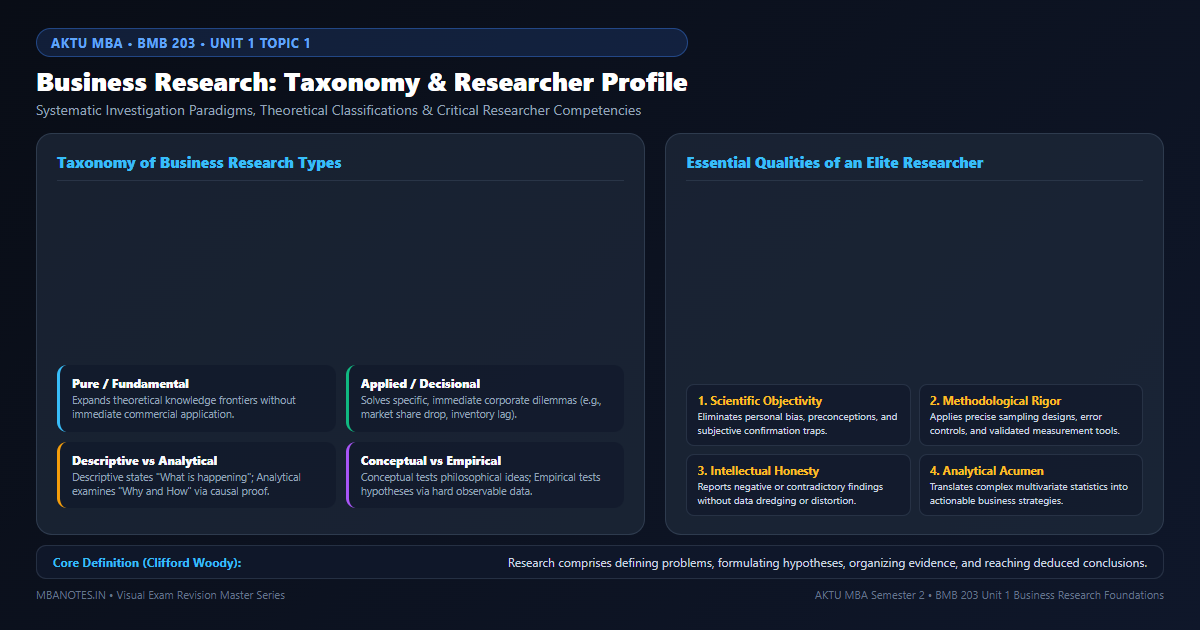
Figure 1: Taxonomy of Business Research Types (Pure vs Applied, Descriptive vs Analytical) and Essential Researcher Competencies.
1. Meaning, Definition & Strategic Importance of Business Research
In modern volatile corporate environments, executive intuition and unassisted judgment are insufficient for navigating complex market dynamics. Business Research serves as the systematic, data-driven foundation that translates ambiguous market signals into actionable strategic intelligence.
Authoritative Definitions
- Clifford Woody: "Research comprises defining and redefining problems, formulating hypothesis or suggested solutions; collecting, organising and evaluating data; making deductions and reaching conclusions; and at last carefully testing the conclusions to determine whether they fit the formulating hypothesis."
- Redman & Mory: "Systematized effort to gain new knowledge."
- Donald Cooper & Pamela Schindler: "A systematic inquiry that provides information to guide managerial decisions."
Strategic Importance of Business Research
- Mitigating Decision-Making Uncertainty: Replaces executive guesswork with empirical probability, reducing the risk of catastrophic capital misallocation in new product launches.
- Identifying Market Opportunities & Unmet Needs: Pinpoints latent consumer demand, underserved demographic segments, and emerging consumption habits before competitors.
- Resource Allocation & Capital Budgeting: Guides financial deployment toward business units and R&D pipelines demonstrating statistically verified customer lifetime value.
- Diagnostic Problem-Solving: Investigates the root drivers of performance anomalies such as sudden spikes in employee attrition, supply chain delivery lags, or product defect rates.
- Competitive Benchmarking: Systematically tracks rival pricing maneuvers, patent filings, digital marketing spend, and operational efficiencies.
- Regulatory & Environmental Adaptation: Analyzes legislative shifts, carbon compliance norms, and consumer data protection laws (such as India's DPDP Act 2023).
- Enhancing Organizational Agility: Enables agile pivoting by tracking real-time consumer sentiment through digital telemetry and continuous feedback loops.
2. Comprehensive Taxonomy of Research Types
Business research is classified across multiple dimensions based on its ultimate purpose, the nature of data gathered, and the underlying analytical methodology.
A. Pure (Basic / Fundamental) vs Applied (Decisional) Research
- Pure / Fundamental Research:
- Driven by intellectual curiosity to expand general theoretical knowledge without immediate commercial intent.
- Examples: Developing a mathematical model of behavioral game theory, studying the neurological basis of human risk aversion.
- Conducted primarily in university laboratories and academic institutes.
- Applied / Decisional Research:
- Undertaken to solve a specific, practical, real-world business dilemma confronting an enterprise.
- Examples: Determining why customer cart abandonment increased by 22% on an e-commerce mobile app, testing which of three packaging designs maximizes retail shelf pickup.
- Conducted by corporate market research departments and management consultants.
B. Descriptive vs Analytical Research
- Descriptive Research:
- Seeks to describe the characteristics of a population, market phenomenon, or operational situation as it exists.
- Answers "What," "Where," "When," and "Who" questions. The researcher has no control over variables and merely reports observations (Ex-Post Facto study).
- Examples: Census surveys, customer demographic profiling, tracking quarterly market share across regional sales zones.
- Analytical Research:
- Goes beyond mere description to evaluate facts and information critically, establishing causal relationships.
- Answers "Why" and "How" questions by testing hypotheses and measuring variable dependencies.
- Examples: Multiple regression analysis evaluating how changes in advertising spend and interest rates impact passenger vehicle sales.
C. Quantitative vs Qualitative Research
- Quantitative Research: Generates numerical data that can be transformed into usable statistics (structured surveys, closed-ended questionnaires, sensor telemetry, large-scale sampling). Emphasizes measurement, objectivity, and statistical generalizability.
- Qualitative Research: Explores underlying motives, subconscious attitudes, beliefs, and emotional drivers (focus groups, projective techniques, depth interviews, ethnography). Emphasizes depth of meaning, nuance, and contextual richness.
D. Conceptual vs Empirical Research
- Conceptual Research: Pertains to abstract ideas, philosophies, or theoretical frameworks. Used by philosophers and theorists to reinterpret existing concepts or propose new management philosophies.
- Empirical Research: Relies exclusively on hard, observable, experiential evidence. Hypotheses are formulated and verified through experimental manipulation or direct field measurement.
3. Essential Qualities & Ethical Competencies of an Elite Researcher
The credibility and utility of research output depend directly upon the scientific discipline and personal integrity of the investigator.
Core Intellectual & Professional Qualities
- 1. Scientific Objectivity: The mental detachment to record and interpret findings strictly as they are, without allowing personal biases, corporate politics, or wishful thinking to distort results.
- 2. Intellectual Curiosity & Alertness: A probing, questioning mind that refuses to accept surface-level appearances and relentlessly searches for underlying root causes.
- 3. Methodological Rigor & Precision: Painstaking attention to detail in defining sampling frames, designing measurement scales, controlling confounding variables, and verifying statistical assumptions.
- 4. Analytical & Quantitative Acumen: Deep competence in selecting appropriate statistical tests (t-tests, ANOVA, regression, factor analysis) and interpreting econometric models accurately.
- 5. Perseverance & Tenacity: The resilience to overcome field obstacles, non-response bias, missing data, and uncooperative respondents during prolonged data collection.
- 6. Lucidity in Communication: The ability to translate abstract statistical findings into clear, executive-ready graphical dashboards and strategic business recommendations.
Ethical Principles in Business Research
- Informed Consent: Respondents must participate voluntarily with complete awareness of the study's purpose and scope.
- Confidentiality & Anonymity: Safeguarding personal respondent identities and proprietary enterprise datasets from public exposure or commercial misuse.
- Integrity in Reporting: Strict avoidance of data fabrication, data dredging (p-hacking), selective omission of negative findings, or plagiarism.
4. The Business Research Process: An Integrated Overview
Scientific business research follows a disciplined, iterative 7-phase lifecycle:
- Problem Discovery & Definition: Clarifying the management dilemma and formulating precise research questions.
- Planning the Research Design: Selecting the overarching framework (Exploratory, Descriptive, or Causal/Experimental).
- Sampling Design: Defining the target population, sampling frame, sample size, and sampling technique.
- Data Collection: Administering structured questionnaires, conducting interviews, or collecting secondary database feeds.
- Data Processing & Preparation: Field editing, coding, data cleaning, and database tabulation.
- Statistical Data Analysis & Hypothesis Testing: Executing descriptive and inferential statistics to test empirical hypotheses.
- Interpretation & Report Formulation: Drawing actionable conclusions, stating limitations, and delivering recommendations to executive decision-makers.
6. Corporate Case Vignette: Tata Nano: When Market Research Failed to Decode Consumer Psychology
Tata Nano: The Peril of Superficial Quantitative Surveys vs Deep Qualitative Insights
Context & Challenge: In 2008, Tata Motors launched the revolutionary Tata Nano with an unprecedented price tag of ₹1 Lakh ($2,500), envisioned by Chairman Ratan Tata as an affordable, safe vehicle for millions of Indian families commuting on two-wheelers in rain and dust. Initial quantitative surveys indicated massive intent-to-buy among two-wheeler owners seeking affordable motorized personal mobility.
The Research Breakdown: Despite flawless engineering and global acclaim, actual commercial sales plummeted far below capacity. A post-mortem diagnostic research study revealed profound methodological flaws in Tata's initial market research:
- Confusing Functional Utility with Social Psychology: The initial research relied on rational, cost-benefit quantitative questionnaires. It failed to employ qualitative projective techniques to explore the social symbolism of car ownership in emerging markets.
- The Stigma of the "Cheap Car": In India, purchasing an automobile is a major aspirational status milestone. By heavily marketing the Nano as the "world's cheapest car," the brand inadvertently attached a social stigma to ownership. Consumers preferred buying pre-owned Maruti cars rather than being seen driving the "cheapest" vehicle.
- Neglecting Qualitative Depth: Had Tata researchers conducted depth interviews and ethnographic projective tests, they would have uncovered that consumers aspired for prestige, not publicized frugality.
Business Lessons: Quantitative survey numbers can be dangerously misleading if unaccompanied by deep qualitative insights into consumer emotional aspirations. Tata Motors subsequently pivoted its research methodology, leading to the highly successful, design-led launches of the Tiago, Nexon, and EV portfolios.
7. AKTU Exam-Focused Previous Year Questions (PYQs) & Model Answers
Section A: 2-Mark Short Answer Formulations
Q1. Define Business Research according to Clifford Woody. [AKTU 2021, 2023]
Q2. Differentiate between Pure and Applied Research with one example each. [AKTU 2020, 2022]
Q3. Distinguish between Descriptive and Analytical Research. [AKTU 2019, 2023]
Q4. Name four essential qualities of a good researcher. [AKTU 2022, 2024]
Section B & C: 10-Mark Detailed Analytical Questions
Q5. What is Business Research? Explain the various types of research used in management decisions. Discuss how research helps managers make effective decisions under uncertainty. [AKTU 2020, 2022, 2024]
Model Answer Structural Outline:
- Definition & Scope: Define business research as an objective, systematic inquiry supporting strategic decisions.
- Detailed Taxonomy of Research Types:
- Pure vs Applied: Theory building vs immediate corporate problem resolution.
- Descriptive vs Analytical: Fact-finding ex-post facto surveys vs causal econometric analysis.
- Quantitative vs Qualitative: Statistical measurement vs depth interviews and projective psychological probing.
- Conceptual vs Empirical: Abstract models vs experiential observable data.
- Role in Decision-Making Under Uncertainty: Explain how research reduces market risk, identifies latent demand, optimizes capital expenditure, and provides competitive benchmarking.
- Conclusion: Modern firms cannot rely on raw intuition; research-driven decision-making is a core competitive advantage.
Q6. "A researcher must possess both scientific detachment and ethical integrity." Critically analyze this statement. Discuss the major ethical dilemmas faced by corporate researchers today. [AKTU 2019, 2021, 2023]
Model Answer Structural Outline:
- Introduction: Define researcher qualities, emphasizing scientific objectivity and freedom from preconceived confirmation bias.
- Key Intellectual & Technical Competencies: Methodological precision, quantitative capability, tenacity, and clear communication.
- Critical Ethical Dilemmas in Corporate Research:
- Consumer Privacy & Data Protection: Covert data scraping and AI profiling without explicit consent (DPDP Act 2023 / GDPR).
- Sponsor Pressure & Bias: Pressure from corporate executives to withhold negative research findings or cherry-pick data to justify pet projects.
- Deceptive Practices: "Sugging" (selling under the guise of research) and "Frugging" (fundraising under the guise of research).
- Safeguards: Institutional review boards, transparent methodology disclosures, and strict researcher codes of ethics.
Discussion & Questions
0 CommentsAcademic insights, questions, and conceptual clarifications from students & faculty.
No questions or comments yet
Have a doubt about this topic, an exam tip, or a conceptual perspective? Start the discussion below!
Leave a Comment / Ask a Question
Your email address will not be published. Required fields are marked *