
Sales Quotas, Performance Appraisal and Sales Force Control: Types of Quotas, Evaluation Models and Control Systems
1. The Strategic Concept and Purpose of Sales Quotas
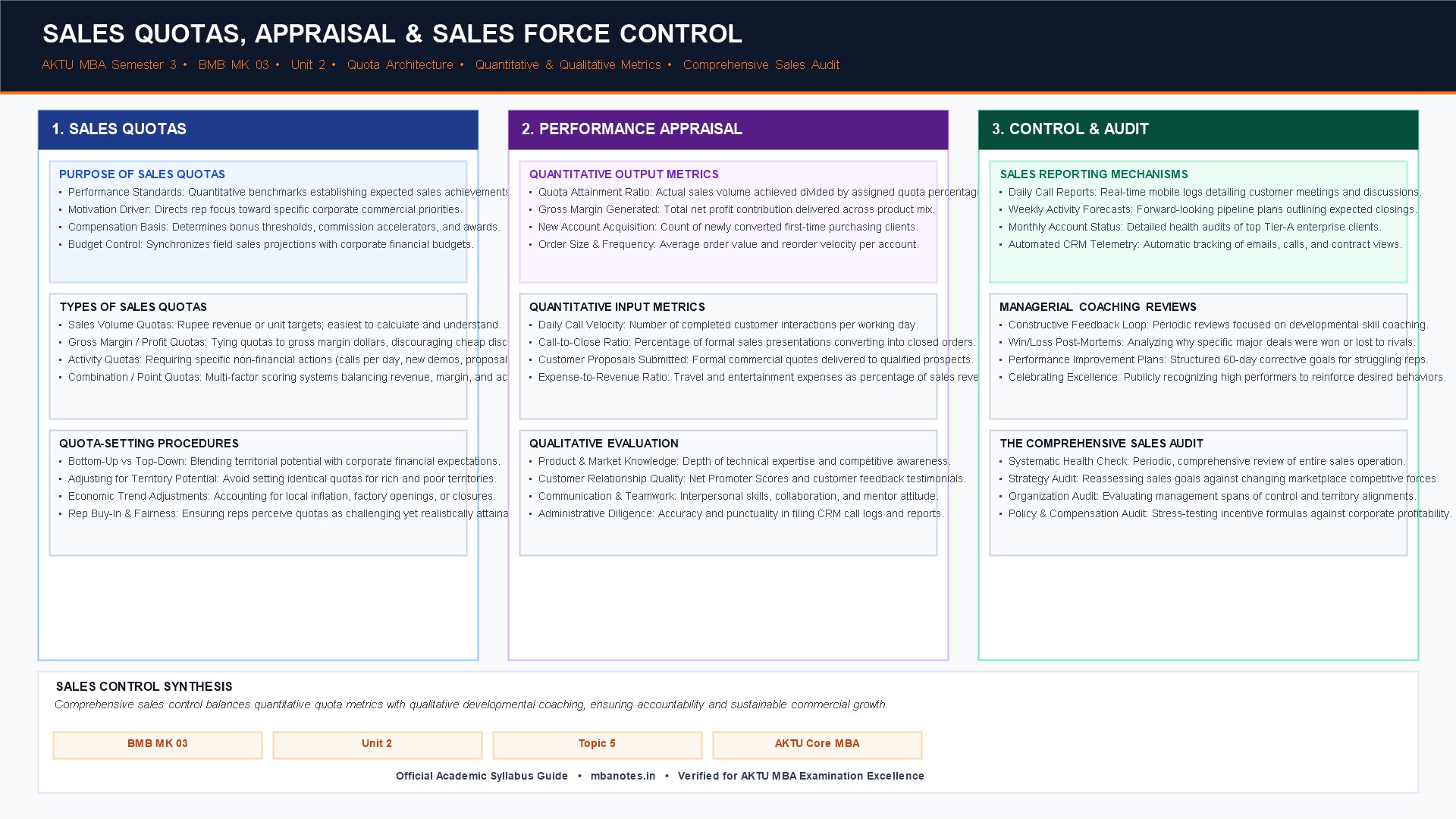
A sales quota is a quantitative commercial target assigned to a specific sales unit—such as an individual sales representative, a dealer partner, a district office, or an entire regional division—to be achieved over a designated time horizon (monthly, quarterly, or annually). Quotas represent the operational translation of broad corporate revenue forecasts into actionable, individualized performance benchmarks. Without rigorously established quotas, sales management possesses no objective standard to measure performance, distribute compensation, or identify operational territory deficiencies.
The primary organizational functions fulfilled by sales quotas include:
- Provides Concrete Motivational Targets: Establishes clear, unambiguous operational performance standards that channel sales rep focus, daily energy, and field activity.
- Controls Operational Selling Expenses: Expense quotas restrict travel and entertainment spending within budgeted percentages of gross sales volume, protecting corporate operating margins.
- Establishes Equitable Performance Baselines: Provides an objective, standardized yardstick to evaluate who deserves promotion, commission accelerators, or performance improvement coaching.
- Aligns Commercial Efforts with Corporate Strategy: Specific product quotas force representatives to promote strategically critical new product innovations rather than relying on legacy goods.
- Improves Sales Forecasting Accuracy: Tracking quota achievement velocity across individual territories provides early warning indicators of macroeconomic demand shifts.
2. Comprehensive Taxonomy of Sales Quotas
Sales management literature and enterprise practice classify sales quotas into four distinct categories, each designed to monitor and steer different aspects of commercial sales performance.
The four primary categories of sales quotas include:
- Sales Volume Quotas: The most prevalent quota type, expressed in physical units (e.g., 500 electric motors) or monetary revenue (e.g., ₹2.5 Crores).
- Pros: Highly understandable, easy to track in real-time, directly tied to corporate revenue targets.
- Cons: Encourages representatives to push low-margin, easy-to-sell commodity products and engage in reckless discounting to hit the number.
- Financial / Profit Quotas: Stated in terms of Gross Contribution Margin, Net Profit, or Return on Sales.
- Pros: Aligns rep behavior with bottom-line corporate profitability; penalizes excessive discounting and focuses effort on high-margin product configurations.
- Cons: More complex to calculate; representatives may feel demotivated if manufacturing cost fluctuations beyond their control erode their commission baselines.
- Activity Quotas: Focused on foundational behavioral inputs and daily sales activities rather than monetary output. Common metrics include number of daily customer calls (e.g., 5 calls/day), product demonstrations conducted (e.g., 10 demos/month), formal proposals submitted, and new prospect accounts opened.
- Pros: Excellent for guiding junior sales reps and monitoring long-cycle consultative B2B selling.
- Cons: High administrative tracking burden; reps may game the system by making quick, low-quality phone calls to hit activity numbers.
- Expense Quotas: Establishes spending ceilings for field travel, customer entertainment, auto allowances, and per diems, often expressed as an Expense-to-Sales percentage (e.g., travel expenses must not exceed 4% of territory revenue).
3. Performance Appraisal Methodologies: Output vs Input Governance
Evaluating a sales representative solely based on whether they hit their volume quota is an outdated, dangerous management practice. A representative in a booming economic territory may easily hit quota despite mediocre effort, while an elite representative in an economically depressed region may perform heroic consultative work but fall slightly short. Modern sales appraisal balances quantitative output metrics with qualitative behavioral inputs.
The standard multi-dimensional sales performance evaluation matrix encompasses:
- Quantitative Output Measures: Objective commercial results delivered, including Total Revenue Generated, Percentage of Quota Attained, Gross Profit Margin Delivered, Number of New Accounts Acquired, Account Retention/Renewal Percentage, and Average Deal Contract Size.
- Quantitative Input Measures: Behavioral activity metrics, including Number of Calls Made per Day, Days Worked in the Field, Call-to-Close Conversion Ratio, Number of Product Proof-of-Concepts Delivered, and Proposal Win Rate.
- Qualitative Competency Measures: Subjective managerial evaluations of professional competence, including Deep Technical Product Mastery, Consultative Negotiation Poise, Active Listening and Empathy, Accuracy and Timeliness of CRM Data Entry, and Peer Teamwork within Cross-Functional Pods.
- 360-Degree Feedback Integration: Gathering performance inputs from multiple stakeholders who interact with the sales representative—including Regional Managers, Sales Engineers, Customer Support Specialists, and direct Customer Satisfaction Surveys.
4. Theoretical Framework: The Sales Force Control System Model
In sales management scholarship, Gregory A. Oliver and E. Anderson formulated the definitive theoretical framework analyzing how corporate organizations govern their sales forces: the Outcome-Based versus Behavior-Based Control System Model.
Anderson & Oliver's Sales Force Control System Theory
Anderson and Oliver proved that corporate sales governance operates along a continuum between two distinct paradigms:
- Outcome-Based Control: Management measures and rewards solely objective commercial outputs (sales volume, closed revenue). Sales reps operate with complete tactical autonomy; compensation is heavily commission-driven. Minimal managerial coaching or activity monitoring.
- Behavior-Based Control: Management actively monitors, directs, and coaches the day-to-day selling behaviors and activities of representatives. Emphasizes structured training, CRM call tracking, consultative skill development, and fixed salary compensation.
| Control Dimension | Outcome-Based Control | Behavior-Based Control |
|---|---|---|
| Primary Focus | Final commercial results (Revenue, Units, Quota %). | Process, daily activities, customer engagement quality. |
| Compensation Structure | High incentive / Heavy straight commission. | High base salary / Structured milestone bonuses. |
| Managerial Involvement | Minimal daily contact; management evaluates monthly revenue. | High daily coaching, joint field calls, CRM audit reviews. |
| Sales Rep Mindset | Independent contractor mentality; transactional focus. | Corporate brand ambassador; long-term consultative mindset. |
| Customer Relationship Quality | Can be compromised by aggressive closing pressure. | High trust, consultative problem-solving, deep loyalty. |
6. Corporate Case Vignette: Real-World Implementation
Microsoft Enterprise Commercial: Transitioning from Volume Quotas to Consumption Metrics
Corporate Context & Challenge: For decades, Microsoft governed its global commercial sales force using strict Outcome-Based Volume Quotas. Representatives were evaluated on the total contract dollar value of multi-year Enterprise Agreements (EAs). This drove reps to aggressively sell multi-million-dollar software licenses that often sat uninstalled on client corporate servers—a phenomenon known in the IT industry as "shelfware." As cloud competitors like AWS and Google Cloud charged customers purely based on active monthly cloud usage, Microsoft found enterprise clients canceling multi-year licensing deals upon renewal.
Strategic Intervention & Implementation: Under CEO Satya Nadella, Microsoft executed a radical overhaul of its global sales quotas and performance appraisal architecture:
- Abolishing Shelfware Quotas: Quotas based solely on signing multi-year licensing agreements were eliminated for Microsoft Azure and Microsoft 365 cloud products.
- Instituting Consumption & Usage Quotas: Sales representatives and technical architects were evaluated and compensated based on actual Customer Cloud Consumption (active monthly workloads running in the client's cloud).
- Customer Success Alignment: If a client signed an Azure contract but failed to actively consume cloud compute resources within 90 days, the sales representative received zero commission bonus. Account reps were forced to partner with internal engineering teams to ensure client software was deployed and operational.
Strategic Outcome & Lessons Learned: Microsoft Azure consumption surged over 70% year-over-year, customer churn among enterprise accounts dropped to record lows, and Microsoft re-established itself as a preeminent global cloud infrastructure provider. The case proves that modern sales control systems must measure customer value realization and consumption rather than superficial contractual signatures.
7. AKTU University Exam Practice Drill
AKTU Master Question Bank: Quotas & Performance Governance
Model answers prepared strictly according to AKTU evaluation rubrics and standard MBA marking schemes.
Define an Activity Quota and cite two operational examples.
Model Answer: An Activity Quota is a quantitative performance target focused on behavioral sales inputs and daily customer engagement tasks rather than monetary revenue outcomes. It is designed to ensure consistent frontline sales effort. Examples: 1. Completing a minimum of 6 qualified customer field visits per day; 2. Delivering 8 product proof-of-concept demonstrations per month.
Explain the different types of sales quotas. Contrast Outcome-Based Control systems with Behavior-Based Control systems, highlighting their respective managerial implications.
Comprehensive University Framework:
1. Classification of Sales Quotas:
- Sales Volume Quotas: Stated in physical units or currency revenue. Simple to track and understand, but can encourage reckless discounting.
- Financial / Margin Quotas: Stated in Gross Margin or Net Contribution. Aligns reps with corporate profitability and discourages margin-eroding discounts.
- Activity Quotas: Focuses on behavioral inputs (calls per day, product demonstrations, new prospect meetings). Vital for long-cycle B2B selling.
- Expense Quotas: Establishes expense-to-sales spending caps on travel and entertainment to protect operating cash flow.
2. Outcome-Based vs Behavior-Based Control Systems (Anderson & Oliver):
- Outcome-Based Control: Evaluates reps purely on bottom-line commercial results (revenue closed). Reps enjoy tactical autonomy; pay is heavy commission. Implications: Weeds out low performers, but reps ignore non-selling activities, may push aggressive discounting, and develop low loyalty to the firm.
- Behavior-Based Control: Evaluates reps on how they sell—monitoring consultative questioning, product mastery, CRM logging, and customer satisfaction. Pay is primarily salaried. Implications: Fosters high consultative brand reputation, superior customer trust, ethical compliance, and low turnover. Requires high managerial coaching time.
3. Managerial Synthesis: Modern B2B organizations are increasingly adopting hybrid control systems, maintaining clear margin-focused outcome quotas while utilizing behavior-based coaching to ensure sustainable customer retention.
Discussion & Questions
0 CommentsAcademic insights, questions, and conceptual clarifications from students & faculty.
No questions or comments yet
Have a doubt about this topic, an exam tip, or a conceptual perspective? Start the discussion below!
Leave a Comment / Ask a Question
Your email address will not be published. Required fields are marked *