
Marketing Channels: Nature, Economic Utilities, Key Functions, Flows and Vertical Channel Levels
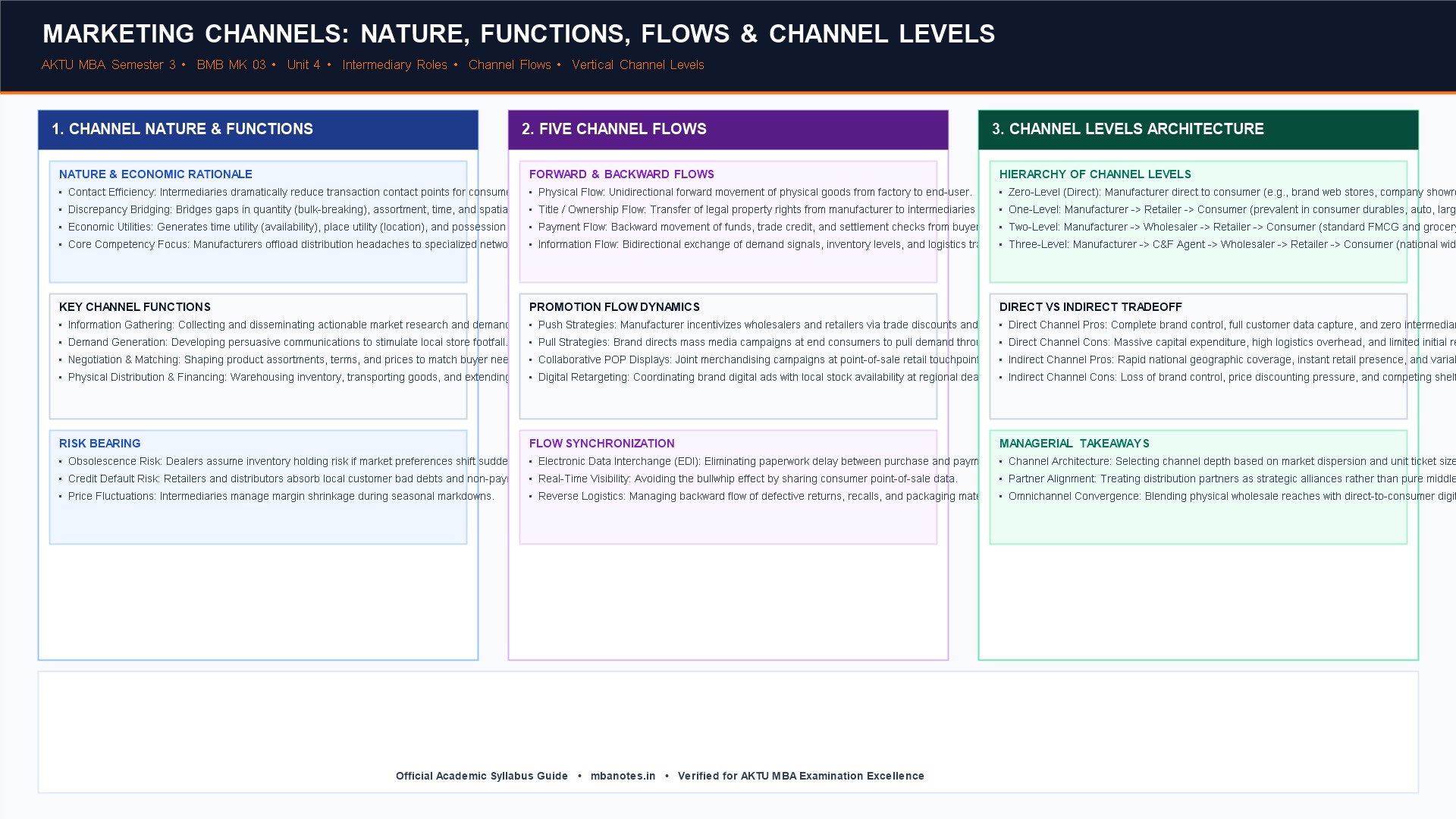
1. Conceptual Foundations and Economic Utilities of Marketing Channels
A marketing channel (also termed a distribution channel) is an organized network of interdependent institutions and agencies—including manufacturers, clearing and forwarding agents, wholesalers, jobbers, and retailers—involved in the physical and commercial process of making a product or service available for use or consumption. Manufacturers typically specialize in technical engineering and mass production; they rarely possess the capital, regional infrastructure, or granular local contacts required to sell directly to millions of dispersed end-users. Intermediaries bridge the massive structural discrepancies that naturally separate producers from consumers.
The fundamental economic utilities and value-additions generated by marketing channels encompass:
- Bridging Discrepancies of Quantity (Bulk Breaking): Factories achieve economies of scale by manufacturing millions of units at a time; consumers purchase in individual units. Intermediaries break bulk, repackaging railcars and truckloads into retail packs.
- Bridging Discrepancies of Assortment (Sorting): Consumers require broad baskets of complementary goods (bread, milk, soap, batteries) at a single shopping trip. Intermediaries assemble diverse product lines from hundreds of unrelated manufacturers into a convenient one-stop assortment.
- Creating Time Utility: Storing inventory in regional distribution warehouses so products are instantly available when customer need arises, decoupling steady manufacturing production runs from erratic consumer buying patterns.
- Creating Place Utility: Transporting goods across continents, states, and rural districts, making products accessible in neighborhood convenience stores and local commercial markets.
- Creating Possession Utility: Facilitating legal title transfer, providing trade credit, accepting payment methods, and completing the formal commercial exchange.
2. The Five Indispensable Channel Flows
A distribution channel is not merely a static pipe through which physical boxes move. Marketing scholar Louis W. Stern demonstrated that a channel represents a dynamic, multi-directional operating system characterized by five distinct, simultaneous flows connecting manufacturers, intermediaries, and buyers.
The five core distribution channel flows include:
- 1. Physical Flow: The unidirectional forward movement of raw materials and physical finished products through warehouses, shipping containers, distribution depots, and retail shelves to the ultimate consumer.
- 2. Title / Ownership Flow: The legal passage of commercial property rights and inventory ownership from the manufacturer to the distributor, wholesaler, retailer, and finally to the end-buyer. (Note: Transportation carriers and storage warehouses participate in the physical flow without ever taking title).
- 3. Payment Flow: The backward movement of funds, bank settlements, credit card transactions, and trade checks from the customer backward through intermediaries to the original producer.
- 4. Information Flow: A bidirectional exchange of operational data: forward flow conveys product pricing, technical specs, and shipment tracking; backward flow transmits point-of-sale customer purchase data, inventory stockout alerts, and warranty complaints.
- 5. Promotion Flow: A multi-directional communication flow: Push strategies (manufacturer incentivizing wholesalers/dealers via volume trade discounts and co-op ads) and Pull strategies (consumer advertising pulling buyers into retail stores).
3. Vertical Channel Levels Architecture and Direct vs Indirect Tradeoffs
The vertical length of a distribution channel is determined by the number of intermediary levels that separate the original producer from the final consumer. Each intermediary that performs work in bringing the product closer to the buyer constitutes a distinct channel level.
The standard vertical channel hierarchy comprises four primary configurations:
- Zero-Level Channel (Direct Marketing): Manufacturer sells directly to consumers with zero intermediaries (e.g., Apple flagship stores, brand D2C e-commerce websites, industrial enterprise sales forces).
- Pros: Complete control over brand pricing, full capture of first-party consumer data, and zero intermediary margin erosion.
- Cons: Massive fixed capital expenditure, high logistics overhead, and limited initial geographic reach.
- One-Level Channel: Manufacturer $ ightarrow$ Retailer $ ightarrow$ Consumer. Commonly utilized in consumer durables, fashion apparel, and large retail chains (e.g., Sony selling television sets through Best Buy or Croma).
- Two-Level Channel: Manufacturer $ ightarrow$ Wholesaler $ ightarrow$ Retailer $ ightarrow$ Consumer. The traditional model for fast-moving consumer goods (FMCG), groceries, hardware, and pharmaceuticals, serving millions of fragmented mom-and-pop retailers.
- Three-Level Channel: Manufacturer $ ightarrow$ C&F Agent (Clearing & Forwarding) $ ightarrow$ Wholesaler $ ightarrow$ Retailer $ ightarrow$ Consumer. Employed in vast continental markets (such as India or China) where regional state depots and C&F agents manage interstate freight taxation, warehousing, and local wholesale credit.
4. Theoretical Framework: Transaction Cost Analysis & Contact Efficiency
Why do manufacturers willingly share their profit margins with distribution intermediaries rather than selling directly to customers? The economic justification is formalized in Transaction Cost Analysis and the Contact Efficiency Principle.
Oliver Williamson's Transaction Cost Analysis & Contact Efficiency
Under Transaction Cost Economics (TCE), a firm establishes direct channels (internal integration) only when external market transaction costs—search costs, opportunistic bargaining, and contractual monitoring—exceed internal administrative overhead. In mass consumer markets, the Contact Efficiency Principle proves that introducing a single intermediary dramatically reduces commercial transactions: if 4 manufacturers attempt to sell directly to 6 consumers, 24 separate contact lines are required ($M imes C = 24$). By inserting 1 wholesaler, total contacts drop to 10 ($M + C = 10$), achieving a 58% reduction in society's total transaction friction.
| Channel Architecture | Intermediary Hierarchy | Capital Requirement | Market Penetration | Brand & Pricing Control |
|---|---|---|---|---|
| Zero-Level (Direct) | Producer -> Consumer | Very High (owned stores, fleets, web IT). | Limited / Concentrated | Absolute (100% control over pricing and CX). |
| One-Level | Producer -> Retailer -> Consumer | Moderate (credit terms to retailers). | High (major retail mall chains). | Moderate (subject to retail shelf placement). |
| Two-Level | Producer -> Wholesaler -> Retailer -> Consumer | Low (wholesalers fund regional stock). | Very High (reaches fragmented local shops). | Low (wholesalers push competitor brands). |
| Three-Level | Producer -> C&F -> Wholesaler -> Retailer -> Consumer | Extremely Low (variable cost distribution). | Maximum (nationwide rural & urban reach). | Very Low (lengthy communication delays). |
6. Corporate Case Vignette: Real-World Implementation
Nestlé India: Managing Multi-Tier Distribution Flows for Maggi Noodles
Corporate Context & Challenge: Nestlé's iconic Maggi instant noodles is consumed daily across urban metropolises, tier-3 towns, and remote Himalayan village tea stalls across India. With a retail price point of ₹14 per packet, selling direct to consumer was mathematically impossible due to shipping costs. Furthermore, India's retail landscape is dominated by over 12 million tiny, independent neighborhood kirana stores who hold minimal cash capital and zero warehouse storage.
Strategic Interventions & Channel Architecture: Nestlé engineered an intricate, highly coordinated Three-Level Distribution Architecture:
- C&F Depots & Mother Hubs: Finished Maggi cases move by rail and line-haul trucks from manufacturing plants to regional Mother Distribution Centers managed by professional Clearing and Forwarding (C&F) agents.
- Redistribution Stockists (RS): Over 4,000 independent Redistribution Stockists purchase inventory from C&F agents, holding dedicated town-level warehouses and extending local trade credit.
- Beat Route Salesmen: Stockist sales reps visit retail kirana stores weekly on fixed motorized two-wheeler beats, taking orders for half-dozen packs and replenishing shelf display jars.
Strategic Outcome & Lessons Learned: Maggi achieved direct retail presence in over 4.5 million retail outlets, establishing an insurmountable market share exceeding 60% in the packaged instant food category. Nestlé's network confirms that in developing mass markets, deep multi-tier indirect channels deliver unprecedented contact efficiency and volume velocity that no direct digital model can match.
7. AKTU University Exam Practice Drill
AKTU Master Question Bank: Distribution Channel Foundations
Model answers prepared strictly according to AKTU evaluation rubrics and standard MBA marking schemes.
Explain the Contact Efficiency Principle in marketing channels.
Model Answer: The Contact Efficiency Principle demonstrates that inserting an intermediary into a commercial distribution network dramatically reduces the total number of transactions required: while direct selling between $M$ manufacturers and $C$ consumers requires $M imes C$ contact lines, utilizing a single intermediary reduces contacts to $M + C$, drastically lowering societal distribution costs and friction.
Define Marketing Channels and explain their economic utilities. Describe the five core flows that occur within marketing channels, and contrast Direct vs Indirect distribution systems.
Comprehensive University Framework:
1. Definition & Economic Utilities: Marketing channels are interdependent networks of commercial organizations involved in transferring goods and ownership from producers to consumers. They generate Time Utility (warehousing), Place Utility (geographic proximity), Possession Utility (ownership transfer), and bridge discrepancies in quantity (bulk-breaking) and assortment (sorting).
2. The Five Channel Flows (Louis W. Stern):
- Physical Flow: Unidirectional forward movement of tangible goods through logistics depots to retailers.
- Title Flow: Formal transfer of legal ownership rights from manufacturer down to the end consumer.
- Payment Flow: Backward movement of funds, trade credit, and invoice settlements from buyers to sellers.
- Information Flow: Bidirectional exchange of demand data, inventory levels, and logistics tracking.
- Promotion Flow: Persuasive marketing communications (Push strategies to dealers and Pull campaigns to consumers).
3. Direct vs Indirect Channel Comparison:
- Direct Channels (Zero-Level): Complete control over brand presentation and customer data; 100% margin retention. Drawbacks: Huge upfront capital expenditure, high fixed logistics costs, and slow geographic scaling.
- Indirect Channels (One, Two, Three Levels): Intermediaries absorb inventory holding risk, fund regional warehousing, and provide instant nationwide retail reach on a variable-cost basis. Drawbacks: Loss of pricing control, margin dilution, and risk of dealer disloyalty.
Discussion & Questions
0 CommentsAcademic insights, questions, and conceptual clarifications from students & faculty.
No questions or comments yet
Have a doubt about this topic, an exam tip, or a conceptual perspective? Start the discussion below!
Leave a Comment / Ask a Question
Your email address will not be published. Required fields are marked *