
Cross-Cultural Management in Global Business: Hofstede’s Cultural Dimensions, Trompenaars Framework, and Contextual Communication
1. The Concept of Culture in International Business
Dutch social psychologist Geert Hofstede famously defined culture as the "collective programming of the mind that distinguishes the members of one group or category of people from another." In international business, culture represents the shared values, beliefs, behavioral norms, religious customs, and communication codes that govern how business executives negotiate, how managers lead subordinates, and how consumers make purchasing decisions.
Cross-cultural failure remains the single largest cause of unsuccessful international joint ventures, failed expatriate assignments, and rejected cross-border marketing campaigns.
2. Geert Hofstede’s Six Cultural Dimensions Model
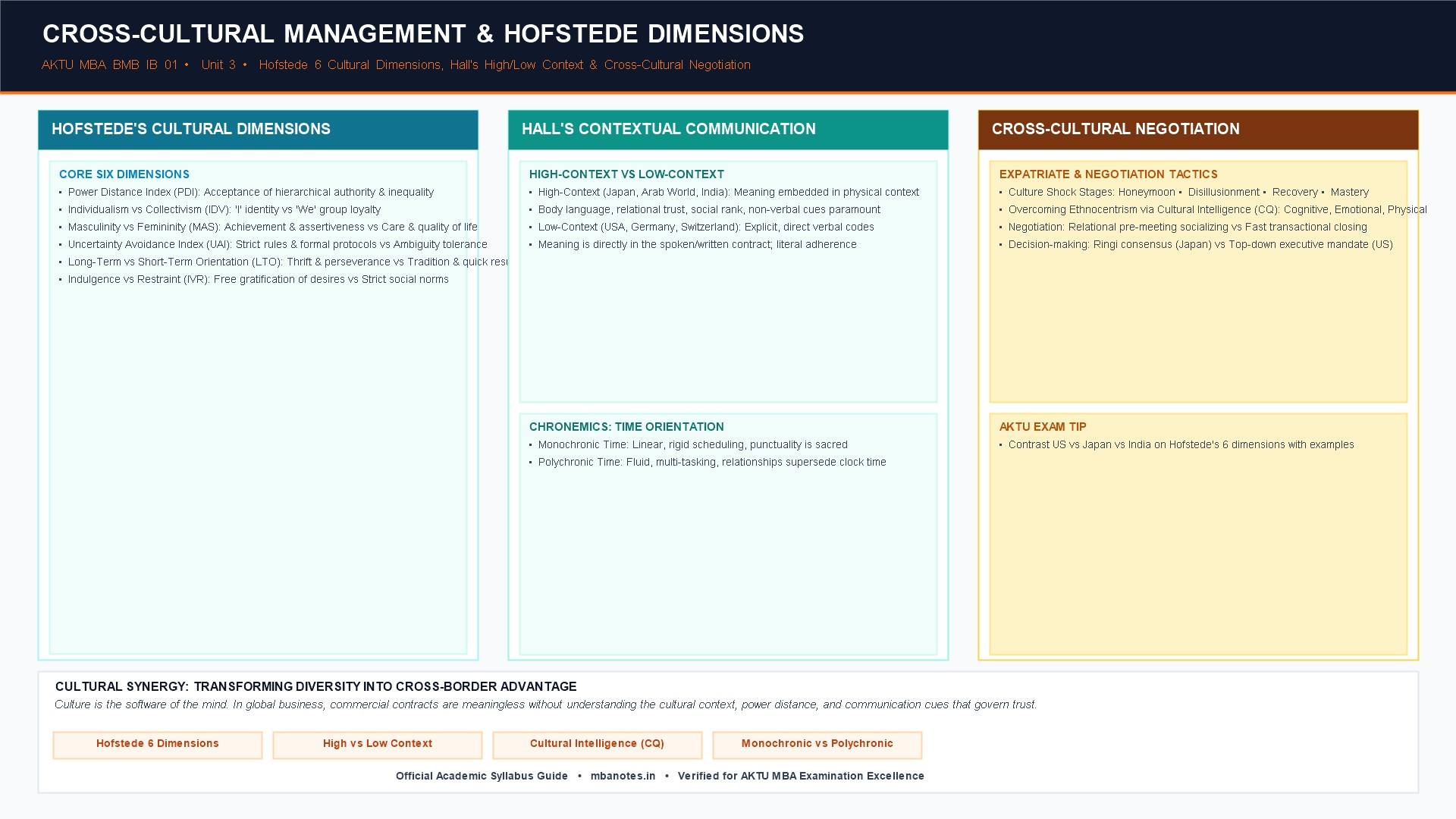
Based on groundbreaking empirical research surveying over 116,000 IBM employees across 50+ countries, Hofstede isolated six fundamental dimensions of national culture:
1. Power Distance Index (PDI)
The degree to which less powerful members of organizations accept that power is distributed unequally. High PDI societies (India, Malaysia, Arab nations) exhibit strict hierarchical deference and autocratic leadership; Low PDI cultures (Denmark, Sweden, Israel) emphasize consultative flatter structures.
2. Individualism vs. Collectivism (IDV)
Individualist societies (USA, Australia, UK) prioritize personal autonomy, individual initiative, and immediate family. Collectivist cultures (Japan, China, Mexico) emphasize cohesive in-groups, loyalty, shared responsibility, and saving collective 'face'.
3. Masculinity vs. Femininity (MAS)
Masculine cultures (Japan, USA, Germany) are driven by competition, achievement, material success, and assertiveness. Feminine societies (Sweden, Norway, Netherlands) prioritize consensus, quality of life, environmental stewardship, and social safety nets.
4. Uncertainty Avoidance Index (UAI)
The extent to which members of a society feel threatened by ambiguous or unstructured situations. High UAI cultures (Greece, Japan, France) enforce rigid formal rules and detailed contracts; Low UAI cultures (Singapore, UK, Denmark) tolerate ambiguity, pragmatism, and entrepreneurial risk.
5. Long-Term vs. Short-Term Orientation (LTO)
Long-Term oriented societies (China, South Korea, Japan) foster virtues oriented toward future rewards: perseverance, thrift, long-range planning. Short-Term cultures (USA, UK) focus on immediate quarterly earnings, tradition, and personal stability.
6. Indulgence vs. Restraint (IVR)
Indulgent cultures (Latin America, USA) permit relatively free gratification of basic human desires for enjoying life and having fun. Restrained societies (Russia, Eastern Europe, Middle East) suppress gratification through strict social norms.
3. Edward T. Hall’s High-Context vs. Low-Context Communication
Anthropologist Edward T. Hall demonstrated that the role of environmental context fundamentally alters international communication:
- High-Context Cultures (Japan, China, Arab World, India): Most of the information is either in the physical context or internalized in the person; very little is coded into explicit words. Non-verbal gestures, social status, long-standing relationships, and indirect phrasing carry the message. Contracts are open-ended frameworks based on interpersonal trust.
- Low-Context Cultures (Germany, Switzerland, USA, Scandinavia): The mass of information is vested in the explicit code. Words mean exactly what they say. Communication is direct, linear, and literal. Commercial contracts are exhaustive, lengthy, and legally binding documents leaving zero room for interpretation.
4. Fons Trompenaars’ Seven Cultural Dilemmas
Fons Trompenaars and Charles Hampden-Turner formulated a complementary model based on how societies resolve fundamental human dilemmas:
- Universalism vs. Particularism: Applying strict universal rules equally vs. adapting rules to fit unique personal relationships and circumstances.
- Individualism vs. Communitarianism: Serving personal interests vs. serving the collective community.
- Neutral vs. Emotional: Restraining emotional displays in business meetings vs. expressing emotions openly and passionately.
- Specific vs. Diffuse: Separating professional work from personal life vs. viewing life and work as holistically overlapping.
- Achievement vs. Ascription: Respect earned through individual performance vs. respect derived from social birth, age, or institutional title.
- Sequential vs. Synchronic Time: Linear, clock-bound scheduling vs. flexible, multitasking fluid time.
- Internal vs. External Direction: Believing individuals control their destiny vs. adapting harmoniously to external nature and fate.
5. Cross-Cultural Negotiation Tactics & Cultural Intelligence (CQ)
To succeed in international negotiations, executives cultivate Cultural Intelligence (CQ)—the capability to function and manage effectively in culturally diverse settings across three pillars:
- Cognitive CQ: Knowledge of cross-cultural norms, business practices, and legal systems.
- Motivational CQ: Confidence, interest, and intrinsic motivation to adapt across diverse cultural environments.
- Behavioral CQ: The verbal and non-verbal flexibility to adjust speech cadence, greeting rituals, and negotiation tactics to match counterparts.
University Examination Question Bank & Model Solutions
Designed as per Dr. A.P.J. Abdul Kalam Technical University (AKTU) MBA Examination Pattern.
Part A: Conceptual 2-Mark Short Answer Questions
Q1 [2 Marks]: State Hofstede's definition of Culture.
Ans: Culture is the collective programming of the mind that distinguishes the members of one group or category of people from another.
Q2 [2 Marks]: Differentiate between High-Context and Low-Context communication.
Ans: In High-Context cultures (Japan, India), messages are conveyed through physical context, body language, and relational trust. In Low-Context cultures (Germany, USA), communication is direct, explicit, and literal.
Q3 [2 Marks]: What is Cultural Intelligence (CQ)?
Ans: Cultural Intelligence is an individual's capability to understand, adapt to, and manage effectively in culturally diverse international business settings across cognitive, motivational, and behavioral dimensions.
Part B & C: Analytical 10-Mark Detailed Solutions & Strategic Frameworks
Question 1 [10/15 Marks]: Examine Geert Hofstede's Six Cultural Dimensions with cross-country comparative examples. How does cultural orientation influence international business negotiations?
Model Examination Answer Blueprint:
2. Hofstede's Six Dimensions: Detail Power Distance (PDI), Individualism vs Collectivism (IDV), Masculinity vs Femininity (MAS), Uncertainty Avoidance (UAI), Long-Term Orientation (LTO), and Indulgence vs Restraint (IVR).
3. Country Comparisons: Contrast the cultural profiles of contrasting nations (e.g., USA vs. Japan vs. India) across these dimensions.
4. Hall's Context Framework: Compare high-context relational negotiations with low-context contract-focused negotiations.
5. Negotiation Strategies: Discuss practical guidelines for international managers to adapt leadership, team dynamics, and conflict resolution across cultures.
Strategic Executive Summary: 2. Cross-Cultural Dynamics & Hofstede Dimensions
- Culture represents the collective programming of the mind; cross-cultural friction is the primary driver of failure in international joint ventures and expatriate management.
- Geert Hofstede's six cultural dimensions—PDI, IDV, MAS, UAI, LTO, and IVR—provide an empirical foundation for comparing national managerial mindsets.
- Edward T. Hall's model differentiates High-Context cultures (relying on non-verbal cues and relational trust) from Low-Context cultures (direct verbal communication and literal contracts).
- Developing Cultural Intelligence (CQ) across cognitive knowledge, motivational drive, and behavioral flexibility is essential for successful cross-border commercial negotiation.
Frequently Asked Questions (Academic & Practitioner FAQ)
Q1. How does high Power Distance affect managerial decision-making?
In high Power Distance cultures (e.g., India, Arab nations), organizational hierarchies are steep, authority is concentrated at the top, subordinates expect direct instructions, and bypassing superiors is considered a serious breach of etiquette.
Q2. What is the difference between polychronic and monochronic time?
Monochronic cultures (e.g., Germany, USA) view time as linear, compartmentalized, and scarce, prioritizing strict punctuality. Polychronic cultures (e.g., Latin America, Middle East) view time as fluid, prioritizing interpersonal relationships over rigid clock schedules.
Q3. What is Cultural Intelligence (CQ)?
Cultural Intelligence is an individual's capability to adapt effectively when interacting with individuals from different cultural backgrounds, encompassing cognitive knowledge of other cultures, intrinsic motivation to adapt, and behavioral flexibility.
Discussion & Questions
0 CommentsAcademic insights, questions, and conceptual clarifications from students & faculty.
No questions or comments yet
Have a doubt about this topic, an exam tip, or a conceptual perspective? Start the discussion below!
Leave a Comment / Ask a Question
Your email address will not be published. Required fields are marked *