
International Marketing Foundations: Strategic Scope, Drivers, and Domestic vs. International Marketing Distinctions
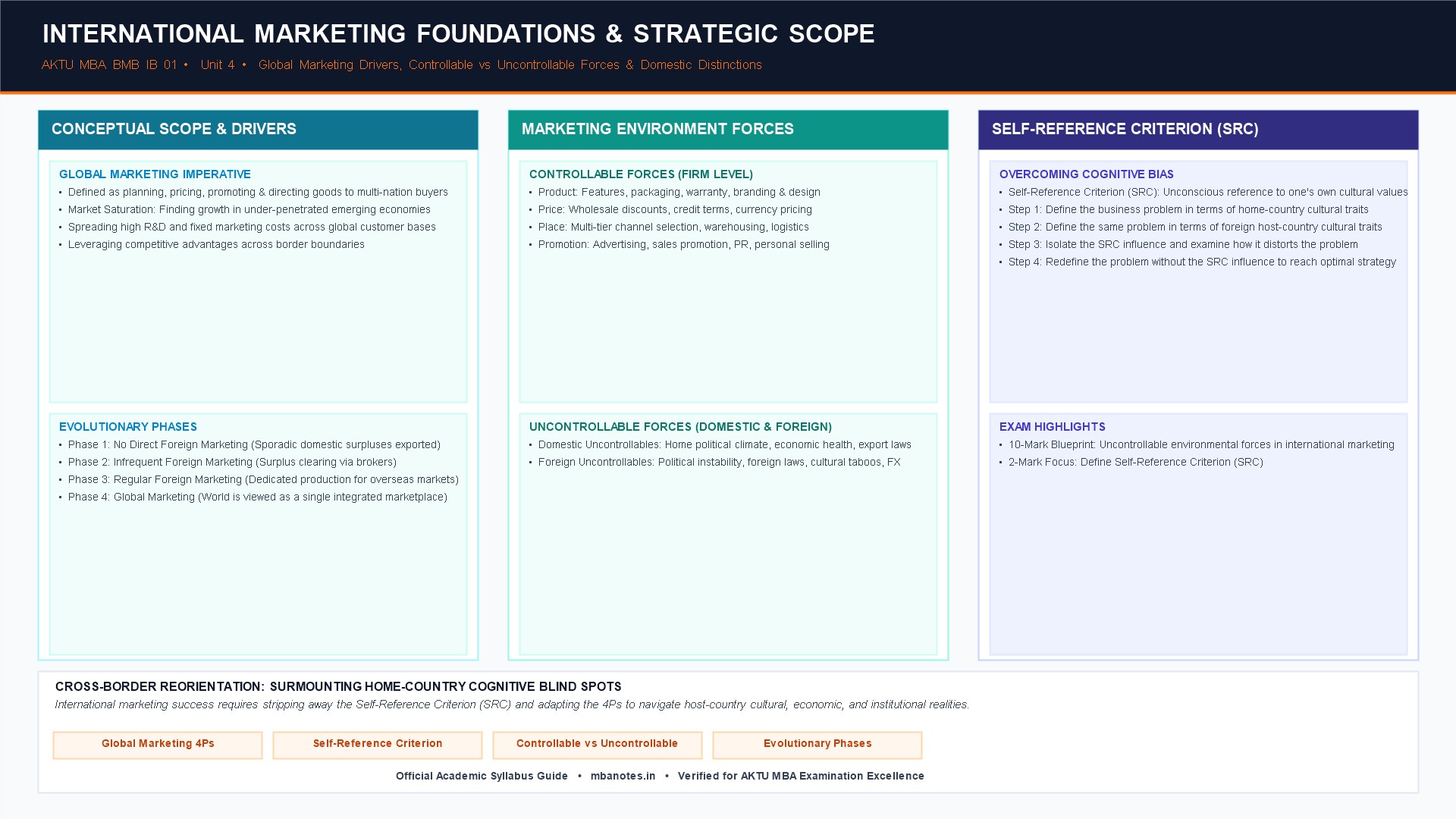
1. Conceptual Scope & Definition of International Marketing
International Marketing is the multinational process of planning, executing, pricing, promoting, and directing the flow of an enterprise’s goods and services to consumers or industrial users in more than one nation for a profit. While the core marketing objective—satisfying customer needs better than rivals—remains universal, the operational environment is complicated by operating across multiple sovereign territories simultaneously.
In global marketing, decisions regarding the 4Ps (Product, Price, Place, Promotion) cannot be made in isolation. Marketers must determine the degree of cross-border standardization versus localized customization required to navigate national cultural values, income levels, and legal mandates.
2. Key Drivers Propelling Global Commercial Marketing
Enterprises expand their marketing boundaries internationally due to powerful strategic catalysts:
- Domestic Market Saturation: Sluggish population growth and mature product life cycles in home markets compel firms to target burgeoning middle-class consumer segments in emerging economies.
- Amortization of High R&D Costs: High-technology industries (smartphones, pharmaceuticals, automotive platforms) require massive global sales volumes to recoup upfront research expenditures.
- Global Consumer Convergence: Advancements in digital media, international streaming, and global travel have created homogeneous transnational segments (e.g., global youth cohorts sharing tech preferences).
- Competitive Pressures & First-Mover Advantage: Securing early market share in high-growth foreign markets preempts global rivals and locks in key distribution channels.
3. The International Marketing Task: Controllable vs. Uncontrollable Forces
The international marketer operates within an intricate matrix of firm-level controllable levers and multi-layered external uncontrollable forces:
Firm Controllable Levers (The 4Ps)
- Product: Design, features, warranty, packaging, and brand positioning.
- Price: Export price quotes, distributor margins, credit terms, and currency denomination.
- Place: International shipping channels, overseas wholesalers, retail placement.
- Promotion: Global advertising campaigns, digital media, trade fairs, and localized PR.
External Uncontrollables
- Domestic Uncontrollables: Home political stability, domestic economic health, and national export regulations.
- Foreign Host Uncontrollables: Political instability, tariffs, non-tariff technical barriers, cultural values, and competitive market structures.
4. Overcoming the Self-Reference Criterion (SRC) & Ethnocentrism
The single most pervasive psychological impediment to successful international marketing is the Self-Reference Criterion (SRC)—the unconscious reference to one’s own cultural values, experiences, and knowledge as a basis for decisions in foreign markets:
The 4-Step Analytical Framework to Eliminate SRC
1) Step 1: Define the business problem or marketing goal in terms of home-country cultural traits, habits, and norms.
2) Step 2: Define the same problem in terms of foreign host-country cultural traits, habits, and norms.
3) Step 3: Isolate the SRC influence in the problem and examine how it complicates or distorts the marketing objective.
4) Step 4: Redefine the marketing problem without the SRC influence and design the optimal adapted marketing mix.
5. Stages of International Marketing Involvement
Corporate involvement in international marketing typically evolves through five progressive stages:
- 1. No Direct Foreign Marketing: The firm does not actively cultivate overseas customers; sales occur via foreign buyers seeking domestic stock or domestic export brokers.
- 2. Infrequent Foreign Marketing: Temporary surpluses caused by domestic recession or inventory overcapacity are sold off in foreign markets; foreign sales cease once domestic demand rebounds.
- 3. Regular Foreign Marketing: Dedicated permanent production capacity is committed to foreign markets, using overseas distributors or company sales branches.
- 4. International Marketing: The firm operates fully integrated manufacturing and marketing subsidiaries in multiple foreign countries, treating each as a distinct profit center.
- 5. Global Marketing: The enterprise treats the entire world as a single integrated marketplace, designing standard product platforms that are customized modularly across transnational segments.
University Examination Question Bank & Model Solutions
Designed as per Dr. A.P.J. Abdul Kalam Technical University (AKTU) MBA Examination Pattern.
Part A: Conceptual 2-Mark Short Answer Questions
Q1 [2 Marks]: Define International Marketing.
Ans: International marketing is the multinational process of planning, pricing, promoting, and distributing goods and services across national boundaries to satisfy consumer needs and corporate objectives.
Q2 [2 Marks]: What is the Self-Reference Criterion (SRC)?
Ans: The unconscious reference to one's own cultural values, experiences, and behavioral norms when evaluating situations and making business decisions in foreign markets.
Q3 [2 Marks]: List two foreign uncontrollable environmental factors.
Ans: 1) Foreign host-country legal and regulatory policies, and 2) Foreign cultural values and linguistic communication differences.
Part B & C: Analytical 10-Mark Detailed Solutions & Strategic Frameworks
Question 1 [10/15 Marks]: Examine the nature, scope, and strategic drivers of International Marketing. Detail the steps required to overcome the Self-Reference Criterion (SRC).
Model Examination Answer Blueprint:
2. Environmental Matrix: Detail firm controllables (4Ps) vs domestic uncontrollables vs foreign uncontrollables.
3. Strategic Drivers: Explain domestic saturation, R&D amortization, and global consumer convergence.
4. The Self-Reference Criterion (SRC): Detail the 4-step analytical methodology to systematically isolate and remove cultural bias.
5. Stages of Involvement: Trace the 5 stages from No Direct Foreign Marketing to mature Global Marketing.
Strategic Executive Summary: 1. International Marketing Scope & Dynamics
- International marketing involves coordinating the 4Ps across sovereign borders, balancing global standardization with host-country localized adaptation.
- The international marketing task requires managing firm-level controllable variables against domestic and host-country uncontrollable environmental forces.
- The Self-Reference Criterion (SRC) is the primary cognitive obstacle to global marketing success; eliminating SRC requires a systematic 4-step comparative cultural analysis.
- Corporate involvement evolves through five progressive stages, culminating in global marketing where the world is treated as a single integrated marketplace.
Frequently Asked Questions (Academic & Practitioner FAQ)
Q1. What is the primary difference between domestic and international marketing?
Domestic marketing operates within a single national market under uniform commercial regulations, a single currency, and relatively homogeneous cultural norms. International marketing operates across multiple sovereign borders with fluctuating currencies, trade barriers, distinct legal codes, and diverse consumer cultures.
Q2. How does the Self-Reference Criterion (SRC) cause marketing blunders?
The SRC causes managers to unconsciously assume that foreign consumers behave, think, and react identically to consumers in their home country, leading to inappropriate product designs, offensive advertising, or unviable pricing strategies.
Q3. What does it mean when a firm reaches the 'Global Marketing' stage?
In the global marketing stage, the firm views the entire world as its marketplace. Instead of treating countries as separate isolated markets, it focuses on cross-border consumer segments and standardizes global marketing programs with localized modular variations.
Discussion & Questions
0 CommentsAcademic insights, questions, and conceptual clarifications from students & faculty.
No questions or comments yet
Have a doubt about this topic, an exam tip, or a conceptual perspective? Start the discussion below!
Leave a Comment / Ask a Question
Your email address will not be published. Required fields are marked *