
Foundations of Co-operative Management: Objectives, Core Functions, Operational Philosophy & Distinctive Characteristics
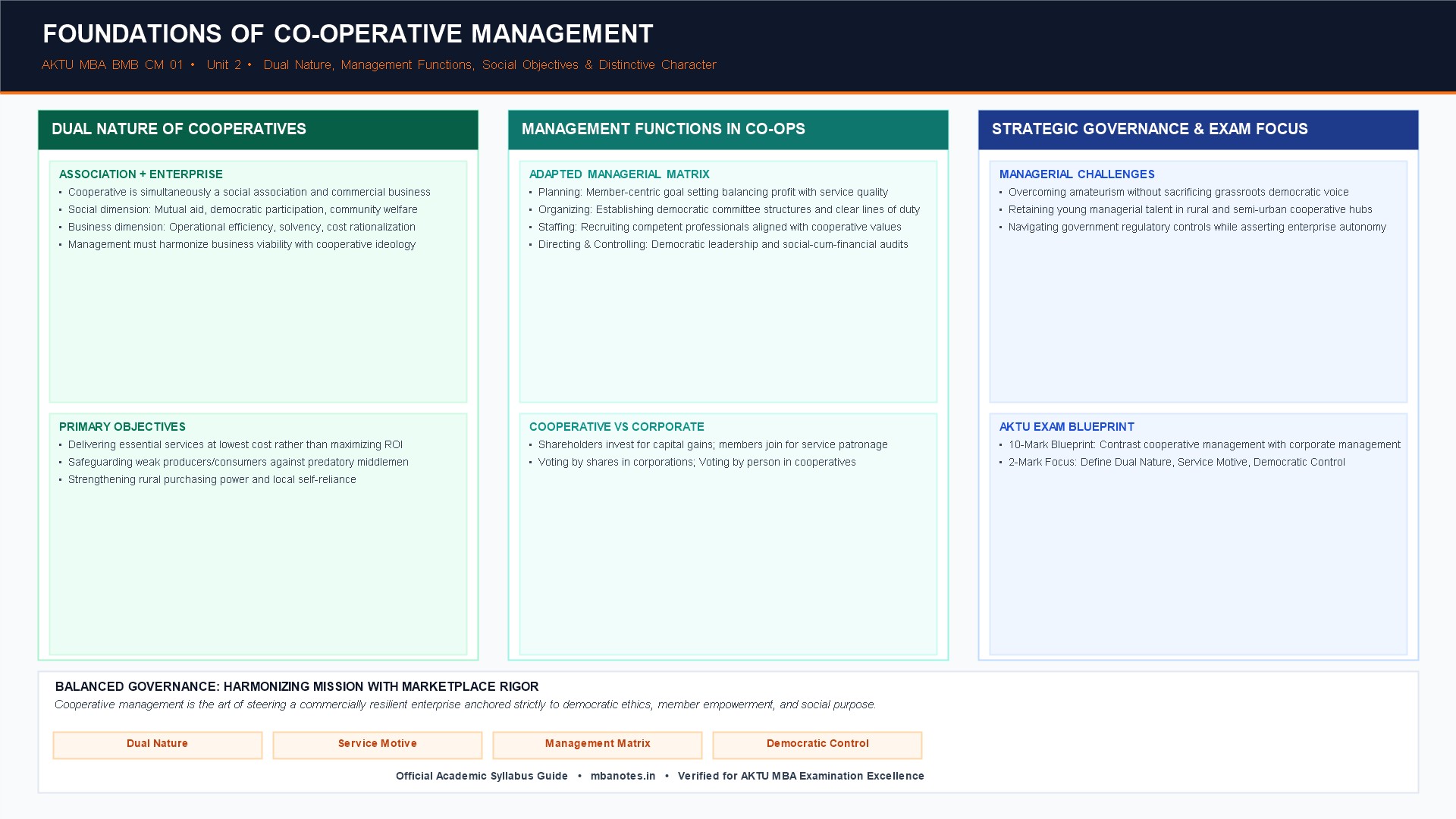
1. Conceptual Definition of Co-operative Management
Co-operative Management is the specialized discipline of coordinating human efforts, financial resources, and physical technology within a democratic, member-owned organizational framework to achieve socioeconomic objectives defined by its member-patrons. Unlike conventional corporate management—which is driven almost exclusively by maximizing equity return (ROE) for external financial investors—cooperative management operates under a dual mandate: maintaining rigorous commercial viability while advancing the welfare and purchasing power of its user-members.
As defined by management theorist Peter Davis, cooperative management is "the practice of management in a values-driven organization based on democratic member participation, collective equity accumulation, and the delivery of cost-effective services."
2. The Dual Nature: Association of Persons vs Commercial Enterprise
The fundamental complexity of managing a cooperative stems from its Dual Character. A cooperative is neither a purely philanthropic NGO nor an ordinary joint-stock company; it is an integrated synthesis of two distinct organizational entities:
1. The Association of Persons (Social Dimension)
A democratic social body where individuals unite voluntarily based on mutual equality, shared community needs, and democratic consensus. Governed by the rule of One Member, One Vote, its priority is member empowerment, human dignity, and solidarity.
2. The Commercial Enterprise (Economic Dimension)
A market-facing business organization that must maintain solvency, generate trading surpluses, control operating overhead, manage inventory, and compete effectively against private corporations. If the enterprise fails commercially, the association collapses.
3. Core Objectives of Cooperative Management
- Delivering Cost-Effective Services: Providing agricultural credit, fertilizers, consumer goods, or milk marketing at lowest sustainable cost or highest farm-gate price.
- Elimination of Middlemen Exploitation: Shielding vulnerable rural producers from speculative trader cartels and usurious moneylenders.
- Democratic Capital Formation: Mobilizing local thrift and small savings into collective productive capital that remains in the community.
- Promotion of Social Justice and Equity: Ensuring that technological advancements and economic gains are distributed equitably without social bias.
4. Adapting Classic Management Functions (POSDCORB)
Luther Gulick’s classical POSDCORB framework operates within cooperatives under democratic and ideological adaptations:
- Planning: Democratic participatory planning where member needs dictate enterprise goals, balancing commercial budgets with social impact metrics.
- Organizing: Establishing clear operational boundaries between the sovereign General Body, policy-making Board, and professional executive CEO.
- Staffing: Recruiting technically competent professionals who possess ideological alignment with cooperative ethos and member empathy.
- Directing: Democratic leadership based on consensus-building rather than authoritarian command.
- Controlling: Dual control systems combining financial audits with statutory administrative inspections and social accountability audits.
5. Distinctive Operational Features: Cooperatives vs Corporate Firms
| Operational Dimension | Joint Stock Corporation | Cooperative Enterprise |
|---|---|---|
| Primary Operating Motive | Maximizing profit for financial shareholders | Maximizing service value for member-patrons |
| Voting Governance | Proportional to shares (Wealth democracy) | Strictly One Member, One Vote (Human democracy) |
| Capital Role | Capital is master; claims residual net profit | Capital is servant; rewarded with limited interest |
| Surplus Distribution | Distributed as dividends per share held | Returned as patronage refund based on usage |
University Examination Question Bank & Model Solutions
Designed as per Dr. A.P.J. Abdul Kalam Technical University (AKTU) MBA Examination Pattern.
Part A: Conceptual 2-Mark Short Answer Questions
Q1 [2 Marks]: Define Cooperative Management.
Ans: The specialized discipline of planning, organizing, directing, and controlling a member-owned enterprise to achieve member service benefits within democratic cooperative values.
Q2 [2 Marks]: What is the 'Dual Nature' of a cooperative society?
Ans: A cooperative is simultaneously a democratic association of persons (social dimension) and a commercial business enterprise (economic dimension).
Q3 [2 Marks]: How does the primary objective of a cooperative differ from a corporation?
Ans: A cooperative aims to maximize service benefits at lowest cost for member-patrons; a corporation aims to maximize financial profit for equity shareholders.
Q4 [2 Marks]: Explain how POSDCORB is adapted in cooperative management.
Ans: Classical functions are modified: Planning is member-participatory, Organizing balances democratic boards with executive CEOs, and Controlling includes social audits.
Q5 [2 Marks]: What is meant by 'Service over Profit'?
Ans: Profit is treated as an operational safety margin rather than the enterprise goal; surplus is returned to members via patronage dividends.
Part B & C: Analytical 10-Mark Detailed Solutions & Regulatory Frameworks
Question 1 [10/15 Marks]: Analyze the Dual Character of cooperatives. How must cooperative managers balance business viability with social ideology?
Model Examination Answer Blueprint:
2. Association of Persons: Democratic equality, human dignity, and voluntary solidarity.
3. Business Enterprise: Solvency, cost control, asset-liability management, and competitive market positioning.
4. Harmonization Challenge: Overcoming the risk of corporate degeneration vs non-profit bankruptcy.
5. Conclusion: Strategic synthesis creating resilient community enterprises.
Question 2 [10/15 Marks]: Compare and contrast Cooperative Management with Corporate Management across 6 structural and operational parameters.
Model Examination Answer Blueprint:
2. Managerial Implications: Stakeholder alignment, democratic consensus, and public transparency.
Strategic Executive Summary: 1. Cooperative Management Objectives & Functions
- Strict AKTU Syllabus Parity: Covers BMB CM 01 Unit 2 Topic 1 comprehensively.
- Management & Governance Rigor: Integrates POSDCORB adaptation, tripartite governance, and professional management models.
- Visual Conceptualization: Illustrated with Figure 2.1 capturing governance hierarchies and operational matrices.
- Examination Readiness: Features 5 Part A 2-mark conceptual questions and 2 comprehensive 10/15-mark university blueprints.
Frequently Asked Questions (Academic & Statutory FAQ)
Q1. What is the core focus of 1. Cooperative Management Objectives & Functions in the AKTU MBA curriculum?
Comprehensive study of cooperative management as a specialized discipline, its dual character (association + enterprise), core management functions, and operational differences from corporate firms. It equips future managers with the organizational principles, governance structures, and professional competencies required to lead cooperative institutions.
Q2. How do practitioners apply these principles in modern cooperative business management?
Executives maintain clear separation of powers between the board and administration, enforce democratic bye-laws, adopt modern Core Banking ERPs, and ensure prudential solvency.
Q3. What are the most frequent examination questions asked from this topic?
AKTU examinations frequently focus on the Dual Nature of cooperatives, tripartite governance diagrams (General Body vs Board vs CEO), bye-law amendment procedures, and the need for professional management.
Discussion & Questions
0 CommentsAcademic insights, questions, and conceptual clarifications from students & faculty.
No questions or comments yet
Have a doubt about this topic, an exam tip, or a conceptual perspective? Start the discussion below!
Leave a Comment / Ask a Question
Your email address will not be published. Required fields are marked *