
Cooperative Constitution & Bye-Laws: Framing, Mandatory Provisions, Amendment Procedures & Statutory Compliance
1. Nature and Legal Status of Cooperative Bye-Laws
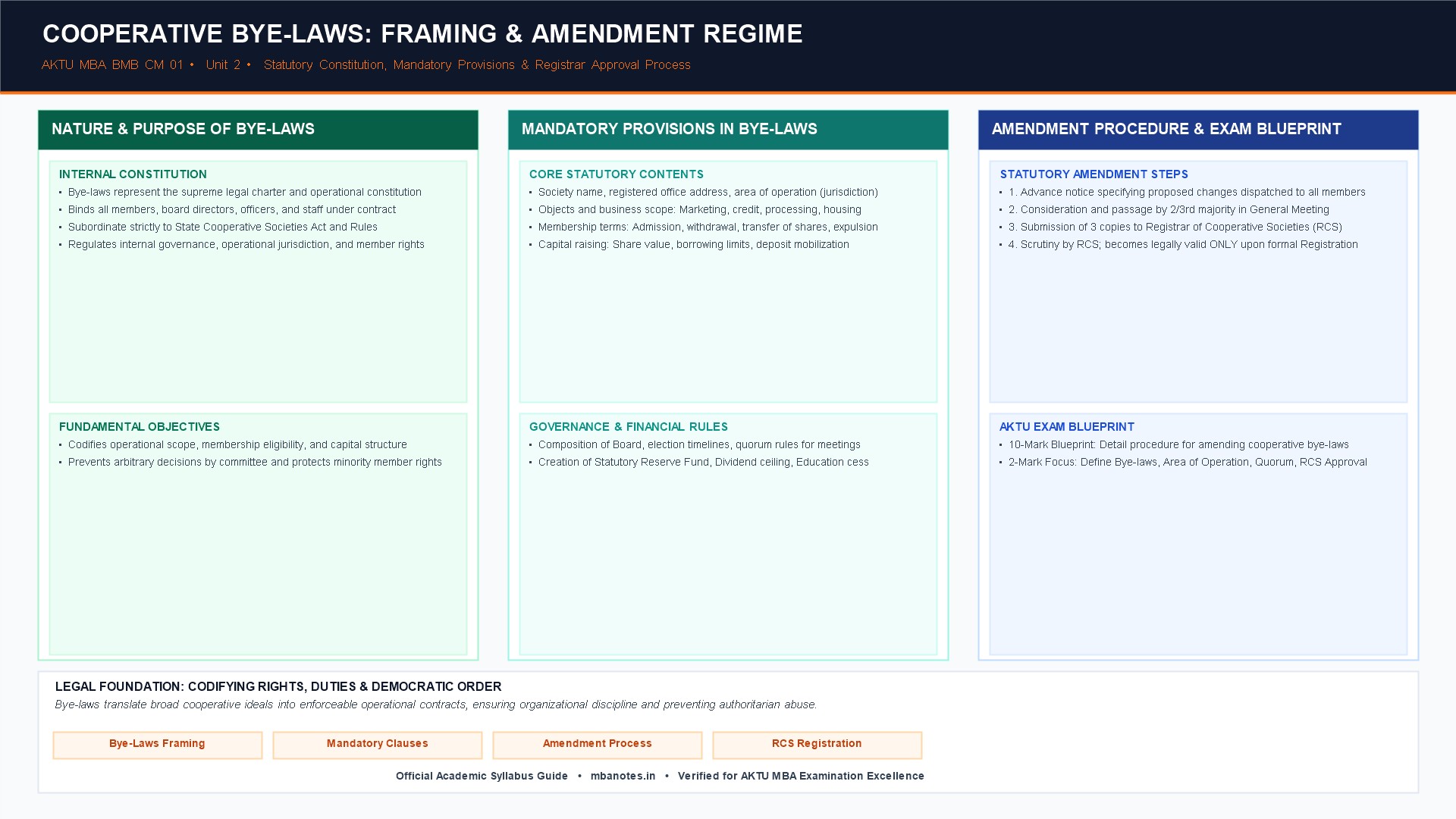
The Bye-laws of a cooperative society constitute its internal constitution and supreme operational code. Legally, bye-laws embody a multilateral statutory contract between the society and its members, as well as among the members themselves. While subordinate to the State Cooperative Societies Act and statutory Rules, bye-laws govern all internal management procedures, member rights, borrowing ceilings, and capital allocation mechanisms.
2. Mandatory Statutory Provisions in Bye-Laws
1. Organizational Identity & Objects
Registered name of society, address of head office, defined geographical area of operation, and explicit primary/secondary business objects.
2. Membership Terms & Voting
Qualifications for admission, share acquisition thresholds, rights and liabilities of members, voting rules, and procedures for resignation or expulsion.
3. Capital Structure & Borrowing
Authorized share capital, value per share, borrowing limits (maximum liability), deposit mobilization rules, and investment avenues under Section 58.
4. Governance & Financial Allocation
Composition of Board, meeting frequencies, quorum mandates, creation of Statutory Reserve Fund (min 25%), dividend limits, and dispute arbitration clauses.
3. Step-by-Step Procedure for Amending Bye-Laws
- Formulation of Proposal: Board of Directors drafts proposed amendment with clear operational justification.
- Mandatory Member Notice: Dispatched with minimum 15 days clear notice to all registered members detailing exact text changes.
- General Body Passage: Must be approved by a two-thirds (2/3rd) majority of members present and voting in a duly convened General Meeting.
- Submission to Registrar: Three copies of the passed resolution, signed by authorized officers, submitted to the Registrar within 30 days.
- Registrar Scrutiny & Certification: The amendment becomes legally valid ONLY upon formal registration and issuance of an amendment certificate by the Registrar.
4. Role and Authority of the Registrar
The Registrar of Cooperative Societies (RCS) possesses statutory duty to verify that proposed amendments do not violate state cooperative law, public policy, or cooperative principles. If an amendment is defective, the Registrar must state written reasons for refusal. In exceptional circumstances, the Registrar can direct a society to amend its bye-laws in the public interest (Direct Amendment).
5. Model Bye-Laws for Multi-Purpose PACS (2022)
In 2022, the Ministry of Cooperation unveiled standardized Model Bye-Laws for Primary Agricultural Credit Societies (PACS). These revolutionary model bye-laws expand the operational mandate of PACS beyond agricultural credit to include over 25 diversified business activities: dairy, fishery, warehousing, custom hiring centers, LPG distribution, petrol pump retail, and Common Services Centers (CSC).
University Examination Question Bank & Model Solutions
Designed as per Dr. A.P.J. Abdul Kalam Technical University (AKTU) MBA Examination Pattern.
Part A: Conceptual 2-Mark Short Answer Questions
Q1 [2 Marks]: What is the legal status of cooperative Bye-laws?
Ans: Bye-laws form a legally binding internal constitution and multilateral contract between the society and its members.
Q2 [2 Marks]: What majority is required in the General Meeting to amend cooperative Bye-laws?
Ans: A two-thirds (2/3rd) majority of members present and voting.
Q3 [2 Marks]: When does an amended bye-law become legally effective?
Ans: Only upon formal registration and issuance of an amendment certificate by the Registrar.
Q4 [2 Marks]: Mention two mandatory provisions that must be included in cooperative Bye-laws.
Ans: 1. Defined area of operation and objects; 2. Membership qualifications and capital structure.
Q5 [2 Marks]: What is the purpose of the 2022 Model Bye-Laws for PACS?
Ans: To transform PACS into multi-purpose economic nodes authorized to conduct over 25 commercial activities.
Part B & C: Analytical 10-Mark Detailed Solutions & Regulatory Frameworks
Question 1 [10/15 Marks]: Detail the procedure for amending cooperative Bye-laws under State Cooperative Societies legislation. What is the role of the Registrar?
Model Examination Answer Blueprint:
2. Step-by-Step Amendment Process: Proposal drafting, 15 days member notice, 2/3rd majority passage, and submission to Registrar within 30 days.
3. Registrar's Scrutiny: Verifying conformity with cooperative principles and state law; written refusal grounds.
4. Direct Amendment Powers: RCS ordering amendments in public interest.
5. Conclusion: Preservation of institutional legality.
Question 2 [10/15 Marks]: Analyze the 2022 Model Bye-Laws for PACS issued by the Ministry of Cooperation. How do they expand the economic viability of village cooperatives?
Model Examination Answer Blueprint:
2. Multi-Purpose Mandate: Authorizing 25+ activities: Dairy, Fishery, Godowns, Petrol Pumps, LPG agencies, and CSC hubs.
3. Modern Governance: Transparent accounting, computerized ERP adoption, and enhanced borrowing limits.
4. Economic Impact: Creating rural employment, diversifying non-interest revenue, and building 'Sahakar Se Samriddhi'.
Strategic Executive Summary: 3. Cooperative Constitution & Bye-Laws Amendments
- Strict AKTU Syllabus Parity: Covers BMB CM 01 Unit 2 Topic 3 comprehensively.
- Management & Governance Rigor: Integrates POSDCORB adaptation, tripartite governance, and professional management models.
- Visual Conceptualization: Illustrated with Figure 2.3 capturing governance hierarchies and operational matrices.
- Examination Readiness: Features 5 Part A 2-mark conceptual questions and 2 comprehensive 10/15-mark university blueprints.
Frequently Asked Questions (Academic & Statutory FAQ)
Q1. What is the core focus of 3. Cooperative Constitution & Bye-Laws Amendments in the AKTU MBA curriculum?
Comprehensive analysis of cooperative bye-laws as the binding internal constitution, required statutory clauses, step-by-step amendment procedures, and the Registrar’s approval regime. It equips future managers with the organizational principles, governance structures, and professional competencies required to lead cooperative institutions.
Q2. How do practitioners apply these principles in modern cooperative business management?
Executives maintain clear separation of powers between the board and administration, enforce democratic bye-laws, adopt modern Core Banking ERPs, and ensure prudential solvency.
Q3. What are the most frequent examination questions asked from this topic?
AKTU examinations frequently focus on the Dual Nature of cooperatives, tripartite governance diagrams (General Body vs Board vs CEO), bye-law amendment procedures, and the need for professional management.
Discussion & Questions
0 CommentsAcademic insights, questions, and conceptual clarifications from students & faculty.
No questions or comments yet
Have a doubt about this topic, an exam tip, or a conceptual perspective? Start the discussion below!
Leave a Comment / Ask a Question
Your email address will not be published. Required fields are marked *