
Agricultural & Dairy Cooperatives in Denmark: Farmers Co-ops, Dairy Federations & Global Export Leadership
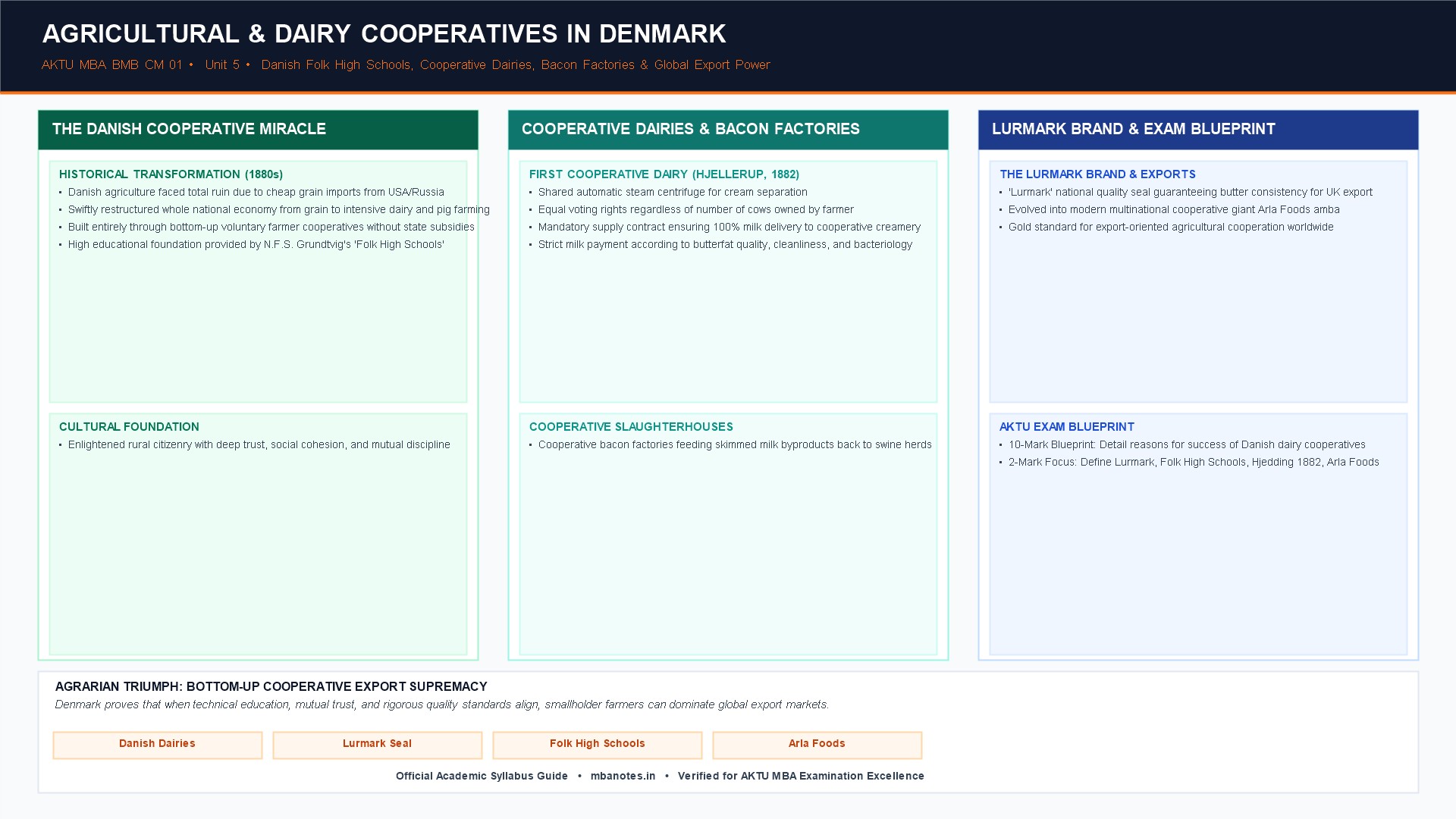
1. The Danish Economic Miracle: From Crisis to World Leadership
In the 1870s, Denmark faced severe economic collapse. Cheap grain from the United States and the Russian steppes flooded European markets, rendering Denmark's traditional grain-export economy entirely unviable.
Instead of seeking state protective tariffs, Danish smallholder farmers executed one of the most brilliant structural pivots in economic history: they converted cheap imported grain into feed for cows and pigs, transitioning rapidly into producers of high-value dairy (butter, cheese) and livestock products (bacon, pork, eggs) for export to the booming British industrial market.
2. The Cultural Catalyst: N.F.S. Grundtvig & Folk High Schools
The foundation of Danish cooperative success was educational rather than bureaucratic. Philosopher N.F.S. Grundtvig established the Folk High Schools (Folkehøjskole) for young rural adults (aged 18–25).
- Civic Enlightenment: Taught Danish literature, national history, songs, and civic ethics—free of formal degrees or examinations.
- Fostering Trust: Developed deep mutual trust, democratic articulation, and collective solidarity among rural youth, who returned to their villages as charismatic organizers of local cooperatives.
3. The Cooperative Dairy Revolution (Andelsmejeri)
In 1882, the world’s first cooperative dairy was established at Hjedding in West Jutland. The adoption of the newly invented steam-driven continuous centrifugal cream separator meant that smallholders pooling their milk could produce butter of uniform, superior quality matching that of aristocratic landed estates.
- Democratic Equality: Voting was conducted on the principle of "One Man, One Vote", regardless of herd size.
- Surplus Distribution: Profits were distributed strictly in proportion to the volume and butterfat content of milk supplied by each member.
- Rapid Scaling: Within 20 years, over 1,000 cooperative dairies covered 80% of Danish dairy production.
4. Bacon Factories, Egg Export Societies & Lurpak Standardization
Following dairy success, Danish farmers organized Cooperative Bacon Factories (Slagterier) in 1887 to utilize skim milk (a dairy byproduct) for pig rearing. To conquer the British breakfast table, Danish cooperatives established rigorous quality control:
- The "Lurmark" (Lurpak) Brand: Introduced in 1901 as a national cooperative quality seal; only butter meeting strict laboratory standards could bear the Lurpak mark.
- Danish Egg Export Association (1895): Instituted individual egg-stamping with the producer’s member number, ensuring total traceability and zero rotten eggs reaching export markets.
5. Structural Peculiarities: Why Denmark Has No Dedicated Cooperative Law
Remarkably, Denmark has no general cooperative law and no state Registrar of Cooperative Societies. Cooperatives operate under general contract law and their own self-drafted democratic bye-laws. This absolute absence of state paternalism proves that when members are educated and trustworthy, cooperatives achieve world-leading commercial efficiency through autonomous self-regulation.
University Examination Question Bank & Model Solutions
Designed as per Dr. A.P.J. Abdul Kalam Technical University (AKTU) MBA Examination Pattern.
Part A: Conceptual 2-Mark Short Answer Questions
Q1 [2 Marks]: Why did Danish agriculture pivot from grain export to livestock in the 1870s?
Ans: Because cheap American and Russian grain flooded Europe, forcing Danish farmers to convert imported grain into animal feed for high-value butter and bacon.
Q2 [2 Marks]: What was the contribution of N.F.S. Grundtvig to the Danish cooperative movement?
Ans: Founding the Folk High Schools (Folkehøjskole), which fostered civic trust, egalitarian values, and leadership among rural youth.
Q3 [2 Marks]: Where and when was the first cooperative dairy (Andelsmejeri) established in Denmark?
Ans: At Hjedding in West Jutland in 1882.
Q4 [2 Marks]: What is the 'Lurpak' (Lurmark) brand and what does it signify?
Ans: A national cooperative quality seal established in 1901 guaranteeing that butter meets stringent laboratory standards for international export.
Q5 [2 Marks]: Does Denmark have a dedicated State Cooperative Societies Act?
Ans: No; Danish cooperatives operate without a special cooperative statute or government Registrar, relying purely on self-drafted democratic contracts.
Part B & C: Analytical 10-Mark Detailed Solutions & Regulatory Frameworks
Question 1 [10/15 Marks]: Explain how Danish farmers executed the historic agricultural transformation from grain production to world-leading dairy and livestock cooperatives.
Model Examination Answer Blueprint:
2. The Structural Pivot: Transforming cheap grain into livestock feed for butter, cheese, bacon, and eggs.
3. Technological Catalyst: The centrifugal cream separator and Hjedding Cooperative Dairy (1882).
4. Industrial Standardization: Lurpak brand, bacon factories, and individual egg stamping.
5. Global Leadership: Becoming Britain's and Europe's premier agricultural exporter.
Question 2 [10/15 Marks]: Discuss the socioeconomic and educational factors behind the success of Danish cooperatives with special reference to Folk High Schools.
Model Examination Answer Blueprint:
2. The Folk High School Ethos: Non-degree residential schools emphasizing national identity, mutual respect, and civic ethics.
3. Organic Trust & Social Capital: Rural youth returning to villages with self-confidence and organizational acumen.
4. Voluntary Self-Regulation: Thriving without government legislation or bureaucratic Registrar oversight.
Strategic Executive Summary: 3. Danish Agricultural & Dairy Cooperatives
- Strict AKTU Syllabus Parity: Covers BMB CM 01 Unit 5 Topic 3 comprehensively.
- Global Comparative Rigor: Integrates German credit models (Raiffeisen & Schulze), British CWS, Swedish KF, Danish dairies, Israeli Kibbutz, and Japanese JA-Zenchu.
- Visual Conceptualization: Illustrated with Figure 5.3 capturing international timelines, organizational frameworks, and comparative matrices.
- Examination Readiness: Features 5 Part A 2-mark conceptual questions and 2 comprehensive 10/15-mark university blueprints.
Frequently Asked Questions (Academic & Statutory FAQ)
Q1. What is the core focus of 3. Danish Agricultural & Dairy Cooperatives in the AKTU MBA curriculum?
Systematic study of Denmark’s world-renowned cooperative revolution: transition from grain to livestock, Folk High Schools (Grundtvig), cooperative dairies (Andelsmejeri), and Lurpak export leadership. It equips future managers with international comparative perspectives and transferable best practices from leading global cooperative economies.
Q2. How did international models directly shape the Indian cooperative movement?
Sir Frederick Nicholson's 1895 recommendation to 'Find Raiffeisen' directly led to the 1904 Co-operative Credit Societies Act, while the Rochdale democratic principles established the voting and surplus distribution rules still used across Indian cooperatives today.
Q3. What are the most frequent examination questions asked from this unit?
AKTU examinations frequently require comparative essays on Raiffeisen vs Schulze-Delitzsch, the monopoly busting strategy of Sweden's KF, the Danish dairy revolution (Lurpak), and international lessons for developing economies.
Discussion & Questions
0 CommentsAcademic insights, questions, and conceptual clarifications from students & faculty.
No questions or comments yet
Have a doubt about this topic, an exam tip, or a conceptual perspective? Start the discussion below!
Leave a Comment / Ask a Question
Your email address will not be published. Required fields are marked *