
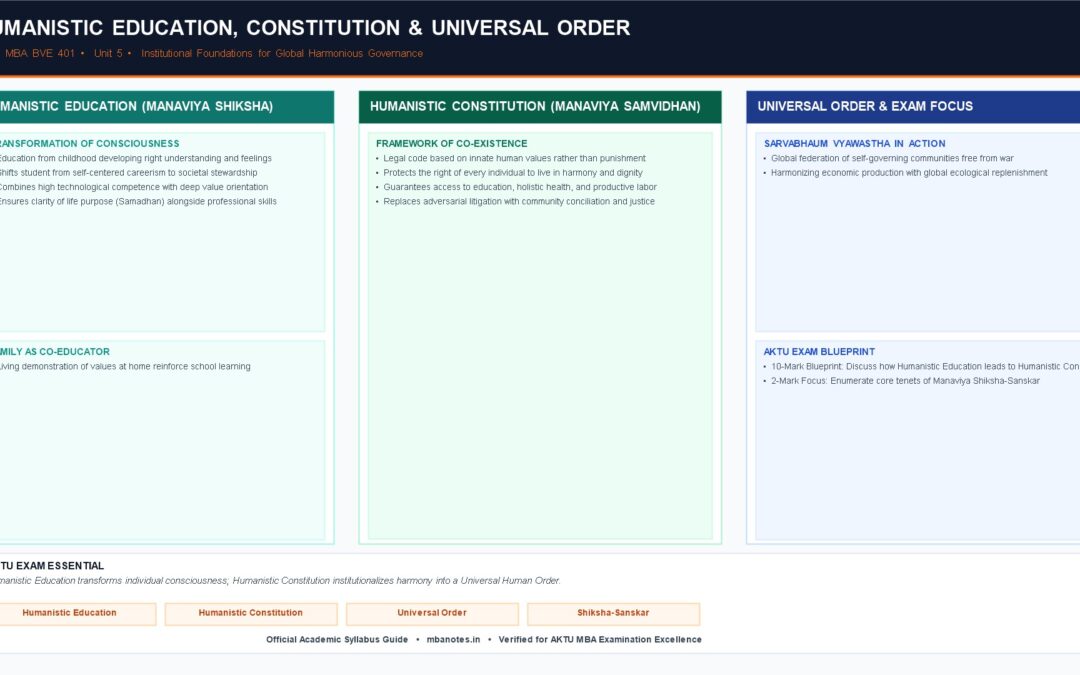
Basis for Humanistic Education, Humanistic Constitution & Universal Order
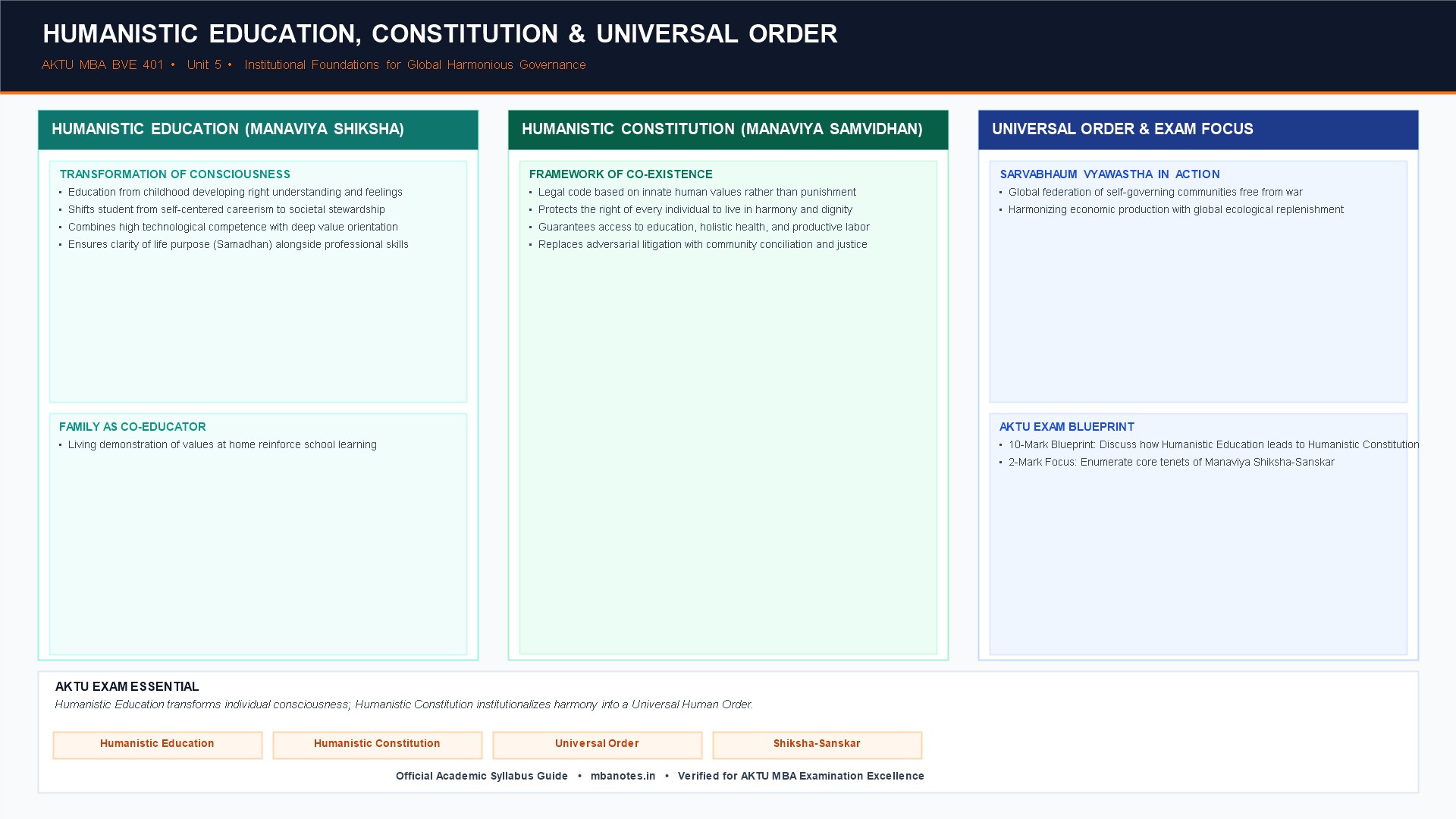
1. The Need for Institutionalization of Values
While individual moral transformation is the essential starting point, values cannot endure across generations unless they are embedded into the societal institutional architecture. If children are taught values at home but enter educational institutions and legal structures that reward cut-throat competition, greed, and exploitation, individual ethics will be constantly undermined.
Therefore, Value Education must culminate in two institutional pillars: Humanistic Education and a Humanistic Constitution, which together support a Universal Human Order.
2. Basis and Vision of Humanistic Education (Manaviya Shiksha)
Humanistic education transforms education from an assembly line producing white-collar economic cogs into a sacred nursery of human wisdom:
- Integration of Values and Skills: Imparts high scientific, mathematical, and technological competence strictly guided by human values and life purpose.
- Development of Human Consciousness: Elevates the child from instinctive animal impulses to conscious self-organization, empathy, and social responsibility.
- Experiential Pedagogy: Replaces rote memorization and competitive grading with inquiry, self-exploration, cooperative problem solving, and hands-on productive labor (Shram).
- Harmony with Nature: Teaches ecology, farming, and renewable resource stewardship from primary grades.
3. Core Tenets of a Humanistic Constitution (Manaviya Samvidhan)
Conventional national constitutions are often patchwork compromises balancing competing corporate lobbies, political factions, and penal punishments. A Humanistic Constitution is built on the universal laws of co-existence:
1. Guarantee of Comprehensive Human Goals
Statutory commitment to ensure Samadhan (Education) in every individual, Samridhi (Livelihood) in every family, Abhay (Justice) in society, and Sah-Astitva (Eco-protection) in nature.
2. Proactive Justice over Retributive Punishment
Replaces adversarial litigation with community mediation and restorative justice aimed at healing relationships and reforming offenders.
3. Ecological Rights of Nature
Constitutional prohibition against technologies and corporate practices that violate cyclical regeneration (Avartansheelta) or cause irreversible biospheric contamination.
4. The Structure of Universal Human Order
The ultimate realization is a bottom-up, decentralized global federation of self-reliant, harmonious village and city republics collaborating through mutual trust rather than nuclear deterrence and economic embargoes.
Strategic Executive Summary: 2. Humanistic Education, Constitution & Order
- Strictly theory-based conceptual framework aligned with Dr. A.P.J. Abdul Kalam Technical University (AKTU) MBA BVE 401 curriculum.
- Explores the definitiveness of ethical human conduct across Values (Mulya), Policy (Niti), and Character (Charitra).
- Details the institutional foundations of Humanistic Education, Humanistic Constitution, and Professional Ethics.
- Synthesizes actionable case studies (Amul, Aravind Eye Care) and a practical transition strategy to a Universal Human Order.
University Examination Question Bank & Model Solutions
Designed as per Dr. A.P.J. Abdul Kalam Technical University (AKTU) MBA Examination Pattern.
Part A: Conceptual 2-Mark Short Answer Questions
Q1 [2 Marks]: Define Humanistic Education (Manaviya Shiksha).
Ans: Humanistic Education is an integrated pedagogical system that imparts technological skills strictly guided by universal human values and life purpose.
Q2 [2 Marks]: What is a Humanistic Constitution (Manaviya Samvidhan)?
Ans: It is a foundational legal code designed to guarantee harmony, mutual fulfillment, restorative justice, and ecological protection across society.
Q3 [2 Marks]: State the primary objective of Manaviya Shiksha-Sanskar.
Ans: To transform human living from Animal Consciousness (greed, survival, sensory dominance) into Human Consciousness (wisdom, mutual fulfillment, harmony).
Part B & C: Analytical 10-Mark Detailed Solutions & Regulatory Frameworks
Question 1
Model Examination Answer Blueprint:
2. Humanistic Education Analyzed: Curriculum, pedagogy, and experiential validation.
3. Humanistic Constitution Analyzed: Guaranteeing comprehensive human goals, restorative justice, and rights of nature.
4. Universal Human Order: Bottom-up global federation of self-governing communities.
Question 2
Model Examination Answer Blueprint:
2. Restorative Systems: Community reconciliation, understanding root causes, Ubhay-Tripti.
3. Societal Impact: Drastic reduction in crime and prison populations.
Frequently Asked Questions (Academic & Examination FAQ)
Q1. How does humanistic education differ from current university degrees?
Current degrees focus almost entirely on market skills to generate income. Humanistic education balances market skills with deep life orientation and social responsibility.
Q2. Does a humanistic constitution abolish private property?
No. It encourages rightful earning (Sva-Dhana) and ownership, while eliminating predatory hoarding and speculative monopolies.
Q3. How can students begin practicing humanistic education today?
By engaging in peer learning, organizing campus sustainability drives, and practicing self-exploration in daily life.
Discussion & Questions
0 CommentsAcademic insights, questions, and conceptual clarifications from students & faculty.
No questions or comments yet
Have a doubt about this topic, an exam tip, or a conceptual perspective? Start the discussion below!
Leave a Comment / Ask a Question
Your email address will not be published. Required fields are marked *