
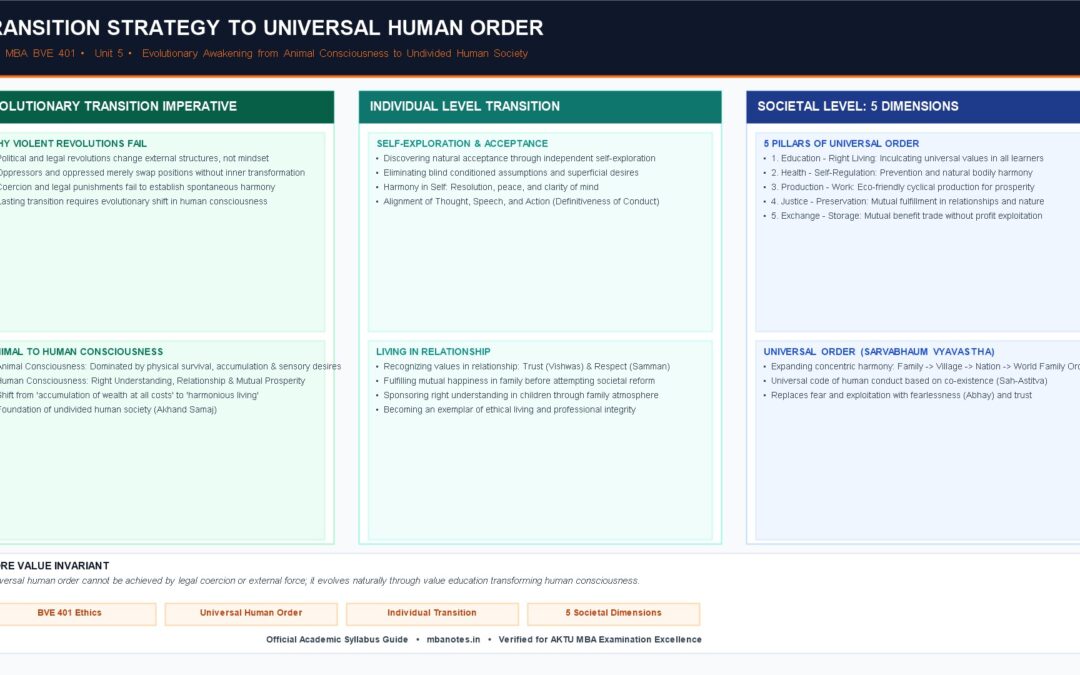
Transition Strategy to Universal Human Order: Individual & Societal Levels

1. The Imperative for an Evolutionary Transition
Human civilization cannot indefinitely sustain its current trajectory of competitive greed, military escalation, and biospheric destruction. Either humanity consciously manages a peaceful transition to a Universal Human Order, or catastrophic ecological collapse and global warfare will force an agonizing reckoning.
The transition roadmap must operate simultaneously on two complementary fronts: The Individual Level (transforming human consciousness) and The Societal Level (transforming institutional systems).
2. Why Violent Revolutions Fail: The Need for Consciousness Shift
History shows that violent political revolutions (e.g. violent overthrows of monarchies or regimes) simply replace one set of corrupt, self-serving rulers with another. If human consciousness remains anchored in greed, fear, and territory (Animal Consciousness), changing the constitution or flag changes nothing fundamental.
The transition to a Universal Human Order must be Educational, Voluntary, and Evolutionary, anchored in the awakening of Manava Chetana (Human Consciousness).
3. Transition Strategy at the Individual Level
Step 1: Committing to Daily Self-Exploration
Regularly verifying desires, thoughts, and habits against Natural Acceptance; shedding blind consumerist conditioning.
Step 2: Right Appraisal of Physical Needs
Calculating definite bodily requirements; adopting voluntary simplicity; stepping off the treadmill of status-driven luxury hoarding.
Step 3: Cultivating Family Harmony
Practicing unconditional trust on others' intention; communicating with affection and respect; resolving domestic complaints through justice.
Step 4: Leading by Living Example
Living with integrity and joy. Authentic living inspires neighbors, peers, and children vastly more than verbal preaching.
4. Transition Strategy at the Societal Level
1. Universalization of Value Education
Mandating Universal Human Values across all primary, secondary, and professional university curricula (as pioneered by AKTU and AICTE).
2. Developing Replicable Model Communities
Creating living demonstrations of sustainable villages and towns practicing organic farming, renewable energy, and cooperative governance.
3. Policy Reformation
Incentivizing cyclical manufacturing, green energy, local cooperatives, and restorative justice while taxing environmental pollution.
5. The Role of MBA Graduates and Engineers in the Transition
MBA graduates and engineers stand at the steering wheel of the global economy. By choosing to build ethical enterprises, design closed-loop products, champion fair wages, and reject corrupt practices, modern professionals are the ultimate vanguard of the Universal Human Order.
Strategic Executive Summary: 6. Transition Strategy: Individual & Societal
- Strictly theory-based conceptual framework aligned with Dr. A.P.J. Abdul Kalam Technical University (AKTU) MBA BVE 401 curriculum.
- Explores the definitiveness of ethical human conduct across Values (Mulya), Policy (Niti), and Character (Charitra).
- Details the institutional foundations of Humanistic Education, Humanistic Constitution, and Professional Ethics.
- Synthesizes actionable case studies (Amul, Aravind Eye Care) and a practical transition strategy to a Universal Human Order.
University Examination Question Bank & Model Solutions
Designed as per Dr. A.P.J. Abdul Kalam Technical University (AKTU) MBA Examination Pattern.
Part A: Conceptual 2-Mark Short Answer Questions
Q1 [2 Marks]: State the two levels of the transition strategy to Universal Human Order.
Ans: 1. Individual Level (transformation of human consciousness), and 2. Societal Level (systemic and policy restructuring).
Q2 [2 Marks]: Why do violent revolutions fail to create a harmonious society?
Ans: Because violent revolutions only alter external political power; if human consciousness remains anchored in greed and fear, the new rulers replicate the same oppression.
Q3 [2 Marks]: State two practical steps for individual transition.
Ans: 1. Regular practice of self-exploration against Natural Acceptance, and 2. Living with Sanyam and correct appraisal of physical needs.
Part B & C: Analytical 10-Mark Detailed Solutions & Regulatory Frameworks
Question 1
Model Examination Answer Blueprint:
2. Individual Roadmap: Self-exploration, clarifying Sukh vs Suvidha, Sanyam, and relationship harmony.
3. Societal Roadmap: Value education in universities, model sustainable villages, and humanistic public policy.
4. Role of Engineers and Managers: Leading green enterprises, refusing corruption, and building high-trust organizations.
5. Conclusion: The dawn of Manava Chetana and Sarvabhaum Vyawastha.
Question 2
Model Examination Answer Blueprint:
2. Campus Ecology: Solar microgrids, zero-waste composting, organic canteens.
3. Relational Culture: Eliminating ragging, fostering mentoring, and mental health peer support.
Frequently Asked Questions (Academic & Examination FAQ)
Q1. How long will it take for humanity to transition to Universal Human Order?
Civilizational shifts take generations. However, individual transformation happens immediately once understanding is awakened, and model communities can be built within years.
Q2. What is the biggest obstacle to this transition?
The inertia of consumerist conditioning and the false assumption that happiness lies in accumulating material luxury.
Q3. How does AKTU's Value Education course contribute to this global transition?
By graduating thousands of ethically grounded, self-aware engineers and managers each year who carry these values into industry and society.
Discussion & Questions
0 CommentsAcademic insights, questions, and conceptual clarifications from students & faculty.
No questions or comments yet
Have a doubt about this topic, an exam tip, or a conceptual perspective? Start the discussion below!
Leave a Comment / Ask a Question
Your email address will not be published. Required fields are marked *