
Comparative Analysis of Business Environment: India and Other Countries
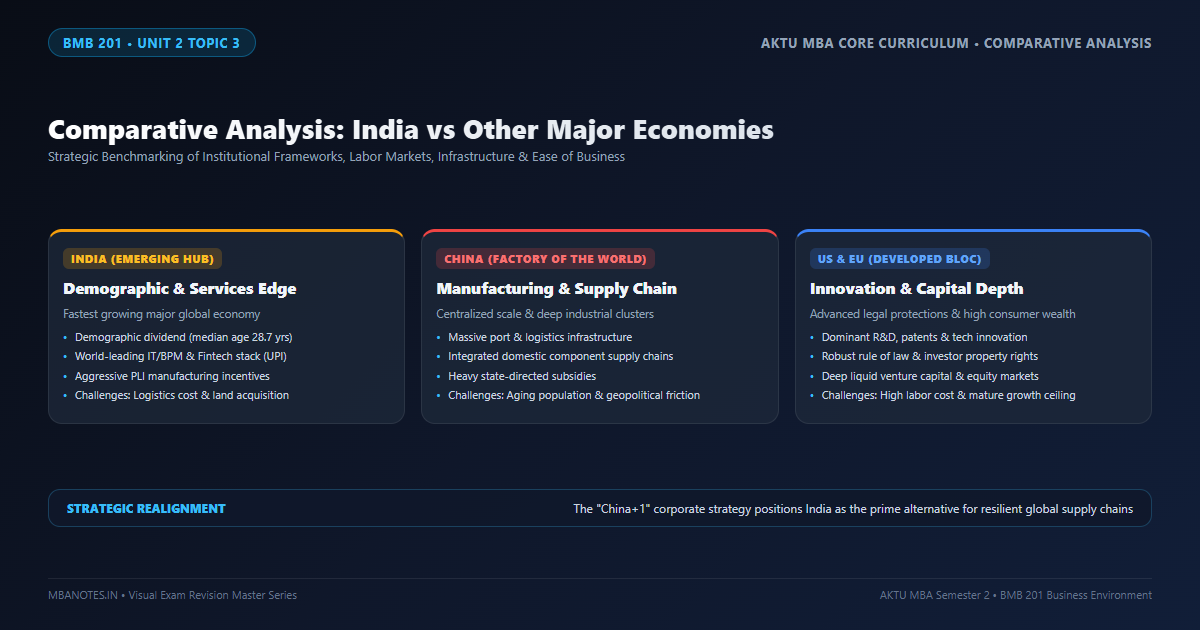
1. Comparative Analytical Dimensions
When multinational enterprises allocate multi-billion-dollar foreign investments, they conduct rigorous comparative environmental audits across four foundational pillars:
Institutional & Regulatory Quality
Transparency of commercial laws, speed of contract enforcement, protection of intellectual property rights, and predictability of corporate taxation.
Factor Endowments & Labor Dynamics
Availability of STEM/engineering talent, wage differentials, labor union rigidity, and demographic trajectory over the next 30 years.
2. Comprehensive Comparative Matrix: India vs. China vs. Western Economies
| Environmental Dimension | India (Emerging Hub) | China (Manufacturing Superpower) | United States & EU (Developed) |
|---|---|---|---|
| Demographic Profile | Median age ~28.7 years; massive expanding workforce dividend. | Median age ~39 years; rapidly aging population and declining birth rates. | Median age >38-42 years; dependent on skilled immigration for talent replenishment. |
| Core Economic Moat | Global IT services, fintech infrastructure, generic pharma, services powerhouse. | Deep integrated industrial component supply chains and massive mega-factories. | Pioneering R&D, advanced semiconductors, venture capital depth, global reserve currency. |
| Infrastructure & Logistics | Rapidly modernizing (Dedicated Freight Corridors, Bharatmala) but logistics costs ~10-12% of GDP. | World-leading high-speed rail, automated deep-sea ports; logistics cost ~8% of GDP. | Mature, highly automated logistics and multimodal air/freight distribution networks. |
| Legal & Governance | Democratic Common Law, independent judiciary, but slow judicial dispute resolution. | One-party state-guided capitalism; swift execution but high political unpredictability. | Rock-solid property rights, rigorous patent protections, swift commercial arbitration. |
3. The "China Plus One" Realignment & India's Strategic Window
Following global supply chain shocks during 2020-2022 and rising geopolitical tensions between Washington and Beijing, multinational corporations adopted the "China+1" diversification strategy. While companies maintain operations in China to serve its domestic market, they establish alternative manufacturing hubs to mitigate operational concentration risk.
India has capitalized on this macro transition through government Production Linked Incentive (PLI) schemes across 14 strategic sectors (mobile phones, semiconductors, auto components, pharma), making India the premier destination for next-generation hardware manufacturing.
4. Critical Bottlenecks Facing India's Business Environment
Despite impressive leaps in corporate tax rationalization (slashed to 22% / 15% for new manufacturing) and digital filing, foreign and domestic investors still cite critical friction points:
- Complex Land Acquisition: Fragmented land records and contentious compensation regimes delaying heavy industrial megaprojects.
- Judicial Delays & Contract Enforcement: Resolving commercial disputes takes an average of over 1,400 days in Indian courts compared to under 400 days in Singapore or the US.
- Regulatory Compliance Density: Sub-national state-level factory inspectorates creating procedural friction for micro and small enterprises.
6. Corporate Case Vignette: Apple's iPhone Manufacturing Shift to India
For over a decade, Apple Inc. assembled over 95% of its iPhones in Zhengzhou and Shenzhen, China. Recognizing excessive geographic vulnerability, Apple aggressively diversified its manufacturing footprint to India via contract manufacturers Foxconn, Pegatron, and Tata Electronics:
- Rapid Production Scaling: In 2021, India manufactured less than 2% of global iPhones; by 2024, India produced over 14% (1 in every 7 iPhones globally), with targets set to reach 25% by 2027.
- Policy Alignment: Apple leveraged India's smartphone Production Linked Incentive (PLI) scheme to offset initial infrastructure disadvantages compared to China.
7. Solved AKTU Previous Years Questions (PYQs)
Q1: What is meant by the 'China Plus One' strategy?
Answer: 'China Plus One' is a global supply chain risk management strategy where multinational enterprises diversify their manufacturing investments outside China into alternative developing economies (such as India, Vietnam, or Mexico) to avoid over-reliance on a single country while maintaining market presence in China.
Q2: Present a comparative analysis of the business environment in India with that of China. What advantages and challenges does India possess in attracting foreign direct investment?
Model Answer Structure for Full 10 Marks:
- Introduction: Define comparative business environment analysis as the empirical benchmarking of institutions, factor costs, and market stability.
- Head-to-Head Comparative Parameters:
- Political & Legal Systems: India's democratic rule of law and intellectual property protections vs. China's centralized state capitalism.
- Demography: India's young median age (28.7 years) and expanding labor pool vs. China's shrinking working-age demographic.
- Infrastructure: China's superior port turnaround and integrated tier-2 component ecosystems vs. India's evolving freight corridors.
- India's Distinct Advantages: Fluent English-speaking engineering talent, digital public infrastructure (UPI/India Stack), geopolitical neutrality, and generous PLI incentives.
- Ongoing Challenges for India: Complex land acquisition rules, bureaucratic compliance layers, and power/logistics tariffs.
- Conclusion: Summarize that ongoing reforms position India as the most viable long-term counterweight to China.
Discussion & Questions
0 CommentsAcademic insights, questions, and conceptual clarifications from students & faculty.
No questions or comments yet
Have a doubt about this topic, an exam tip, or a conceptual perspective? Start the discussion below!
Leave a Comment / Ask a Question
Your email address will not be published. Required fields are marked *