
Business Environment with Reference to Global Integration
1. Understanding Global Integration in the Business Environment
Global Integration refers to the economic process whereby distinct national markets, cultures, and supply chains become interconnected into an interdependent worldwide economic system. In a globally integrated environment, goods, services, capital, technology, and labor flow across national boundaries with minimal friction.
For domestic enterprises, global integration transforms the business environment from a closed, protected sanctuary into an open, highly contested arena where domestic firms face world-class foreign multinationals at home while simultaneously gaining access to overseas consumer markets.
2. The Four Fundamental Drivers of Global Integration
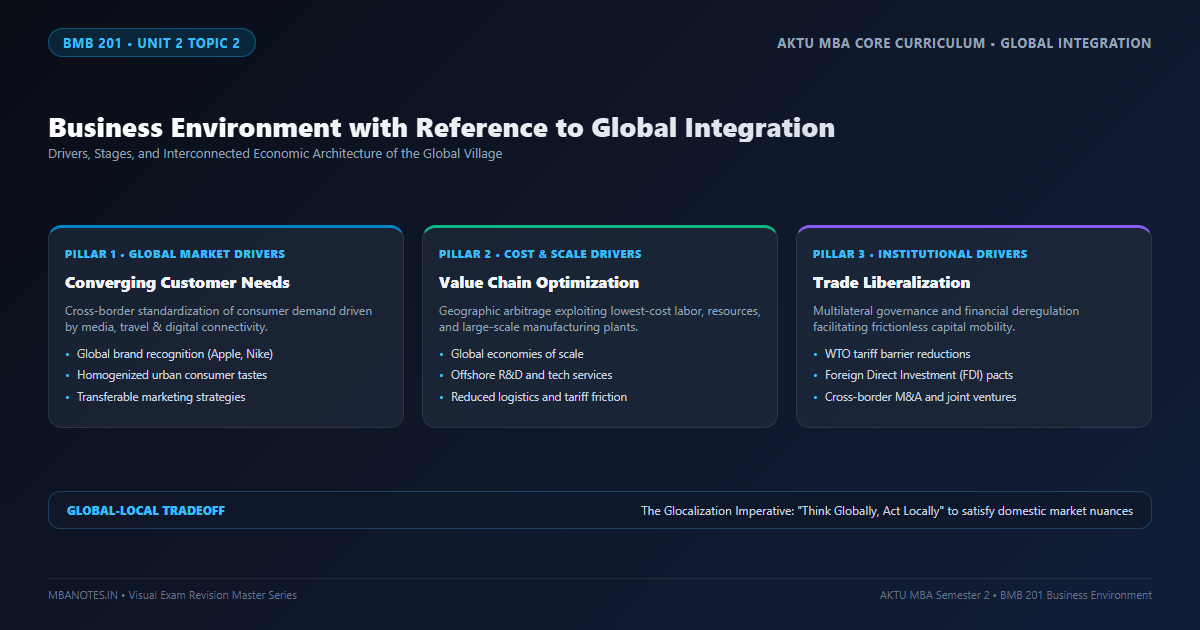
According to George Yip's classic globalization framework, four distinct environmental vectors compel industries toward global integration:
1. Market Drivers
- Convergence of consumer lifestyles across global urban centers (smartphones, athleisure, streaming entertainment).
- Global customer accounts demanding standardized worldwide supply contracts.
- Transferable marketing channels (YouTube, Instagram, search engines).
2. Cost Drivers
- Push for economies of scale exceeding single-country domestic absorption capacity.
- Labor and resource cost arbitrage (e.g. software development in India, hardware assembly in East Asia).
- High R&D amortization demands (pharmaceutical molecule trials, microchip fabrication).
3. Government Drivers
- Reduction of tariff walls under World Trade Organization (WTO) accords.
- Dismantling of foreign ownership caps and liberalized Foreign Direct Investment (FDI) policies.
- Harmonization of technical standards and intellectual property protections (TRIPS).
4. Competitive Drivers
- High cross-border trade intensity where competitors export directly into each other's home turfs.
- Emergence of global competitors utilizing global cash flows to subsidize entry into new regional markets.
3. Global Integration vs. Local Responsiveness (The Glocalization Paradigm)
MNEs face a fundamental tension formulated in the Bartlett & Ghoshal model: the pressure for global integration (cost reduction through global product standardization) versus the pressure for local responsiveness (adapting products to meet unique local tastes and domestic regulatory mandates).
4. Impact of Global Integration on Indian Enterprises
- Global market access for Indian IT (TCS, Infosys) and pharmaceutical generic exporters (Sun Pharma, Dr. Reddy's).
- Inflow of modern advanced production technologies and global venture capital.
- Upgradation of Indian manufacturing quality to achieve ISO/Six Sigma standards.
- Vulnerability to cheap subsidized imports (e.g. Chinese solar cells and steel).
- Acquisition of venerable Indian domestic brands by global giants (e.g. Thums Up sold to Coca-Cola).
- Immediate transmission of international financial contagion and commodity inflation.
6. Corporate Case Vignette: Tata Motors' Reverse Global Integration (JLR Acquisition)
In 2008, Tata Motors acquired the struggling British luxury marquees Jaguar and Land Rover (JLR) from Ford for $2.3 billion. Rather than being disrupted by global integration, Tata utilized global capital markets and cross-border engineering to reverse the flow of corporate control:
- Technological Spillover: Tata leveraged JLR's world-class chassis engineering and aluminum lightweighting to radically upgrade its domestic Indian passenger vehicle lineup (Harrier, Safari).
- Global Market Diversification: JLR gave Tata immediate high-margin revenue exposure across China, North America, and continental Europe, insulating the group from Indian domestic economic downturns.
7. Solved AKTU Previous Years Questions (PYQs)
Q1: What is 'Glocalization'? Explain with an example.
Answer: Glocalization is a business strategy where a multinational firm combines global operational scale and brand positioning with local cultural, culinary, or regulatory customization ("Think Globally, Act Locally").
Example: Domino's Pizza maintaining its standard global delivery infrastructure in India while introducing paneer tikka and spicy peri-peri toppings tailored to regional palates.
Q2: Explain the drivers of global integration. How has the integration of the Indian economy with global markets reshaped domestic business strategies?
Model Answer Structure for Full 10 Marks:
- Introduction: Define Global Integration and the transition from isolated domestic markets to interconnected borderless economic flows.
- Drivers of Globalization (Yip's Framework): Detail Market Drivers (standardized consumer needs), Cost Drivers (economies of scale, wage differentials), Government Drivers (tariff cuts, WTO norms), and Competitive Drivers (global interdependence).
- Impact on Indian Corporate Strategy:
- Shift from Cost Center to Innovation Hub: Evolution of Indian IT and GCCs (Global Capability Centers) from cheap coding shops to strategic AI/Cloud design centers.
- Quality and Supply Chain Modernization: Automotive component makers (e.g. Bharat Forge) integrating into European and US OEM supply networks.
- Competitive Defense against Influx: Domestic retail giants (Reliance Retail, DMart) scaling hyper-efficient physical networks to counter Amazon and Walmart-Flipkart.
- Conclusion: Summarize that integration requires continuous productivity improvements and agile risk management.
Discussion & Questions
0 CommentsAcademic insights, questions, and conceptual clarifications from students & faculty.
No questions or comments yet
Have a doubt about this topic, an exam tip, or a conceptual perspective? Start the discussion below!
Leave a Comment / Ask a Question
Your email address will not be published. Required fields are marked *