
Cooperative Education, Training & Research: NCUI, VAMNICOM, ICMs, RICMs & Human Resource Development Architecture
1. Why Cooperative Education is the Lifeblood of the Movement
As cooperative visionary Dr. Mauritz Bonow famously observed, "If the cooperative movement does not educate its members and train its managers, it will surely die." Unlike capitalistic firms where passive financial investment suffices, cooperatives require active, informed, and ethically committed member-owners alongside highly competent professional managers.
To operationalize the 5th ICA Principle ("Education, Training, and Information"), India has developed one of the world’s most extensive institutional infrastructures for cooperative human resource development.
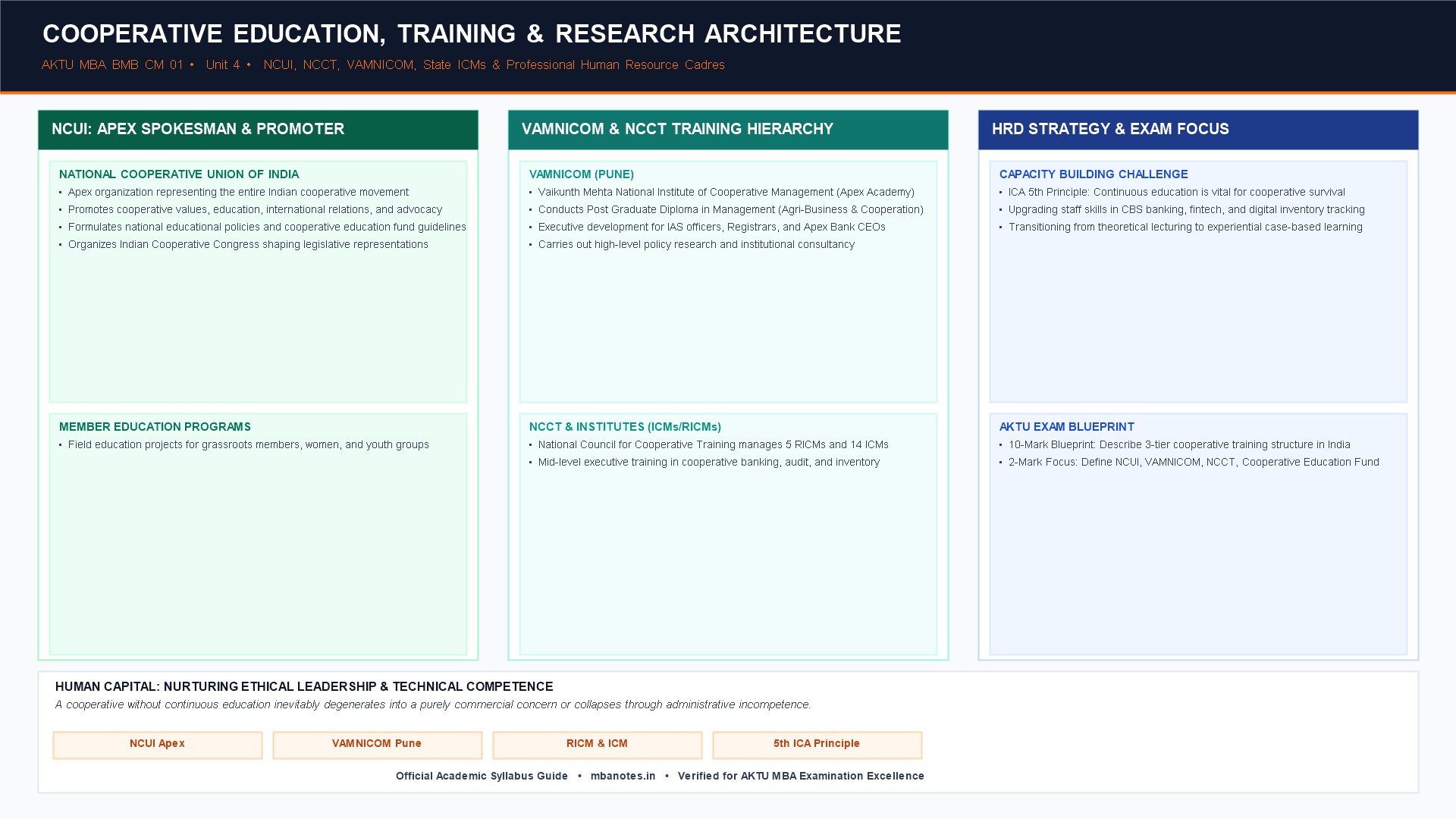
2. National Cooperative Union of India (NCUI): Apex Leadership
Originally founded in 1929 as the All India Co-operative Institutes Association and rechristened as NCUI in 1961, it represents the entire Indian cooperative movement internationally and domestically.
- Advocacy & Policy Liaison: Acts as the single voice of Indian cooperatives before the Union Government, Planning Bodies, and International Cooperative Alliance (ICA).
- Field Education Projects (CEPs): Runs over 40 Cooperative Education Field Projects in underdeveloped districts, training women self-help groups, youth, and artisanal cooperatives.
- NCUI Haat: Provides free marketing and exhibition stalls to grassroots cooperative artisans and women entrepreneurs at its Delhi headquarters.
3. VAMNICOM, Pune: The Apex Training & Research Institute
The Vaikunth Mehta National Institute of Cooperative Management (VAMNICOM), situated in Pune, Maharashtra, is the national center of excellence for cooperative training, policy research, and executive education.
- Genesis: Named after the legendary cooperative thinker Vaikunth Lallubhai Mehta, established in 1967 through the merger of the Central Cooperative Training College and the National Cooperative Research Institute.
- Programs: Offers the flagship AICTE-approved Post Graduate Diploma in Management (Agri-Business Management), along with in-service leadership development courses for IAS officers, RCS registrars, DCCB Managing Directors, and apex federation executives.
- Applied Research: Conducts diagnostic studies, policy evaluations, and capacity audits commissioned by RBI, NABARD, and the Union Ministry of Cooperation.
4. National Council for Cooperative Training (NCCT) & The ICM/RICM Grid
To ensure structured training delivery across all states, the National Council for Cooperative Training (NCCT) operates a three-tier vertical network:
| Tier | Institutional Entity | Target Audience & Course Profile |
|---|---|---|
| National Apex Tier | VAMNICOM (Pune) | Senior executives, IAS/RCS officers, CEOs of State Co-op Banks, PGDM-ABM students. |
| Regional Tier (5 Institutes) | Regional Institutes of Cooperative Management (RICMs: Chandigarh, Bengaluru, Kalyani, Gandhinagar, Patna) | Middle-level officers, Branch Managers of DCCBs, Joint/Deputy Registrars, HDCM diploma programs. |
| State / Sub-Regional Tier (14 Institutes) | Institutes of Cooperative Management (ICMs: Lucknow, Dehradun, Bhopal, Jaipur, Guwahati, etc.) | Junior cooperative executives, Assistant Registrars, Cooperative Inspectors, PACS Secretaries. |
5. Modernizing Cooperative Pedagogy: Emerging HRD Challenges
To keep pace with the ongoing computerization of 63,000 PACS, the training curriculum is undergoing sweeping reforms: transitioning from manual ledger keeping to ERP workflows, Core Banking Systems (CBS), cyber security protocols, and digital marketing.
University Examination Question Bank & Model Solutions
Designed as per Dr. A.P.J. Abdul Kalam Technical University (AKTU) MBA Examination Pattern.
Part A: Conceptual 2-Mark Short Answer Questions
Q1 [2 Marks]: What is the 5th Principle of the International Cooperative Alliance (ICA)?
Ans: 'Education, Training, and Information' for members, elected representatives, managers, and employees.
Q2 [2 Marks]: Where is VAMNICOM located and what is its primary role?
Ans: Located in Pune, Maharashtra; it is the national apex institute for cooperative executive training, policy research, and PGDM (Agri-Business Management).
Q3 [2 Marks]: What is the full form of NCUI and when was it established?
Ans: National Cooperative Union of India, originally founded in 1929 and rechristened in 1961.
Q4 [2 Marks]: Name the apex body that oversees Regional and State Institutes of Cooperative Management (RICMs & ICMs).
Ans: National Council for Cooperative Training (NCCT).
Q5 [2 Marks]: What does the Higher Diploma in Cooperative Management (HDCM) train personnel for?
Ans: Middle-level administrative and managerial roles in DCCBs, marketing societies, and cooperative departments.
Part B & C: Analytical 10-Mark Detailed Solutions & Regulatory Frameworks
Question 1 [10/15 Marks]: Discuss the institutional architecture of cooperative education, training, and research in India with special reference to NCUI, VAMNICOM, and NCCT.
Model Examination Answer Blueprint:
2. NCUI Apex Role: Advocacy, international representation, and Cooperative Education Field Projects.
3. VAMNICOM (Pune): Executive programs, PGDM-ABM, and high-level applied research.
4. NCCT Training Network: 5 RICMs and 14 ICMs delivering functional diplomas and ERP certifications.
5. Modern Pedagogical Shifts: Core Banking Systems (CBS) and cloud ERP training for 63,000 PACS.
Question 2 [10/15 Marks]: Evaluate the contemporary challenges facing cooperative human resource management in India and suggest strategic solutions.
Model Examination Answer Blueprint:
2. Technological Skills Gap: Transitioning from manual books to cloud ERP and digital banking.
3. Recommended HR Interventions: Specialized cadre creation, campus recruitment from VAMNICOM/ICMs, performance bonuses.
4. Institutional Capacity Building: Mandatory leadership development for elected board directors.
Strategic Executive Summary: 3. Cooperative HRD: NCUI, VAMNICOM & Training Network
- Strict AKTU Syllabus Parity: Covers BMB CM 01 Unit 4 Topic 3 comprehensively.
- Institutional & Commercial Rigor: Integrates apex developmental bodies (NABARD, NCDC, NDDB), commercial giants (IFFCO, AMUL, NAFED), and HRD networks.
- Visual Conceptualization: Illustrated with Figure 4.3 capturing institutional frameworks and operational matrices.
- Examination Readiness: Features 5 Part A 2-mark conceptual questions and 2 comprehensive 10/15-mark university blueprints.
Frequently Asked Questions (Academic & Statutory FAQ)
Q1. What is the core focus of 3. Cooperative HRD: NCUI, VAMNICOM & Training Network in the AKTU MBA curriculum?
Systematic analysis of India’s cooperative education and training framework: NCUI at the apex, VAMNICOM’s national leadership programs, Regional and State Institutes of Cooperative Management (RICMs & ICMs). It equips future managers with deep knowledge of national promotional agencies, commercial cooperative giants, and movement culture.
Q2. How do practitioners leverage apex institutions like NABARD and NCDC?
Executives utilize NABARD for concessional credit refinancing and KCC limits, while tapping NCDC for term loans to construct godowns, cold storages, and processing plants.
Q3. What are the most frequent examination questions asked from this unit?
AKTU examinations frequently ask for comparative studies of NABARD vs NCDC, Operation Flood and the Anand pattern, IFFCO's Nano Urea innovations, and the All India Cooperative Week themes.
Discussion & Questions
0 CommentsAcademic insights, questions, and conceptual clarifications from students & faculty.
No questions or comments yet
Have a doubt about this topic, an exam tip, or a conceptual perspective? Start the discussion below!
Leave a Comment / Ask a Question
Your email address will not be published. Required fields are marked *