
Framing Effects, Richard Thaler's Mental Accounting, and Lola Lopes' SP/A Theory
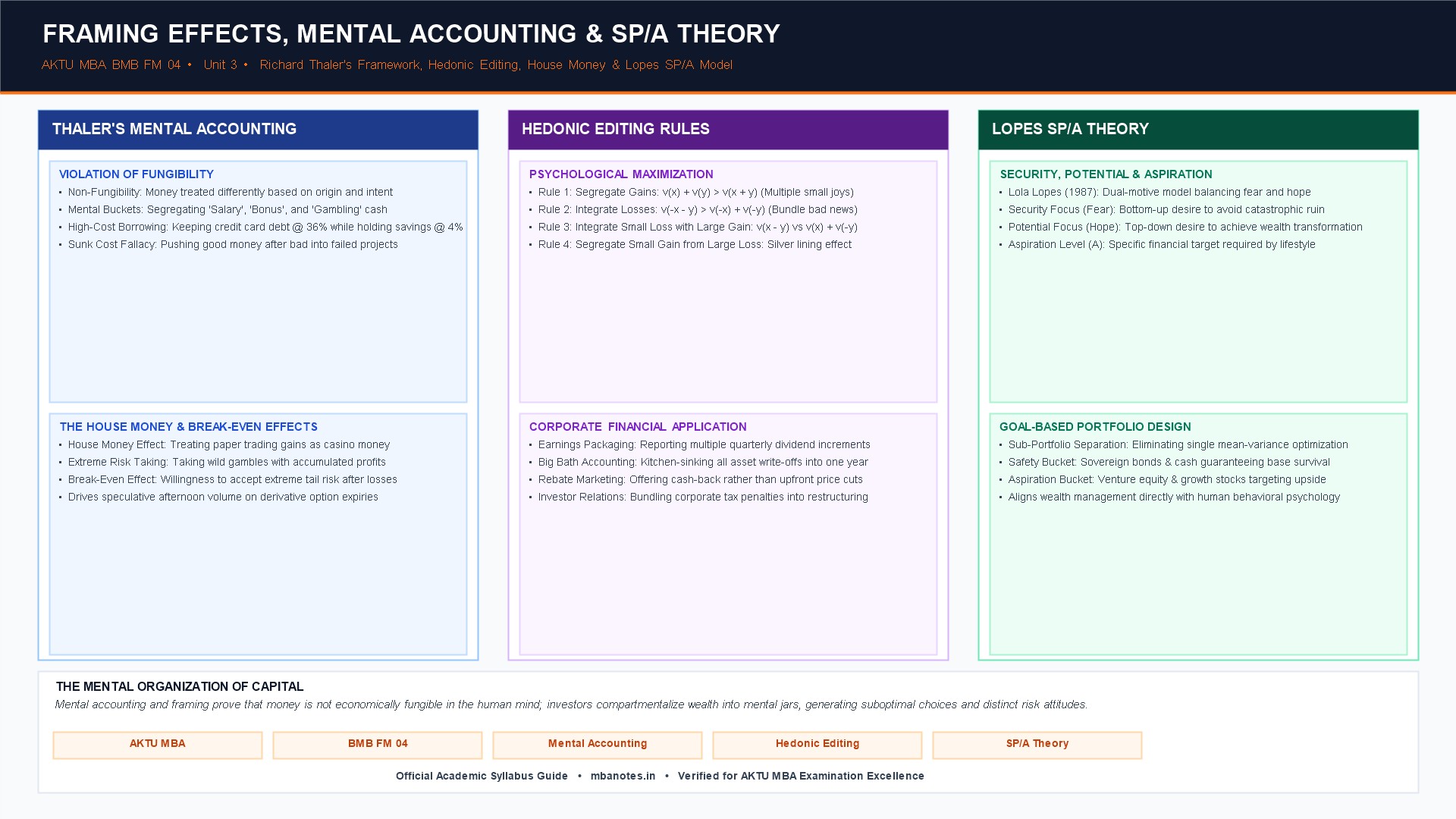
Figure 3.2: Mental Accounting Mechanics – Fungibility Violations, Hedonic Editing Rules, and the Lopes Security-Potential-Aspiration Model.
1. Framing Effects & The Collapse of Money Fungibility
In classical finance, money is universally fungible: an Indian Rupee earned from an arduous 60-hour work week is economically identical to a Rupee won in a poker game, received as a tax refund, or earned via corporate dividends. Neoclassical finance assumes that rational agents pool all wealth into a single unified ledger and optimize global consumption.
However, Framing Effects (Tversky & Kahneman, 1981) prove that the manner in which an economic problem is presented dramatically alters decision-making. People respond completely differently to identical mathematical payoffs depending on whether the transaction is framed as a “gain” or a “discount” versus a “loss” or a “surcharge.”
2. Richard Thaler’s Mental Accounting Framework
Nobel laureate Richard Thaler formalized Mental Accounting as the cognitive operations used by individuals and households to organize, evaluate, and keep track of financial activities. Mental accounting operates through three primary mechanisms:
| Mental Accounting Element | Cognitive Mechanism | Financial Market Application |
|---|---|---|
| Non-Fungibility of Accounts | Compartmentalizing money into strict categories based on source (regular income vs bonus windfall) or intended use (kid’s education vs vacation). | Keeping INR 5 Lakh in a low-interest savings account (earning 3%) while carrying credit card debt of INR 2 Lakh (costing 42% interest). |
| House Money Effect | Treating prior accumulated capital gains as separate, expendable funds rather than one’s own hard-earned wealth. | Day traders taking reckless speculative bets on penny stocks after a lucky early-morning gain, risking total capital. |
| Sunk Cost & Transaction Utility | Evaluating purchases by Acquisition Utility (value of good vs price) and Transaction Utility (perceived deal quality: price paid vs reference price). | Buying useless financial products simply because they were offered at an “80% festival discount” or with a free gift voucher. |
3. Hedonic Editing & Lola Lopes’ SP/A Theory
Thaler proposed that individuals naturally engage in Hedonic Editing — mentally combining or separating multiple financial events to maximize psychological utility:
- Segregate Gains: Because the value function is concave ($v”(x) < 0$), two distinct small gains produce more happiness than one large combined gain: $v(x) + v(y) > v(x + y)$. (e.g., winning INR 5,000 today and INR 5,000 tomorrow feels better than winning INR 10,000 once).
- Integrate Losses: Because the value function is convex in losses ($v”(x) > 0$), combining multiple losses into a single lump sum minimizes pain: $v(-(x + y)) > v(-x) + v(-y)$. (e.g., receiving one consolidated bill of INR 10,000 hurts less than ten separate INR 1,000 bills).
- Integrate Small Losses with Large Gains: Offsetting a small loss against a large gain eliminates loss aversion through the cancellation effect: $v(x – y) > v(x) + v(-y)$ where $x > y$.
- Segregate Small Gains from Large Losses (Silver Lining): Finding a small positive rebate or discount amidst a large loss provides a distinct psychological relief: $v(y) + v(-x) > v(y – x)$ where $x gg y$.
Lola Lopes’ SP/A Theory
In 1987, psychologist Lola Lopes formulated Security-Potential / Aspiration (SP/A) Theory. Lopes argued that risk preferences are governed by two distinct psychological criteria: the balance between the desire for Security (avoiding disaster) and the search for Potential (chasing riches), bounded by a personal Aspiration Level (a target benchmark such as buying a house or retiring comfortably). Investors choose portfolios that satisfy their survival security needs first before allocating residual wealth to aspirational lottery bets.
4. Mathematical Model, Hedonic Editing Formulations & Worked Problem
We formalize the mathematical equations governing Hedonic Editing and quantify the psychological utility differences between segregated and integrated cash flows.
Mathematical Formulation: Hedonic Editing Utility Optimization
Where:
- $x_1, x_2$: Independent positive cash flow events (gains).
- $y_1, y_2$: Independent negative cash flow events (losses).
- $Delta U_{\text{Segregation}}$: Net psychological welfare differential achieved by cognitive restructuring.
Step-by-Step Worked Numerical Problem: Quantifying Hedonic Editing Welfare
Problem Statement: An equity investor experiences two distinct financial events on the same trading day:
- Event 1: Stock Alpha declares a special dividend of $ ext{INR } 40,000$.
- Event 2: Stock Beta declares a bonus share dividend with cash equivalent of $ ext{INR } 60,000$.
Using the standard Kahneman-Tversky value function $v(x) = x^{0.88}$ for gains:
- Calculate the subjective psychological utility if the two dividend gains are evaluated separately (Segregated): $U_{\text{seg}} = v(40,000) + v(60,000)$.
- Calculate the subjective utility if the investor mentally combines them into a single integrated lump-sum of INR 1,00,000: $U_{\text{int}} = v(1,00,000)$.
- Determine whether segregation or integration yields higher psychological satisfaction, and compute the Hedonic Surplus ($Delta U$).
- Now suppose the investor experiences two investment losses: Loss 1 = $- ext{INR } 40,000$ and Loss 2 = $- ext{INR } 60,000$ (with $v(-y) = -2.25 y^{0.88}$). Calculate whether integrating or segregating the losses minimizes psychological pain.
Step 1: Compute Utility of Segregated Gains
\[ v(40,000) = (40,000)^{0.88} = 11,213.13 \text{ utils} \] \[ v(60,000) = (60,000)^{0.88} = 15,992.83 \text{ utils} \] \[ U_{\text{seg}} = v(40,000) + v(60,000) = 11,213.13 + 15,992.83 = \mathbf{+27,205.96 \text{ utils}} \]Step 2: Compute Utility of Integrated Gain
\[ U_{\text{int}} = v(40,000 + 60,000) = v(1,00,000) = (1,00,000)^{0.88} = \mathbf{+25,118.86 \text{ utils}} \]Step 3: Compare Gains & Determine Hedonic Surplus
\[ \Delta U_{\text{Gains}} = U_{\text{seg}} – U_{\text{int}} = 27,205.96 – 25,118.86 = \mathbf{+2,087.10 \text{ utils}} \]Because the value function is concave, segregating gains increases happiness by 8.3%! Corporate finance departments exploit this by issuing quarterly dividends rather than a single annual dividend.
Step 4: Evaluate Segregated vs Integrated Losses
- Segregated Losses: \[ v(-40,000) = -2.25 \times 11,213.13 = -25,229.54 \text{ utils} \] \[ v(-60,000) = -2.25 \times 15,992.83 = -35,983.87 \text{ utils} \] \[ U_{\text{loss, seg}} = -25,229.54 + (-35,983.87) = \mathbf{-61,213.41 \text{ utils}} \]
- Integrated Loss: \[ U_{\text{loss, int}} = v(-1,00,000) = -2.25 \times 25,118.86 = \mathbf{-56,517.44 \text{ utils}} \]
Integrating the two losses into a single consolidated deduction eliminates 4,696 utils of psychological trauma. Investors prefer experiencing bad news all at once (the corporate “kitchen sink” write-down strategy).
6. Corporate Case Vignette: Dividend Cash Preference vs Capital Gains
Corporate Case Vignette: Why Retail Investors Demand Cash Dividends
Under Miller and Modigliani’s (1961) Dividend Irrelevance Theorem, in frictionless capital markets, corporate dividend policy does not affect shareholder value: an investor needing cash can simply sell a tiny fraction of their shares (“homemade dividend”), which is mathematically identical to receiving a cash dividend.
Yet in real capital markets, public shareholders exhibit an intense, irrational preference for cash dividends over share buybacks, often choosing high-dividend PSU stocks that underperform the broader market.
The Behavioral Explanation: As proven by Shefrin and Statman (1984), retail investors rely on mental accounting rules to control spending impulses: “Live off the dividends, never touch the principal.” Selling shares to generate cash feels like a traumatic impairment of the primary capital account (triggering loss aversion), whereas spending dividend cash feels like consuming disposable income from a free current account. Mental accounting completely overrides Modigliani-Miller financial logic.
7. AKTU Exam Drill: 2-Mark & 10-Mark University Questions
Short-Answer Conceptual Checkpoints
Q1: Define Mental Accounting in the words of Richard Thaler.
Answer: Mental accounting is the set of cognitive operations used by individuals and households to organize, evaluate, and track financial activities into separate, non-fungible mental accounts.
Q2: State the principle of Money Fungibility and explain why mental accounting violates it.
Answer: Fungibility states that all money is interchangeable regardless of its source or location; mental accounting violates this by treating money differently based on its origin (e.g., bonus vs salary).
Q3: What are the two core rules of Hedonic Editing for gains and losses?
Answer: 1) Segregate multiple gains to maximize utility: $v(x) + v(y) > v(x+y)$; 2) Integrate multiple losses to minimize pain: $v(-(x+y)) > v(-x) + v(-y)$.
Q4: What is the ‘House Money Effect’?
Answer: The behavioral tendency where an investor who has accumulated prior profits gambles more recklessly, treating gains as the ‘house’s money’ rather than their own hard-earned capital.
Q5: What do the letters S, P, and A stand for in Lola Lopes’ SP/A Theory?
Answer: Security (desire to avoid severe loss), Potential (desire to achieve major gains), and Aspiration (a specific financial wealth target benchmark).
In-Depth Analytical & Long-Answer Questions
Q6: Critically analyze Richard Thaler’s Mental Accounting framework. Discuss its components, violations of economic fungibility, and consequences for household budgeting and capital markets.
Model Answer Outline:
- Introduction: Define Mental Accounting and contrast it with neoclassical fungibility assumptions.
- Core Mechanisms: Detail non-fungibility of accounts (source vs use), transaction utility vs acquisition utility, and sunk cost tracking.
- Empirical Anomalies: Explain the credit card debt paradox (carrying high-interest debt while maintaining low-interest savings) and tax refund splurging.
- Hedonic Editing Principles: Detail the four rules (segregating gains, integrating losses, cancellation, silver lining) with mathematical justifications.
- Worked Numerical Proof: Reproduce the numerical problem showing that segregating two gains yields +27,206 utils vs +25,119 utils for integrated gains, while integrating losses saves 4,696 utils of psychological pain.
- Corporate Applications: Discuss how corporations package pricing (all-inclusive pricing to integrate losses) and corporate dividend frequency.
Q7: What is Lola Lopes’ SP/A Theory? Contrast it with Markowitz Portfolio Theory and explain how it models investor risk attitudes.
Model Answer Outline:
- Conceptual Genesis: Introduce Lola Lopes’ 1987 Security-Potential / Aspiration theory as an alternative to Expected Utility Theory and Mean-Variance analysis.
- The Two Psychological Motives: Explain the tension between Security-minded investors (fear-driven, focus on worst-case payoffs) and Potential-minded investors (hope-driven, focus on upside jackpots).
- The Role of Aspiration Level: Explain how an explicit financial goal (e.g., funding college, buying a home) creates an anchor that dictates risk tolerance.
- Comparison with Modern Portfolio Theory: Show how MPT assumes a single global risk tolerance across all assets, whereas SP/A explains why individuals hold safe government bonds alongside lottery-style penny stocks.
- Application to Behavioral Portfolio Theory: Detail how SP/A directly inspired Shefrin and Statman’s layered portfolio pyramid.
Discussion & Questions
0 CommentsAcademic insights, questions, and conceptual clarifications from students & faculty.
No questions or comments yet
Have a doubt about this topic, an exam tip, or a conceptual perspective? Start the discussion below!
Leave a Comment / Ask a Question
Your email address will not be published. Required fields are marked *