
Lending Operations, Recovery Management & NPA Mitigation: Loan Portfolio Structuring, Causes of Overdues, Prudential Provisioning & Recovery Mechanisms
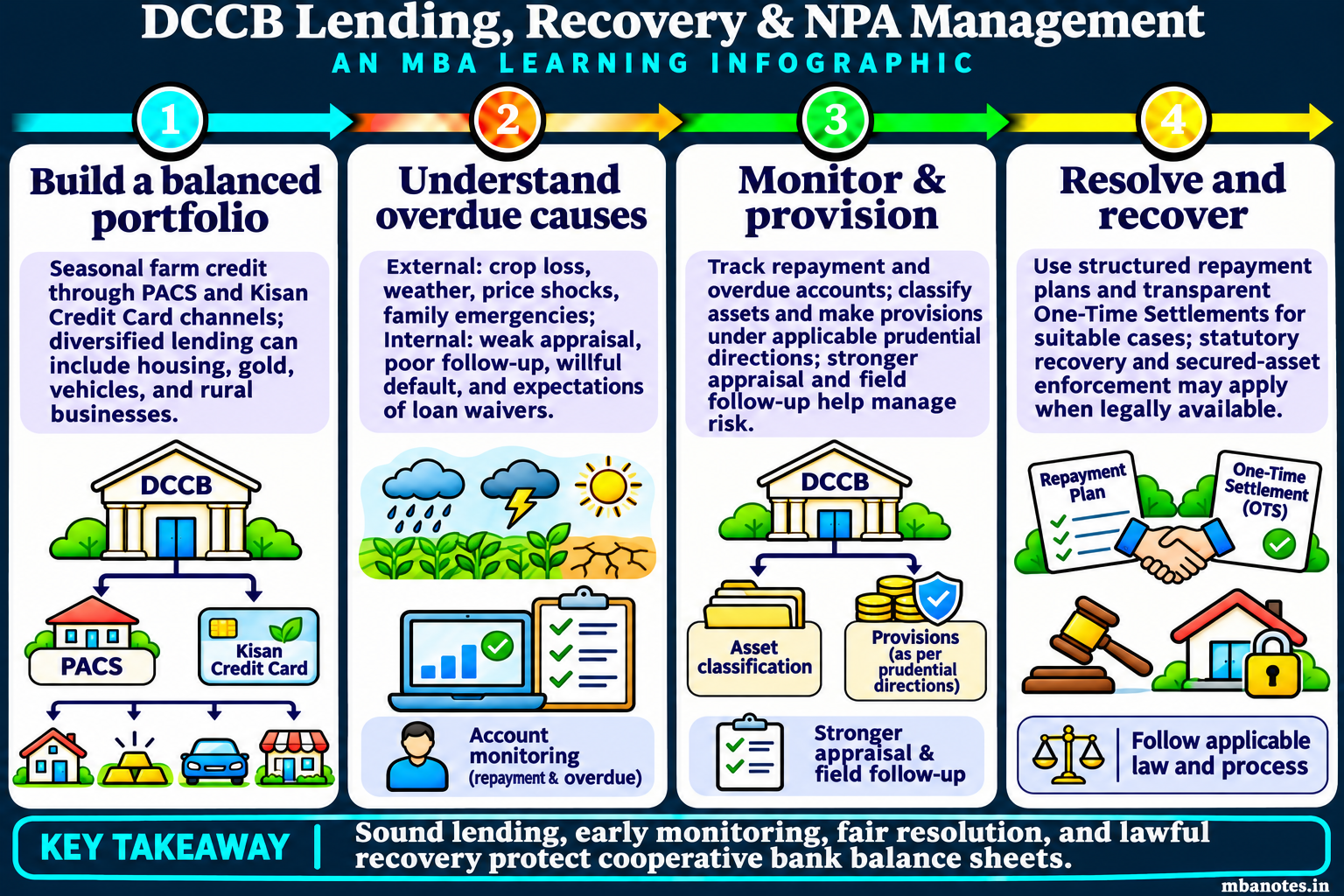
1. The Credit Portfolio Structure of District Central Banks
The credit deployment of a DCCB is dominated by Short-Term Agricultural Credit disbursed through affiliated PACS under the Kisan Credit Card (KCC) scheme, which accounts for 60% to 75% of its loan book.
To optimize interest margins, modern DCCBs diversify into direct lending: gold loans, housing finance, vehicle loans, and working capital lines to agro-processing units and rural retail enterprises.
2. The Overdue Epidemic: Root Causes of Agricultural NPAs
High overdues are the chronic disease of cooperative credit. Economists classify the causes into two categories:
Non-Willful External Factors
Recurrent droughts, erratic monsoon flooding, crop pest epidemics, post-harvest distress sales due to commodity price crashes, and family medical emergencies.
Willful Internal Factors & Politicization
Anticipation of populist political loan waivers before state elections; affluent landlords willfully defaulting with impunity; lax loan appraisal; and lack of post-disbursement field tracking.
3. Prudential Provisioning and IRAC Compliance
Under RBI prudential guidelines, DCCBs must classify agricultural loans into Standard, Sub-Standard, Doubtful, and Loss assets, and make mandatory provisions against net profit:
- Unprovisioned NPAs are deducted directly from Tier I capital, which causes CRAR to collapse below the statutory 9% threshold, triggering RBI prompt corrective action.
4. Multi-Pronged Recovery Mechanisms: SARFAESI and Section 92
Cooperative banks deploy aggressive legal instruments to recover defaulted loans:
- Recovery Certificates under Section 92: The Registrar issues recovery certificates to the District Collector to recover dues as Arrears of Land Revenue through attachment of crops, movable property, and auctioning of mortgaged land.
- The SARFAESI Act, 2002: Following the landmark Supreme Court ruling in Pandurang Ganpati Chaugule (2020), cooperative banks are legally recognized as "Banks" under the SARFAESI Act. They can seize and auction secured commercial properties without intervening through court decrees.
5. Compromise Settlements: One-Time Settlement (OTS) Schemes
For chronic, intractable sticky advances, DCCBs formulate non-discretionary, transparent One-Time Settlement (OTS) Schemes: waiving compounding penal interest in exchange for immediate lump-sum settlement of principal, thereby cleaning balance sheets and unlocking blocked capital.
University Examination Question Bank & Model Solutions
Designed as per Dr. A.P.J. Abdul Kalam Technical University (AKTU) MBA Examination Pattern.
Part A: Conceptual 2-Mark Short Answer Questions
Q1 [2 Marks]: What is the dominant component of a DCCB's credit portfolio?
Ans: Short-term agricultural crop loans disbursed through PACS under the Kisan Credit Card (KCC) scheme.
Q2 [2 Marks]: State two non-willful causes of agricultural overdues in cooperative banking.
Ans: 1. Natural calamities (droughts, floods); 2. Post-harvest agricultural commodity price crashes.
Q3 [2 Marks]: State two willful causes of loan overdues.
Ans: 1. Anticipation of political loan waivers; 2. Willful diversion of loan funds to speculative non-farm activities.
Q4 [2 Marks]: Can cooperative banks use the SARFAESI Act 2002 to recover bad debts?
Ans: Yes; the Supreme Court in the Pandurang Chaugule case (2020) confirmed that cooperative banks can enforce SARFAESI powers.
Q5 [2 Marks]: What is a One-Time Settlement (OTS) scheme in cooperative banking?
Ans: A negotiated compromise where the bank waives penal interest in exchange for immediate lump-sum settlement of principal.
Part B & C: Analytical 10-Mark Detailed Solutions & Regulatory Frameworks
Question 1 [10/15 Marks]: Critically examine the causes of overdues in District Central Cooperative Banks and evaluate modern NPA mitigation mechanisms.
Model Examination Answer Blueprint:
2. Detailed Taxonomy of Overdues: Non-willful (crop failure, price volatility) vs willful (political loan waiver expectations, evergreening).
3. Prudential Impact: Collapsing CRAR, mandatory provisioning, loss of NABARD refinance eligibility.
4. Legal Recovery Mechanisms: Section 92 recovery certificates (land revenue arrears), SARFAESI Act property seizures, Lok Adalats.
5. OTS Compromise Strategy: Transparent balance sheet cleaning through One-Time Settlements.
Question 2 [10/15 Marks]: Discuss the application of the SARFAESI Act 2002 to cooperative banks following the 2020 Supreme Court ruling.
Model Examination Answer Blueprint:
2. Supreme Court Constitutional Bench Verdict (2020): Unanimously ruling cooperative banks fall under Entry 45 (Banking) of Union List.
3. SARFAESI Powers Conferred: Issuing 60-day demand notice under Section 13(2), taking physical possession of secured assets.
4. Bypassing Court Decrees: Auctioning mortgaged non-agricultural commercial properties without civil court delays.
5. Transformative Effect: Drastic reduction in chronic NPA recovery time.
Strategic Executive Summary: 3. Lending, Recovery & NPA Mitigation
- Strict AKTU Syllabus Parity: Covers BMB CM 03 Unit 3 Topic 3 comprehensively.
- Credit Banking & Statutory Rigor: Exhaustive treatment of DCCBs, deposit mobilization, lending operations, StCBs, ARDB long-term debentures, Sinking Fund formulas, UCBs, and RBI/NABARD supervision.
- Visual Conceptualization: Illustrated with Figure 3.3 capturing banking tiers, Sinking Fund mechanics, and supervisory frameworks.
- Examination Readiness: Features 5 Part A 2-mark conceptual questions and 2 comprehensive 10/15-mark university blueprints.
Frequently Asked Questions (Academic & Statutory FAQ)
Q1. What is the core focus of 3. Lending, Recovery & NPA Mitigation in the AKTU MBA curriculum?
Comprehensive analysis of DCCB credit management: credit portfolio structuring, root causes of agricultural overdues, SARFAESI Act applicability, Section 92 recovery certificates, and NPA provisioning. It equips future banking managers with operational mastery over DCCBs, apex banks, long-term debenture flotation, UCB regulation, and RBI/NABARD supervision.
Q2. How do practitioners apply these principles in cooperative credit institutions?
Executives manage district balancing center operations, structure ALM portfolios, calculate Sinking Fund annuities for debenture redemption, enforce Section 40 payroll deductions, and comply with CAMELSC inspection norms.
Q3. What are the most frequent examination questions asked from this unit?
AKTU examinations frequently focus on the DCCB balancing center role, Sinking Fund mathematical formula, UCB dual regulation under the 2020 Amendment Act, Section 40 payroll deductions, and NABARD's Section 35(6) inspection role.
Discussion & Questions
0 CommentsAcademic insights, questions, and conceptual clarifications from students & faculty.
No questions or comments yet
Have a doubt about this topic, an exam tip, or a conceptual perspective? Start the discussion below!
Leave a Comment / Ask a Question
Your email address will not be published. Required fields are marked *