
Medium-Term Credit, NFS Lending & Credit-Marketing Integration: Term Lending, Non-Farm Sector Finance, Micro-Credit & Linking PACS with Marketing Societies
1. The Need for Diversified Rural Credit Beyond Seasonal Crops
While short-term crop loans provide working capital for seeds and fertilizers, agricultural productivity cannot rise without investment in productive capital assets: milch animals, irrigation pumpsets, draft cattle, and farm machinery. Furthermore, over 40% of rural households depend on non-farm enterprises: handloom weaving, pottery, blacksmithy, and village food processing.
To build resilient rural livelihoods, cooperatives deliver Medium-Term (MT) loans, Non-Farm Sector (NFS) finance, and establish structural linkages with Cooperative Marketing Societies.
2. Medium-Term (MT) Cooperative Lending: Scope and Appraisal
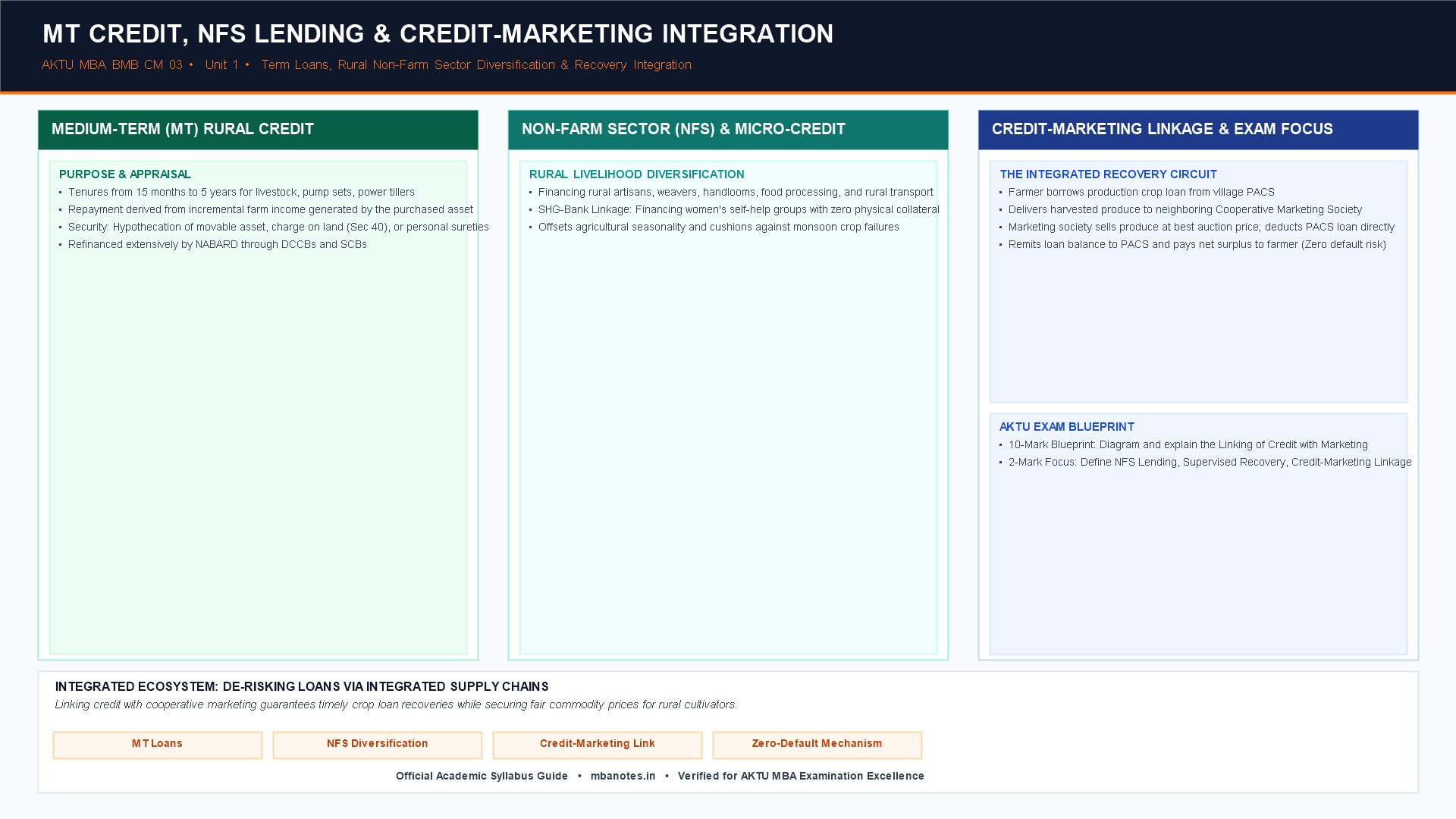
Medium-Term loans span a duration of 15 months to 5 years. Unlike crop loans which are repaid in a single lump sum post-harvest, MT loans are repaid in half-yearly or annual installments generated from incremental income:
- Eligible Purposes: Purchase of milch cows/buffaloes, sheep/goat rearing units, installation of diesel/electric pumpsets, purchase of power tillers, and construction of cattle sheds.
- Security: Hypothecation of purchased livestock/machinery, accompanied by mortgage of land or personal sureties depending on loan quantum.
- MT Conversion Facility: When natural calamities (droughts/floods) cause crop losses exceeding 50%, short-term crop loans are statutorily converted into Medium-Term Conversion Loans (repayable over 3 to 5 years), supported by the National Agricultural Credit (Stabilization) Fund maintained by NABARD.
3. Non-Farm Sector (NFS) Financing and Rural Micro-Enterprise
To curb rural-urban distress migration, DCCBs and PACS provide term finance and working capital to rural cottage industries and artisans:
Artisan & Weavers Credit
Financing handloom weavers, carpet makers, leather artisans, and rural carpenters via Swarojgar Credit Cards (SCC) with composite loan limits.
Agro-Processing & Micro-Enterprises
Financing small flour mills (atta chakkis), oil expellers, spice grinding units, and cold chain pickup vans operated by rural youth and Self-Help Groups (SHGs).
4. The Integrated Credit-Marketing Linkage Mechanism
One of the most brilliant institutional designs formulated by the All India Rural Credit Survey Committee (1954) is the Linkage between Credit and Marketing Cooperatives:
- A farmer borrows a seasonal crop loan from their village PACS and executes a statutory declaration pledging to sell their harvest through the nearest Primary Cooperative Marketing Society (PCMS).
- Post-harvest, the farmer delivers grain, oilseeds, or sugarcane to the marketing society, securing a fair, auction-based market price free from moneylender manipulation.
- The marketing society sells the produce, deducts the principal and interest due to the PACS, remits the loan recovery directly to the PACS account at the DCCB, and pays the remaining net surplus cash directly to the farmer.
5. Overcoming Bottlenecks in Cooperative Credit-Marketing Synergies
While credit-marketing linkage achieves near-100% recovery in sugarcane societies (due to statutory delivery quotas at cooperative sugar mills) and dairy unions (via daily milk deduction), general food grain linkage faces hurdles because private traders offer instant cash advances. Modern digitization of mandi auctions and warehouse receipt pledge financing are restoring this vital linkage.
University Examination Question Bank & Model Solutions
Designed as per Dr. A.P.J. Abdul Kalam Technical University (AKTU) MBA Examination Pattern.
Part A: Conceptual 2-Mark Short Answer Questions
Q1 [2 Marks]: What is the tenure of a Medium-Term (MT) cooperative agricultural loan?
Ans: Fifteen (15) months to five (5) years.
Q2 [2 Marks]: Name three eligible purposes for Medium-Term cooperative financing.
Ans: 1. Purchase of milch cattle; 2. Installation of pumpsets; 3. Farm equipment like power tillers and sprayers.
Q3 [2 Marks]: What is a 'Medium-Term Conversion Loan'?
Ans: Conversion of short-term crop loans into 3 to 5-year medium-term loans when natural disasters cause crop losses exceeding 50%.
Q4 [2 Marks]: What is the core mechanism of the Credit-Marketing Linkage system?
Ans: PACS members agree to sell produce through cooperative marketing societies, which deduct loan dues from sale proceeds and remit them to the PACS.
Q5 [2 Marks]: In which two agricultural sectors is the credit-marketing linkage most successful in India?
Ans: Sugarcane cooperative mills and dairy cooperative federations (AMUL/PCDF).
Part B & C: Analytical 10-Mark Detailed Solutions & Regulatory Frameworks
Question 1 [10/15 Marks]: Analyze the operational scope, appraisal methodology, and significance of Medium-Term (MT) lending and Non-Farm Sector (NFS) finance by cooperative credit institutions.
Model Examination Answer Blueprint:
2. Medium-Term Lending Scope: Milch animals, irrigation pumps, cattle sheds; repayment from incremental cash flow.
3. Non-Farm Sector (NFS) Finance: Rural artisans, handlooms, food processing, and SHGs via Swarojgar Credit Cards.
4. MT Conversion Facility: Role of NABARD's Agricultural Credit Stabilization Fund during droughts and floods.
5. Socioeconomic Impact: Diversifying rural incomes and mitigating agrarian distress.
Question 2 [10/15 Marks]: Describe the integrated Credit-Marketing Linkage mechanism recommended by the AIRCSC (1954). What are its benefits and operational challenges?
Model Examination Answer Blueprint:
2. Operational Sequence: PACS disbursement -> member pledge -> marketing society auction -> loan recovery deduction -> net cash surplus to farmer.
3. Benefits: Guaranteed 100% loan recovery, elimination of middlemen, fair price realization.
4. Success Case Studies: Sugarcane societies in UP/Maharashtra; dairy unions in Gujarat.
5. Bottlenecks: Food grain linkage frictions, private trader cash competition, and warehouse receipt solutions.
Strategic Executive Summary: 4. Medium-Term, NFS & Credit-Marketing Linkage
- Strict AKTU Syllabus Parity: Covers BMB CM 03 Unit 1 Topic 4 comprehensively.
- Credit Banking & Prudential Rigor: Integrates STCCS/LTCCS architectures, Scale of Finance formulas, KCC mechanics, review committees (Gorwala, CRAFICARD, Vaidyanathan), and IRAC norms.
- Visual Conceptualization: Illustrated with Figure 1.4 capturing credit flows, committee timelines, and asset classification tables.
- Examination Readiness: Features 5 Part A 2-mark conceptual questions and 2 comprehensive 10/15-mark university blueprints.
Frequently Asked Questions (Academic & Statutory FAQ)
Q1. What is the core focus of 4. Medium-Term, NFS & Credit-Marketing Linkage in the AKTU MBA curriculum?
Comprehensive study of diversified cooperative lending: Medium-Term loans for livestock and machinery, Non-Farm Sector (NFS) artisan finance, and the vital structural linkage between Credit PACS and Marketing Cooperatives. It equips future banking managers with complete command over credit delivery mechanisms, committee reforms, and prudential banking regulations.
Q2. How do practitioners apply these principles in rural cooperative banking?
Managers formulate annual crop loan limits using Scale of Finance formulas, administer KCC revolving credit with interest subvention, classify assets under IRAC guidelines, and maintain mandatory 9% CRAR.
Q3. What are the most frequent examination questions asked from this unit?
AKTU examinations frequently focus on the three-tier vs two-tier structure, the Scale of Finance formula, KCC subvention, CRAFICARD and the creation of NABARD, the Vaidyanathan Revival Package, and IRAC provisioning percentages.
Discussion & Questions
0 CommentsAcademic insights, questions, and conceptual clarifications from students & faculty.
No questions or comments yet
Have a doubt about this topic, an exam tip, or a conceptual perspective? Start the discussion below!
Leave a Comment / Ask a Question
Your email address will not be published. Required fields are marked *