
Mutual Funds in India: Fiduciary Structure, Scheme Categorization, NAV Calculation, and SEBI Regulations
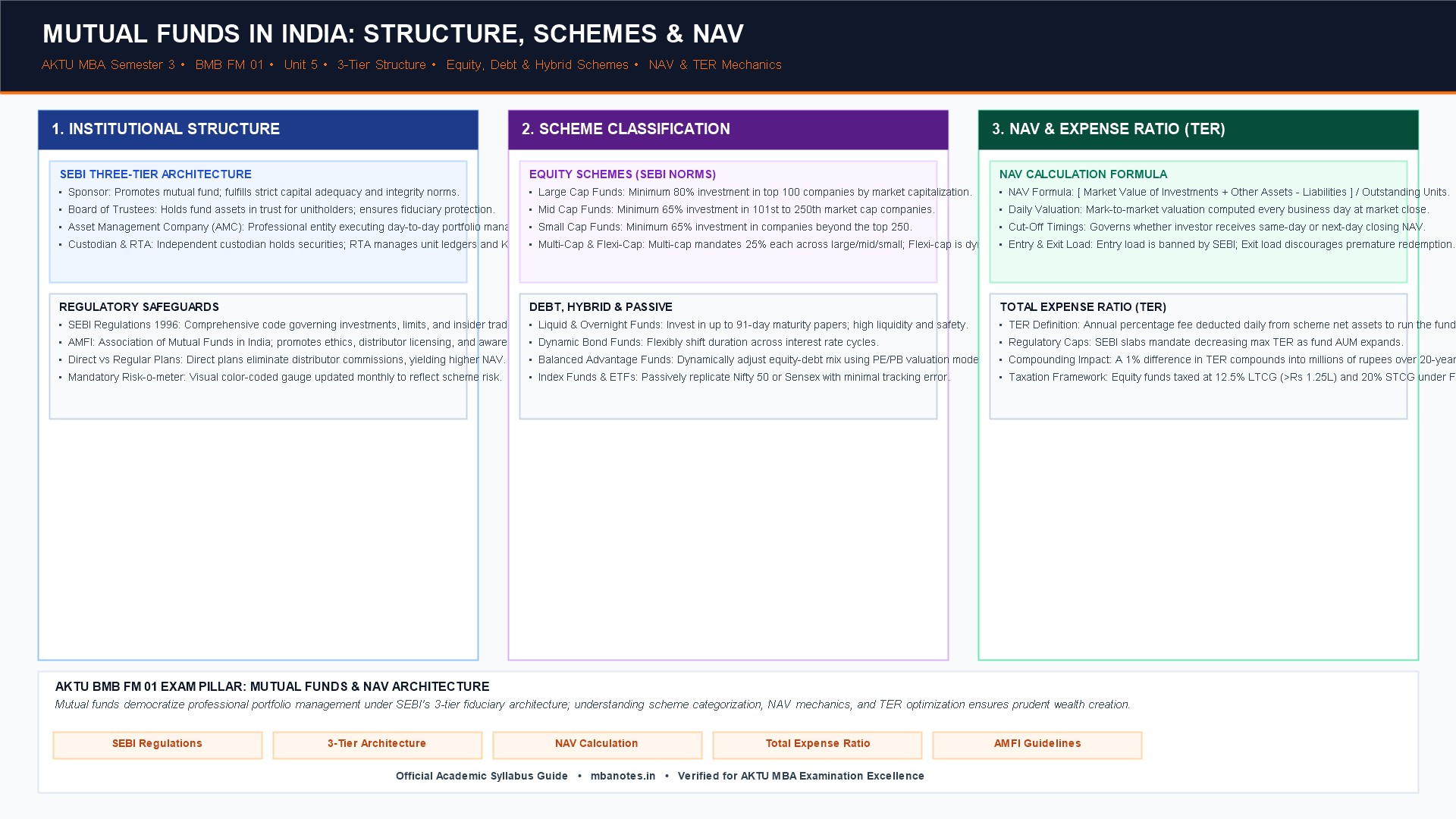
1. Legal & Regulatory Architecture of Mutual Funds in India
In India, the mutual fund industry is regulated under the comprehensive provisions of the SEBI (Mutual Funds) Regulations, 1996. To ensure fiduciary integrity and prevent conflicts of interest, SEBI mandates a strict separation of powers through a four-pillar institutional trust structure.
- 1. The Sponsor: The promoter entity that establishes the mutual fund trust. Under SEBI rules, the sponsor must contribute at least 40% of the net worth of the Asset Management Company, possess a continuous 5-year track record in financial services, and maintain a positive net worth with net profits in at least three of the immediately preceding five years.
- 2. The Trust & Board of Trustees: The mutual fund is constituted as a public trust under the Indian Trusts Act, 1882. The Trustees hold legal ownership of the fund's assets in trust for the benefit of unitholders. At least two-thirds of the trustees must be completely independent individuals with no affiliation to the sponsor. Trustees monitor the operations of the AMC to ensure compliance with SEBI guidelines.
- 3. The Asset Management Company (AMC): The operational management company appointed by the Trustees and approved by SEBI. The AMC employs Chief Investment Officers (CIOs), fund managers, and equity research analysts to invest the pool of capital in accordance with each scheme's Offer Document / Scheme Information Document (SID). At least 50% of the directors of the AMC must be independent.
- 4. The Custodian & Registrar and Transfer Agent (RTA):
- Custodian: An independent financial institution (e.g., Stock Holding Corporation of India, Deutsche Bank, Citibank) responsible for the physical and electronic safekeeping of securities purchased by the fund. The AMC never takes physical custody of unitholder assets.
- Registrar and Transfer Agent (RTA): Institutional intermediaries (e.g., CAMS, KFintech) managing unitholder records, processing fresh purchases, redemptions, Systematic Investment Plans (SIPs), and dividend distributions.
2. SEBI Scheme Categorization: Equity, Debt, Hybrid & Passive Funds
In October 2017, SEBI issued circular SEBI/HO/IMD/DF3/CIR/P/2017/114 on Categorization and Rationalization of Mutual Fund Schemes to eliminate misleading scheme names and ensure true-to-label portfolio management. SEBI standardized the universe into five overarching classes:
- 1. Equity Schemes (10 Standard Categories):
- Large Cap Fund: Minimum 80% investment in equity of top 100 companies by full market capitalization.
- Mid Cap Fund: Minimum 65% in equity of companies ranked 101st to 250th by market cap.
- Small Cap Fund: Minimum 65% in companies ranked 251st and below.
- Large & Mid Cap Fund: Minimum 35% in large caps and minimum 35% in mid caps.
- Flexi Cap Fund: Minimum 65% in equities across large, mid, and small-cap stocks with complete dynamic allocation freedom for the manager.
- Multi Cap Fund: Minimum 25% mandatory allocation in large cap, 25% in mid cap, and 25% in small cap.
- ELSS (Equity Linked Savings Scheme): Minimum 80% in equities with a statutory 3-year lock-in offering tax deduction under Section 80C.
- 2. Debt Schemes (16 Standard Categories):
- Overnight Fund: Invests in debt securities with 1-day maturity.
- Liquid Fund: Invests in money market instruments with maturity up to 91 days.
- Ultra Short Duration Fund: Macaulay duration between 3 and 6 months.
- Corporate Bond Fund: Minimum 80% in highest-rated corporate debt (AA+ and AAA).
- Credit Risk Fund: Minimum 65% in corporate bonds rated AA and below (higher default risk, higher yield).
- Gilt Fund: Minimum 80% in Central and State Government securities with zero credit risk.
- 3. Hybrid Schemes (6 Standard Categories):
- Conservative Hybrid Fund: 10% to 25% equity, 75% to 90% debt instruments.
- Aggressive Hybrid Fund: 65% to 80% equity, 20% to 35% debt instruments.
- Dynamic Asset Allocation / Balanced Advantage Fund (BAF): Completely flexible equity-debt allocation dynamically governed by quantitative valuation models (e.g., P/E, P/B, yield spreads).
- Multi Asset Allocation Fund: Minimum 10% investment across at least three distinct asset classes (e.g., Equity, Debt, and Gold).
- 4. Solution-Oriented & Other Schemes: Retirement funds, Children's funds (5-year lock-in), Index Funds, and Exchange Traded Funds (ETFs) tracking benchmark indices with minimum 95% replication.
3. Economics of Mutual Funds: NAV, TER & Direct vs. Regular Plans
Understanding the financial mechanics of Net Asset Value computation and cost structure is critical for evaluating fund economics.
- Mark-to-Market Valuation Principle: By SEBI mandate, every mutual fund must mark its underlying securities to market price at the close of every business day. Equity holdings are valued at closing stock exchange prices. Fixed-income securities are valued using matrix pricing supplied by independent rating agencies (CRISIL / ICRA).
- Total Expense Ratio (TER): TER represents the annual percentage of fund assets charged by the AMC to cover fund management fees, administrative expenses, custodian charges, audit fees, and marketing costs. SEBI Regulation 52 caps maximum TER on a tiered asset slab:$$\boxed{ \text{TER (\%)} = \frac{ \text{Total Operating Expenses Incurred in Period}}{ \text{Average Daily Net Assets of Scheme}} \times 100 }$$
- Direct Plans vs. Regular Plans: Introduced by SEBI in January 2013:
- Regular Plan: Sold through distributors, brokers, or banks. The AMC pays ongoing trail commissions (typically 0.5% to 1.2% per annum) to the distributor out of the scheme's assets. Consequently, the TER of a Regular Plan is higher, and its daily NAV is lower.
- Direct Plan: Purchased directly by the investor from the AMC. Zero distributor commission is paid. The TER is 50 to 120 basis points lower, resulting in a higher daily NAV and significantly greater compounded wealth over long horizons.
- Exit Load: A contingent deferred sales charge levied on unitholders who redeem their units prior to a specified holding period (e.g., 1% exit load if redeemed within 365 days). Exit load proceeds are credited back to the scheme to compensate remaining unitholders for liquidity friction.
4. Mathematical Formula Card, Worked Numerical Problem & Scheme Taxonomy Table
The Net Asset Value (NAV) represents the intrinsic price per unit of a mutual fund scheme.
Mutual Fund Valuation & Return Formula Suite
Step-by-Step Worked Numerical Problem: Balance Sheet NAV & Expense Ratio Computation
Problem Statement: An equity mutual fund scheme has 50,00,000 (5 million) units outstanding at the close of trading on March 31. The portfolio details of the fund are as follows:
- Market Value of Listed Equities: ( ext{Rs. } 85,00,00,000 ) (Rs. 85.00 Crore)
- Government Securities & Cash Equivalents: ( ext{Rs. } 12,50,00,000 ) (Rs. 12.50 Crore)
- Dividends & Interest Receivable: ( ext{Rs. } 1,75,00,000 ) (Rs. 1.75 Crore)
- Accrued Asset Management Fees: ( ext{Rs. } 45,00,000 ) (Rs. 0.45 Crore)
- Custodial & Administrative Dues: ( ext{Rs. } 30,00,000 ) (Rs. 0.30 Crore)
Required:
(a) Calculate the Net Asset Value (NAV) per unit of the scheme.
(b) If an investor purchases units at this NAV and redeems them after exactly 3 years at an exit NAV of Rs. 268.50 per unit (with zero exit load), calculate the 3-year Compound Annual Growth Rate (CAGR) earned by the investor.
(c) If the total annual recurring expenses incurred by the AMC during the year totaled Rs. 1.80 Crore on average daily net assets of Rs. 90.0 Crore, compute the Total Expense Ratio (TER) of the fund.
Solution Walkthrough:
Part (a): Calculation of NAV per Unit
First, compute the Total Gross Assets of the fund:
Part (b): Calculation of 3-Year CAGR
Given: ( ext{NAV}_{ ext{Start}} = ext{Rs. } 197.00 ), ( ext{NAV}_{ ext{End}} = ext{Rs. } 268.50 ), ( n = 3 ext{ years} ).
Part (c): Total Expense Ratio (TER) Calculation
SEBI Scheme Classification Matrix
| Scheme Category | Asset Allocation Mandate | Risk Profile | Target Investor Horizon |
|---|---|---|---|
| Large Cap Equity | Min 80% in top 100 companies by market cap | Moderate to High | 5+ Years |
| Mid Cap Equity | Min 65% in 101st to 250th companies by market cap | High | 7+ Years |
| Liquid Debt Fund | 100% in money market instruments maturing ≤ 91 days | Very Low | 1 Day to 3 Months |
| Balanced Advantage (BAF) | 0% to 100% Equity / 0% to 100% Debt dynamic model | Moderate | 3 to 5 Years |
| Corporate Bond Fund | Min 80% in AA+ and AAA rated corporate debt | Low to Moderate | 2 to 3 Years |
6. Corporate Case Vignette: The Franklin Templeton Debt Crisis
Franklin Templeton India: 6 Debt Schemes Winding Up (April 2020)
On April 23, 2020, Franklin Templeton Mutual Fund abruptly announced the voluntary winding up of six open-ended debt mutual fund schemes managing over Rs. 28,000 Crore of investor capital. The affected schemes included Franklin India Ultra Short Bond Fund, Low Duration Fund, Short Term Income Plan, Credit Risk Fund, Dynamic Accrual Fund, and Income Opportunities Fund.
The root cause was a structural asset-liability mismatch exacerbated by systemic illiquidity. The AMC had pursued a high-yield investment strategy, allocating substantial capital to unlisted, lower-rated (AA, A, BBB) corporate debt securities with high illiquidity. When the COVID-19 nationwide lockdown induced severe panic, institutional and high-net-worth investors submitted unprecedented redemption requests.
Because secondary market buyers for illiquid lower-rated debt dried up completely, Franklin Templeton exhausted its bank credit borrowing lines and was forced to gate redemptions to prevent fire-sale liquidations that would destroy remaining unitholder value.
The episode triggered landmark regulatory interventions by SEBI:
- Mandatory requirement for open-ended debt schemes to hold at least 10% in liquid assets (cash, G-Secs, T-Bills).
- Strict caps on unlisted debt exposures and single-issuer concentration limits.
- Introduction of the Swing Pricing Framework during market dislocation to prevent early redeemers from shifting transaction costs onto continuing unitholders.
7. AKTU MBA Exam Drill: 2-Mark Short Notes & 10-Mark Model Answers
Section A: 2-Mark High-Frequency University Questions
Q1. State the role of the Board of Trustees in an Indian mutual fund.
The Board of Trustees holds the fund's assets in legal trust for the benefit of unitholders, oversees the operations of the Asset Management Company (AMC), and ensures strict compliance with SEBI (Mutual Funds) Regulations, 1996.
Q2. Define Total Expense Ratio (TER) and state its regulatory importance.
Total Expense Ratio (TER) is the annual operating expense of running a mutual fund expressed as a percentage of its daily average net assets. SEBI caps TER to ensure excessive fees do not erode investor wealth.
Q3. Why does a Direct Plan offer a higher NAV than a Regular Plan of the same scheme?
A Direct Plan does not pay distributor commissions or marketing fees, resulting in a lower Total Expense Ratio (TER). Because fewer expenses are deducted from fund assets daily, its NAV compounds at a higher rate.
Q4. What is a Balanced Advantage Fund (BAF)?
A Balanced Advantage Fund (or Dynamic Asset Allocation Fund) is an open-ended hybrid mutual fund that dynamically alters its asset allocation between 0% and 100% in equity and debt using quantitative valuation models.
Q5. A mutual fund has net assets of Rs. 450 Crore and 15 Crore units outstanding. Calculate its NAV.
Section B & C: 10-Mark Comprehensive University Model Answers
Q6. Detail the regulatory framework and institutional structure of mutual funds in India as mandated by SEBI. Explain the rights and duties of the Sponsor, Trustees, AMC, and Custodian.
1. Regulatory Framework Overview:
Mutual funds in India are governed by the SEBI (Mutual Funds) Regulations, 1996. The regulatory architecture is structured to enforce a strict fiduciary separation of roles, preventing the asset manager from expropriating investor capital.
2. Institutional Entities and Their Fiduciary Functions:
• The Sponsor: Sets up the mutual fund trust and appoints trustees. Under SEBI criteria, the sponsor must have a track record of carrying on business in financial services for not less than 5 years, maintain a positive net worth for all 5 years, and show net profits in at least 3 out of 5 years.
• The Board of Trustees: Formed under the Indian Trusts Act, 1882. The Trustees hold legal title to all scheme assets for the unitholders. At least 66.7% of the trustees must be independent. They ensure that the AMC acts in accordance with the Scheme Information Document (SID) and SEBI regulations.
• The Asset Management Company (AMC): Appointed by Trustees with SEBI approval. The AMC conducts investment research, manages the fund portfolio, calculates daily NAV, and manages operations. At least 50% of the AMC board must be independent directors.
• The Custodian: An independent agency holding physical and electronic custody of all securities. The AMC cannot hold portfolio securities directly.
3. Checks, Balances, and Governance Mechanisms:
This multi-tier structure ensures that operational failures or malfeasance at the AMC level do not lead to theft of investor assets, as legal ownership rests with the Trustees and custody rests with independent custodians.
Q7. Explain the SEBI 2017 scheme categorization framework. Why was scheme categorization necessary in India, and how did it benefit mutual fund investors?
1. Background and Genesis:
Prior to October 2017, mutual funds in India suffered from rampant scheme proliferation and vague naming conventions. AMCs ran multiple similar funds with names like "Advantage Fund", "Opportunities Fund", or "Prudence Fund" without standardized mandates, confusing retail investors and preventing meaningful peer comparison.
2. SEBI's 2017 Rationalization Mandate:
SEBI categorized mutual funds into 5 broad groups with 36 clearly defined categories, allowing only one scheme per category per AMC (with exceptions for Index/ETF and Sectoral funds):
- Equity Schemes: 10 categories based strictly on market-cap rankings (Large cap: 1–100, Mid cap: 101–250, Small cap: 251+).
- Debt Schemes: 16 categories based on Macaulay duration (Overnight, Liquid, Ultra-short, Short, Medium, Long) and credit risk (Corporate Bond vs. Credit Risk).
- Hybrid Schemes: 6 categories based on equity-debt allocation proportions (Conservative, Balanced, Aggressive, Dynamic Asset Allocation).
- Solution-Oriented Schemes: Retirement and Children's funds.
- Other Schemes: Index Funds, ETFs, and Fund of Funds.
3. Key Benefits for Investors:
• True-to-Label Portfolios: Fund managers can no longer market a fund as Large Cap while secretly taking Mid Cap bets to chase short-term returns.
• Clean Peer Comparison: Investors can evaluate like-for-like performance against identical benchmarks.
• Consolidation: Eliminated duplicate overlapping schemes, reducing management bloat across the industry.
Frequently Asked Questions (FAQ)
What is Net Asset Value (NAV) of a mutual fund?
NAV is the net market value of all securities held by the fund plus current assets, minus accrued liabilities and expenses, divided by the total number of outstanding units of the scheme.
How does a Direct Plan differ from a Regular Plan?
Direct Plans are bought directly from the AMC without paying distributor trail commissions, leading to a lower Total Expense Ratio (TER) and higher compounded long-term returns compared to Regular Plans.
What is the primary role of a Custodian in a mutual fund?
The Custodian is an independent entity responsible for holding and safeguarding the physical and electronic securities purchased by the mutual fund, preventing the AMC from directly accessing unitholder assets.
Discussion & Questions
0 CommentsAcademic insights, questions, and conceptual clarifications from students & faculty.
No questions or comments yet
Have a doubt about this topic, an exam tip, or a conceptual perspective? Start the discussion below!
Leave a Comment / Ask a Question
Your email address will not be published. Required fields are marked *