
Need, Want, Demand
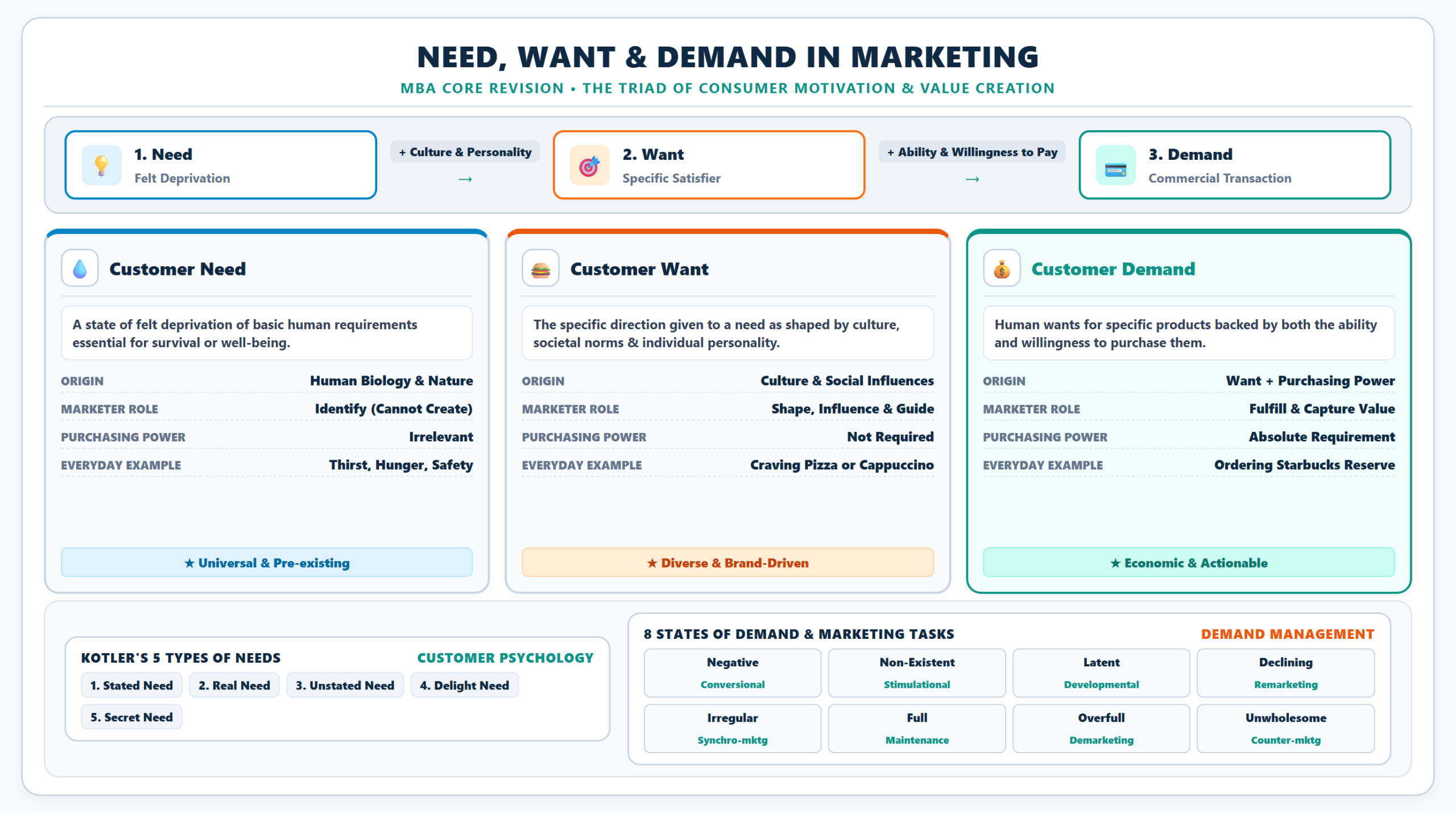
1. The Consumer Motivation Triad: Needs, Wants, and Demands
In marketing theory, the distinction between Needs, Wants, and Demands forms the bedrock of customer discovery, product positioning, and economic value creation. Confusing these three concepts is the primary cause of product failure and marketing myopia.
States of felt deprivation. They are biological, social, and individual necessities (nutrition, warmth, security, self-expression). Marketers do not create needs; needs are intrinsic to the human condition.
The specific object or experience chosen to satisfy a need as shaped by culture and personality. A person in Lucknow needs food and wants biryani; a person in Tokyo needs food and wants sushi. Marketers actively influence wants.
Wants backed by the ability to pay (purchasing power). While millions of consumers may want an Apple MacBook Pro, only those with sufficient financial liquidity generate effective market demand.
2. Philip Kotler's Five Types of Customer Needs
To satisfy customer needs effectively, a marketer must look beyond surface statements. Philip Kotler classifies customer needs into five distinct psychological layers:
3. Comparative Synthesis: Need vs. Want vs. Demand
The table below synthesizes the structural and managerial differences across the triad:
| Parameter | Needs | Wants | Demands |
|---|---|---|---|
| 1. Nature & Origin | Innate biological/social deprivation | Cultural & psychological preference | Economic ability & willingness to purchase |
| 2. Marketer Creation | Cannot be created by marketers | Heavily influenced & shaped by marketing | Stimulated via pricing & credit financing |
| 3. Finite vs Infinite | Limited and finite in scope | Virtually infinite and boundless | Constrained by individual disposable income |
| 4. Corporate Example | Communication & social connection | Desiring an Apple iPhone 15 Pro Max | Purchasing via ₹1,34,000 cash or EMI |
5. Real-World Corporate Example: Tata Salt vs. Bisleri (Transforming Commodities into Demand)
From Physical Need to Branded Market Demand: Water and iodine are universal human survival needs. Historically in India, consumers drank tap water and bought loose unpackaged rock salt from local grocers. Brands like Bisleri and Tata Salt transformed these unbranded basic needs into multi-crore demand engines.
Key Takeaway: Marketers create value not by inventing artificial needs, but by elevating basic survival needs into trusted, branded preferences backed by purchasing power.
6. High-Frequency AKTU Previous Year Exam Questions (PYQs)
Review these standard exam questions frequently asked in AKTU MBA Marketing Management papers:
Section A: Short Conceptual Questions (2 Marks Each)
Answer: A want is a desire for a specific satisfier shaped by culture and individual personality. A demand is that want backed by the financial ability and willingness to purchase (Demand = Want + Ability to Pay).
Answer: No. Human needs pre-exist in human biology and social conditions (e.g., need for nourishment, security, social affiliation). Marketers influence wants by designing and promoting attractive satisfiers, and stimulate demand by making them accessible and affordable.
Answer: Negative demand occurs when consumers dislike a product and may even pay to avoid it (e.g., dental root canals, vaccinations). The marketing task is Conversional Marketing — redesigning the offering, lowering perceived pain, and reframing benefits.
Answer: (1) Latent demand, (2) Irregular demand, (3) Overfull demand, and (4) Unwholesome demand.
Section B & C: Long Conceptual Questions (7 & 10 Marks)
How to Structure Your Exam Answer:
- 1. Conceptual Argument: Validate the statement — needs are fundamental biological/psychological deprivations (food, shelter, status, communication).
- 2. Analysis of the Triad: Detail the progressive transition: Need (deprivation) → Want (cultural choice) → Demand (economic ability).
- 3. Role of Marketers: Clarify that marketers influence wants by creating awareness, framing lifestyle benefits, and engineering desirable solutions (e.g., Apple did not invent the need to communicate; it created the iPhone to fulfill that need).
- 4. Ethical Considerations: Discuss criticisms regarding aggressive advertising inducing hyper-consumerism versus genuine value creation.
- 5. Conclusion: Reiterate that sustainable businesses uncover latent pre-existing needs rather than trying to engineer artificial deprivations.
How to Structure Your Exam Answer:
- 1. Introduction: Define demand management as the core operational task of marketing.
- 2. Systematic Breakdown of the 8 States:
• Negative: Disliked product → Conversional marketing.
• Non-existent: Unaware/uninterested → Stimulational marketing.
• Latent: Strong unfulfilled need → Developmental marketing.
• Declining: Falling sales → Remarketing (rejuvenation).
• Irregular: Seasonal peaks/valleys → Synchromarketing (off-peak incentives).
• Full: Optimum volume → Maintenance marketing.
• Overfull: Demand exceeds capacity → Demarketing (price hikes, rationing).
• Unwholesome: Harmful goods → Counter-marketing (destructive campaigns). - 3. Conclusion: Emphasize that marketing is not merely demand generation, but demand regulation to match corporate supply capacity.
AKTU University Examination Questions: Solved Model Formulations
Discussion & Questions
0 CommentsAcademic insights, questions, and conceptual clarifications from students & faculty.
No questions or comments yet
Have a doubt about this topic, an exam tip, or a conceptual perspective? Start the discussion below!
Leave a Comment / Ask a Question
Your email address will not be published. Required fields are marked *