
Operational Risk Management Framework: Workflow Design, RCSA, and Basel Capital Measurement
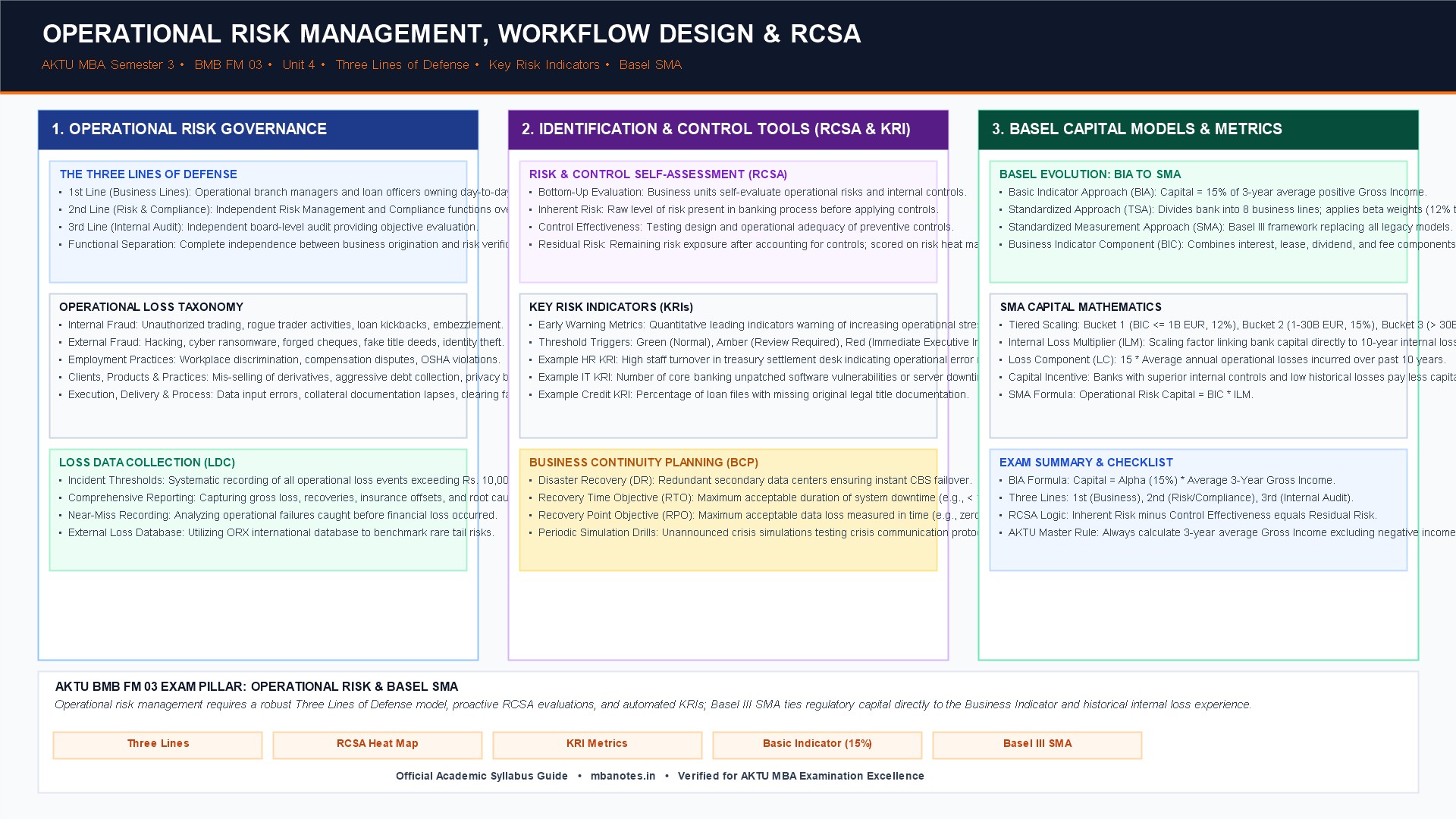
Figure 4.2: Operational Risk Architecture - Three Lines of Defense, RCSA Risk Heat Maps, and Basel Standardized Measurement Approach.
Foundational Architecture: The Basel Operational Risk Framework
Unlike credit risk (which is voluntarily assumed in expectation of interest returns) and market risk (assumed in trading activities), Operational Risk is an inherent, unavoidable byproduct of conducting financial business. Under the Basel Committee on Banking Supervision (BCBS) definition, operational risk encompasses:
"The risk of loss resulting from inadequate or failed internal processes, people, and systems or from external events."
Statutory Clarification: The definition explicitly includes legal and regulatory compliance risk, but excludes strategic risk (faulty business decisions) and reputational risk.
- Internal Fraud: Misappropriation of assets, unauthorized trading, tax evasion, and forgery committed by employees.
- External Fraud: Robbery, check forgery, hacking, credit card cloning, and phishing scams perpetrated by outside parties.
- Employment Practices & Workplace Safety: Compensation disputes, discrimination claims, sexual harassment liabilities, and OSHA safety violations.
- Clients, Products & Business Practices: Mis-selling of financial products, antitrust violations, insider trading, and breach of fiduciary privacy.
- Damage to Physical Assets: Terrorism, vandalism, earthquakes, floods, and fire destroying corporate premises or bank data centers.
- Business Disruption & System Failures: Hardware crashes, telecom outages, software bugs in core banking, and power blackout failures.
- Execution, Delivery & Process Management: Data entry errors, collateral documentation flaws, accounting errors, and vendor delivery failures.
Operational Governance: The Three Lines of Defense Model
To eliminate operational gaps and prevent rogue employee misconduct, commercial banking institutions enforce the internationally recognized Three Lines of Defense risk governance framework.
- First Line of Defense (Business Operations & Frontline Units): Branch managers, credit underwriting officers, treasury traders, and customer relationship personnel. They directly own, identify, and manage operational risks in daily transactions, executing maker-checker controls and verifying identity under KYC protocols.
- Second Line of Defense (Operational Risk Management & Compliance Functions): The Chief Risk Officer (CRO), Operational Risk Management Department (ORMD), and Chief Compliance Officer (CCO). They design the enterprise risk framework, establish policies, challenge first-line risk assessments, monitor Key Risk Indicators (KRIs), and oversee compliance with RBI guidelines.
- Third Line of Defense (Independent Internal Audit): The Head of Internal Audit and Audit Committee of the Board. They provide independent, objective assurance to the board of directors regarding the design adequacy and operating effectiveness of both the first and second lines of defense.
Identification & Monitoring Tools: RCSA, KRIs & Loss Data Collection
Commercial banks deploy specialized qualitative and quantitative management tools to proactively identify operational vulnerabilities before they materialize into devastating financial losses.
- Risk & Control Self-Assessment (RCSA): A structured methodology where business units systematically identify their operational processes, evaluate Inherent Risk (the risk level before controls), assess Control Effectiveness (maker-checker, dual authorization, system checks), and determine Residual Risk (the remaining net exposure). Results are mapped onto a 5x5 Probability-Impact Heat Map.
- Key Risk Indicators (KRIs): Forward-looking quantitative metrics that signal shifts in operational risk exposure before loss events occur. Examples:
- Staff Turnover Rate in Credit Underwriting (>15% triggers alert).
- Number of System Downtime Incidents in Core Banking (>0.05% of trading hours).
- Unreconciled Clearing Accounts Aging (>30 days indicates fraud vulnerability).
- Loss Data Collection & Event Logging (LDCE): Mandatory capture of all historical internal operational loss events above a threshold (e.g., ₹10,000), logging gross loss, recoveries, cause classification, and corrective remediation.
- Scenario Analysis: Assessing extreme, low-probability but high-severity catastrophic events (e.g., a massive ransomware attack encrypting the Core Banking Solution).
Practical Application: Basic Indicator (BIA) & SMA Capital Sizing
Operational Risk Capital Allocation Formulae
$$ ext{BIA Capital Requirement} = left( rac{sum_{i=1}^{n} max(GI_i, 0) imes alpha}{m} ight)$$
Where: $GI_i$ = Annual Gross Income over the previous 3 years; $alpha = 15%$; $m$ = Number of years in which Gross Income was positive ($m le 3$).
$$ ext{Basel III SMA Business Indicator Component (BIC)} = ext{Bucket 1} (12%) + ext{Bucket 2} (15%) + ext{Bucket 3} (18%)$$
Step-by-Step Worked Numerical: Basic Indicator Approach (BIA) Capital Sizing
Case Problem: Shivalik Commercial Bank reports the following audited financial income statement figures over the preceding three financial years:
- Year 1:
- Net Interest Income (Interest Earned ₹1,200 Cr - Interest Paid ₹850 Cr): ₹350.00 Crore
- Net Non-Interest Income (Fees, commissions, forex margins): ₹120.00 Crore
- Gross Income Year 1 = ₹350.00 + ₹120.00 = ₹470.00 Crore
- Year 2:
- Net Interest Income: ₹380.00 Crore
- Net Non-Interest Income: ₹140.00 Crore
- Operating Expenses (Staff & Admin): ₹260.00 Crore (Note: Operating expenses are NOT deducted for Gross Income under Basel rules)
- Gross Income Year 2 = ₹380.00 + ₹140.00 = ₹520.00 Crore
- Year 3:
- Net Interest Income: -₹40.00 Crore (Negative margin due to liquidity shock)
- Net Non-Interest Income: ₹25.00 Crore
- Gross Income Year 3 = -₹40.00 + ₹25.00 = -₹15.00 Crore (Negative Gross Income)
Required: (a) Calculate the Gross Income eligible for Basel BIA operational risk capital sizing across the 3 years; (b) Calculate the minimum operational risk capital charge under the Basic Indicator Approach ($alpha = 15%$); (c) Compute the equivalent Operational Risk-Weighted Assets (RWA) assuming a minimum Capital Adequacy Ratio of 11.50%.
Step 1: Evaluate Eligible Gross Income & Exclusions
- Year 1 Gross Income = ₹470.00 Crore (Positive, Included)
- Year 2 Gross Income = ₹520.00 Crore (Positive, Included)
- Year 3 Gross Income = -₹15.00 Crore (Negative Gross Income)
- Basel BIA Rule: Negative and zero gross income years must be excluded from both the numerator and the denominator ($m$).
- Number of positive years ($m$) = 2 (Years 1 and 2 only).
- $$ ext{Total Eligible Gross Income} = ₹470.00 ext{ Cr} + ₹520.00 ext{ Cr} = mathbf{₹990.00 ext{ Crore}}$$
Step 2: Calculate BIA Operational Risk Capital Charge
$$ ext{Average Annual Positive Gross Income} = rac{₹990.00 ext{ Crore}}{2} = ₹495.00 ext{ Crore}$$
$$ ext{Operational Risk Capital Charge} = ₹495.00 ext{ Crore} imes 15% (alpha) = mathbf{₹74.25 ext{ Crore}}$$
Step 3: Compute Equivalent Risk-Weighted Assets (RWA)
Under Basel framework, RWA is derived by dividing the capital charge by the statutory CAR (11.50% in India, or the reciprocal multiple $1 / 0.115 = 8.6956$):
$$ ext{Operational Risk RWA} = rac{₹74.25 ext{ Crore}}{0.115} = mathbf{₹645.65 ext{ Crore}}$$
| Measurement Framework | Underlying Methodology | Data Inputs Required | Regulatory Complexity |
|---|---|---|---|
| Basic Indicator Approach (BIA) | Fixed 15% alpha applied to 3-year average positive Gross Income | Audited annual gross income figures only | Low (Standard for small/regional commercial banks) |
| The Standardized Approach (TSA) | Gross Income split across 8 business lines; beta factors (12% to 18%) | Business-line segmented audited revenue statements | Medium (Requires segment accounting) |
| Standardized Measurement (SMA) | Business Indicator Component (BIC) combined with Internal Loss Multiplier | Interest, lease, dividend, trading income + 10-year loss history | High (Mandatory Basel III replacement framework) |
Corporate Case Study: Barings Bank & Nick Leeson Unauthorized Trading Collapse
The Operational Flaw: Founded in 1762, Barings Bank was the oldest merchant bank in London. In 1992, junior trader Nick Leeson was appointed head of futures and options trading at Barings Futures Singapore (BFS). Critically, management permitted Leeson to function simultaneously as Head Trader (Front Office) and Head of Settlements and Clearing (Back Office)—a catastrophic violation of the Four-Eye principle and segregation of duties.
The Concealed Trades: Leeson began making unauthorized speculative bets on the Japanese Nikkei 225 stock index. When his trades turned sour, he exploited his back-office settlement authority to conceal cumulative trading losses within a dormant error account known as "Account 88888," fabricating internal audit records and margin cash calls.
The Final Collapse: Following the Kobe earthquake in January 1995, the Nikkei crashed, inflating Leeson's concealed losses to a staggering £827 Million ($1.3 Billion)—more than double Barings Bank's entire equity capital. The venerable 233-year-old bank went bankrupt overnight and was acquired for a symbolic £1 by Dutch group ING, serving as the definitive global corporate case study on the lethal consequences of inadequate operational controls.
AKTU Exam Drill: 2-Mark Compulsory & 10-Mark Evaluative Questions
Part A: Short-Answer Compulsory Questions (2 Marks Each)
Q1: Define Operational Risk under the Basel Framework.
Model Answer: Operational Risk is defined as the risk of financial loss resulting from inadequate or failed internal processes, people, and systems, or from external events. It explicitly includes legal risk, but excludes strategic and reputational risks.
Q2: What is the "Four-Eye Principle" in banking operational risk?
Model Answer: The Four-Eye Principle mandates that every significant financial transaction, credit disbursement, or administrative override must be reviewed and authorized by at least two competent individuals (Maker-Checker segregation) to eliminate single-point fraud or error.
Q3: Explain the concept of Risk & Control Self-Assessment (RCSA).
Model Answer: RCSA is a proactive qualitative risk management process where operational departments evaluate their own internal workflows, measure inherent risks, evaluate the effectiveness of existing controls, and map net residual risks on risk heat maps.
Q4: State the alpha ($alpha$) percentage used in the Basic Indicator Approach (BIA).
Model Answer: Under the Basic Indicator Approach (BIA), the regulatory capital charge is set at 15% ($alpha = 0.15$) of the average annual positive gross income over the previous three financial years.
Q5: Give two examples of Key Risk Indicators (KRIs) in commercial banking.
Model Answer: (1) Volume and aging of unreconciled suspense and clearing accounts. (2) Frequency and duration of Core Banking Solution (CBS) downtime incidents.
Part B: Descriptive Comprehensive Questions (10 Marks Each)
Q6: Critically analyze the "Three Lines of Defense" model in modern banking operational risk governance. How does segregation of duties between the front office, risk management, and internal audit safeguard against rogue employee fraud? (10 Marks)
Model Answer Structure:
- Introduction: Define the Three Lines of Defense as the universal institutional framework ensuring clear accountability and oversight.
- Detailed Structural Examination:
- 1st Line (Frontline Business Units): Owns and manages daily operational risks; implements maker-checker controls, dual passwords, and transaction limit checks.
- 2nd Line (Risk Management & Compliance): Independent monitoring; designs RCSA templates, tracks KRIs, establishes risk tolerance boundaries, and oversees regulatory compliance.
- 3rd Line (Internal Audit): Independent assurance reporting directly to the Board Audit Committee; audits adherence to policies and evaluates the robustness of the 1st and 2nd lines.
- Safeguarding Against Rogue Employee Fraud: Drawing on the Barings Bank catastrophe, explain how maintaining an absolute operational wall between front-office trading and back-office clearing prevents unauthorized concealment of trading losses and preserves balance sheet integrity.
Q7: Compare and contrast the Basic Indicator Approach (BIA) and the Basel III Standardized Measurement Approach (SMA) for computing operational risk regulatory capital. Why did the Basel Committee phase out the Advanced Measurement Approach (AMA)? (10 Marks)
Model Answer Structure:
- Evolution of Operational Risk Capital: Trace the shift from early Basel II approaches to modern Basel III standards.
- Basic Indicator Approach (BIA): Explain the formula ($15% imes ext{Average Gross Income}$), its simplicity, and its fundamental flaw of treating revenue as an imperfect proxy for operational vulnerability.
- The Standardized Measurement Approach (SMA): Detail the Business Indicator Component (BIC) tiered buckets and the Internal Loss Multiplier (ILM) linking capital charges directly to a bank's verified 10-year historical operational loss record.
- Reasons for Phasing Out the Advanced Measurement Approach (AMA): Discuss the opacity, excessive complexity, wide variability of proprietary statistical models, and systemic failure of internal models to predict mega-operational losses during the 2008 financial crisis.
Discussion & Questions
0 CommentsAcademic insights, questions, and conceptual clarifications from students & faculty.
No questions or comments yet
Have a doubt about this topic, an exam tip, or a conceptual perspective? Start the discussion below!
Leave a Comment / Ask a Question
Your email address will not be published. Required fields are marked *