
Operations Research (OR): Concept, Phases, Models & Applications in Decision Making
Scientific Decision Making, Interdisciplinary Approach, 6-Phase OR Methodology & Model Taxonomy
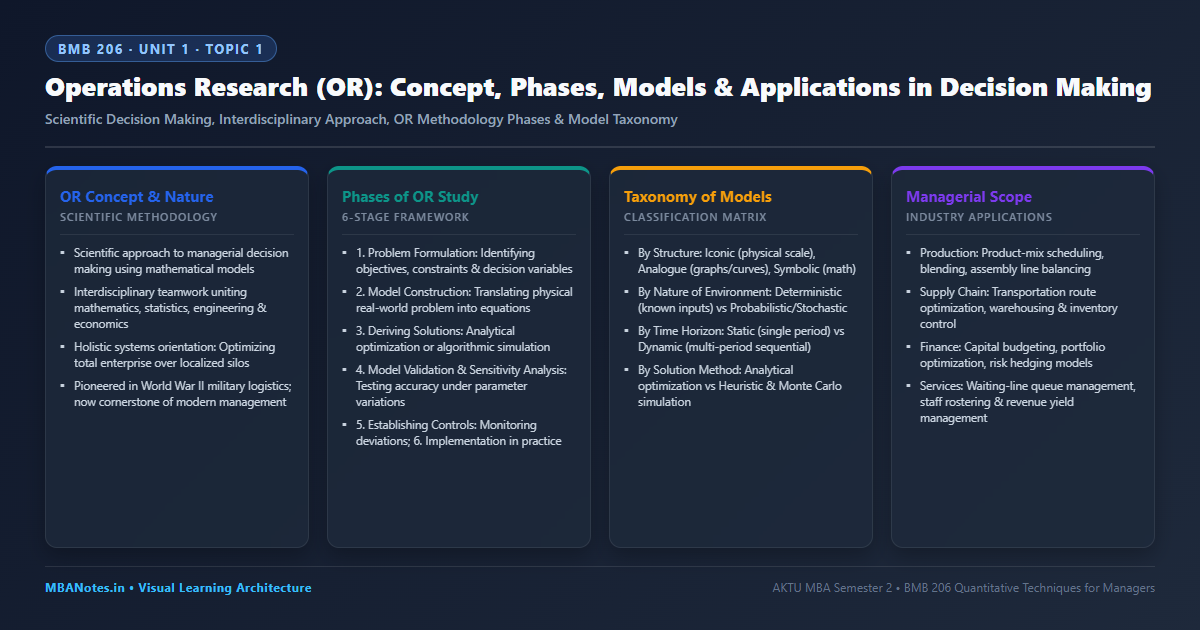
1. Operations Research (OR): Concept, Origin & Core Characteristics
Operations Research (OR) is the discipline of applying advanced analytical methods, mathematical modeling, statistical algorithms, and scientific principles to executive decision making. Formally defined by the Operational Research Society of Great Britain, ‘Operational Research is the application of the methods of science to complex problems arising in the direction and management of large systems of men, machines, materials and money in industry, business, government and defense.’
Historically, OR originated during World War II (1939–1945) in the United Kingdom, where multidisciplinary teams of physicists, mathematicians, and engineers (famously termed ‘Blackett’s Circus’ led by Nobel laureate P.M.S. Blackett) were assembled to analyze radar deployment, anti-aircraft gun locations, and naval convoy routing. Following the war, these quantitative techniques were rapidly adopted by industrial corporations to solve complex commercial resource-allocation challenges.
The 8 Defining Characteristics of Operations Research
- Systems Orientation (Holistic View): Evaluates operational decisions from the perspective of the entire enterprise rather than individual departments, eliminating localized sub-optimization.
- Interdisciplinary Team Approach: Combines expertise from diverse fields—such as mathematics, statistics, computer science, economics, behavioral sciences, and industrial engineering—to formulate robust solutions.
- Application of the Scientific Method: Follows rigorous scientific protocols: observing real-world phenomena, formulating hypotheses, constructing mathematical abstractions, and conducting empirical experiments.
- Goal-Seeking Optimization: Strives to identify the globally optimal solution (maximizing profit, minimizing cost, or optimizing service levels) rather than settling for intuitive rule-of-thumb compromises.
- Quantitative Mathematical Modeling: Translates qualitative management verbal dilemmas into precise mathematical objective functions, constraints, and relational variables.
- Electronic Computer Dependency: Employs computational software and linear algebra algorithms to process large-scale matrices and combinatorial problem spaces.
- Decision-Support Role: Acts as an executive decision aid; OR does not replace managerial judgment, intuition, and ethical accountability, but substantiates decisions with quantitative evidence.
- Adaptability and Continuous Control: Incorporates feedback loops and sensitivity analysis to update model parameters as operating environments shift.
Classification Matrix: Taxonomy of Operations Research Models in Management
| Classification Dimension | Model Category | Operational Characteristics | Practical Management Examples |
|---|---|---|---|
| By Physical Structure | Iconic (Physical) Models | Scaled-down visual or physical replicas preserving geometric properties | 3D architectural factory plant layout models, wind-tunnel prototypes |
| By Physical Structure | Analogue (Schematic) Models | Physical characteristics substituted by alternative physical properties | Gantt charts, CPM/PERT network diagrams, organizational flowcharts |
| By Physical Structure | Symbolic (Mathematical) Models | Abstract mathematical symbols, algebraic equations, and matrices | Linear Programming, Transportation models, EOQ inventory formulas |
| By Certainty Level | Deterministic Models | All parameters, inputs, and functional relationships known with 100% certainty | Standard Simplex LPP, Assignment problems, Classical EOQ without stockouts |
| By Certainty Level | Probabilistic (Stochastic) Models | Parameters follow known probability distributions; outcomes carry risk | Queuing theory (M/M/1), Decision trees, Monte Carlo simulation, Markov chains |
| By Time Horizon | Static Models | Evaluates single decision period; ignores time-varying behavioral lags | Single-period newsboy inventory problem, static product-mix LPP |
| By Time Horizon | Dynamic Models | Evaluates sequential multi-period interlinked decisions over time | Dynamic programming, multi-stage production smoothing, inventory staging |
2. The 6 Methodological Phases of an Operations Research Study
Executing an Operations Research project demands a structured, iterative methodology to ensure that abstract mathematical abstractions accurately solve tangible industrial challenges. The standard OR roadmap progresses through six interdependent phases:
1. Problem Formulation & Objective Specification
The operational investigation begins by converting ambiguous executive symptoms into clear quantitative definitions:
- Identifying the specific decision maker and ultimate organizational stakeholders.
- Defining the primary objective (e.g., maximize annual gross margin or minimize logistics delivery lead time).
- Isolating controllable decision variables (e.g., units to produce, reorder batch sizes) from uncontrollable parameters (e.g., tax rates, raw material costs).
- Cataloging resource boundaries, operating capacities, machine availability limits, and statutory regulations.
2. Mathematical Model Construction
The analyst formalizes the real-world operational problem into symbolic mathematical language:
- Defining the Objective Function: An algebraic equation expressing the performance metric ($Z$) as a function of decision variables.
- Formulating System Constraints: A system of linear inequalities or equalities representing capacity ceilings, budgetary caps, and quality standards.
- Establishing Non-Negativity Restrictions: Ensuring physical variables cannot take negative values ($x_j ge 0$).
3. Deriving Solutions from the Model
Applying rigorous mathematical algorithms to compute the optimal decision values:
- Analytical Techniques: Utilizing exact mathematical algorithms such as the Simplex method, Vogel’s Approximation Method (VAM), or Hungarian algorithm.
- Numerical & Iterative Algorithms: Stepwise convergence toward optimal values when direct analytical formulas do not exist.
- Simulation Modeling: Executing Monte Carlo sampling runs when the problem contains complex probabilistic interdependencies.
4. Model Testing, Validation & Sensitivity Analysis
Before operational deployment, the model must be audited for structural validity and predictive accuracy:
- Benchmarking model outputs against historical performance data (back-testing).
- Executing Sensitivity Analysis (Post-Optimality Testing): Evaluating how the optimal solution shifts when input costs, capacities, or technological coefficients vary.
5. Establishing Operational Controls Over the Solution
Developing monitoring protocols to detect when external environmental shifts invalidate model assumptions:
- Establishing control limits for parameter variances (e.g., significant increases in raw material freight costs).
- Defining trigger conditions requiring model re-calibration or parameter updating.
6. Implementation & Operational Integration
Translating mathematical solutions into practical standard operating procedures (SOPs), software workflows, and user-friendly executive dashboards for line managers.
3. Managerial Scope & Cross-Functional Applications of Operations Research
Modern enterprise management relies heavily on Operations Research methodologies across all core organizational verticals:
Core Functional Applications
- Manufacturing & Operations: Product-mix optimization via Linear Programming; assembly line balancing; job-shop sequencing using Johnson’s algorithm; preventive maintenance scheduling.
- Supply Chain, Logistics & Distribution: Physical distribution cost minimization via Transportation algorithms; optimal warehouse location modeling; vehicle routing problems (VRP); automated dispatching.
- Inventory & Materials Management: Determining Economic Order Quantity (EOQ); multi-echelon inventory control; safety stock determination under lead-time demand uncertainty; ABC/VED categorization.
- Financial Resource Management: Markowitz portfolio optimization; capital expenditure rationing; cash balance optimization (Miller-Orr model); credit scoring risk algorithms.
- Marketing & Revenue Management: Media selection advertising-mix models; dynamic hotel room and airline seat pricing (yield management); consumer brand-switching Markov chains.
- Human Resource & Service Systems: Workforce shift rostering; hospital bed allocation; retail checkout waiting-line reduction using $M/M/1$ queuing theory; optimal sales territory assignment.
Implementation Roadblocks & Limitations of Operations Research
- Model Oversimplification vs. Intractability: Linear models assume constant returns to scale and certainty, whereas business environments are inherently non-linear and volatile.
- Severe Data Requirements: Complex OR models demand vast volumes of clean, accurate numerical data that may be unavailable or cost-prohibitive to gather.
- The Human Factor & Behavioral Realities: Mathematical optimization assumes rational decision makers and compliant operators, frequently failing to account for worker morale, informal politics, and resistance to change.
- Communication Gap Between Analysts & Executives: Non-technical managers often view advanced mathematical formulations as an opaque ‘black box’, fostering skepticism and reluctance to implement solutions.
Mathematical Optimization Model Formulation: Decision Variables, Objective & Constraints
Step-by-Step Solved Problem Illustration:
Problem Statement: Apex Engineering Ltd. manufactures two precision mechanical assemblies: Model Alpha (\(x_1\)) and Model Beta (\(x_2\)). Profit contribution is ₹600 per unit of Alpha and ₹400 per unit of Beta. Production requires processing across two work-centers: CNC Machining and Manual Assembly. Each unit of Alpha requires 3 hours of CNC Machining and 2 hours of Manual Assembly. Each unit of Beta requires 2 hours of CNC Machining and 4 hours of Manual Assembly. Total available weekly capacity is 180 hours on CNC Machining and 200 hours on Manual Assembly. Formulate this business problem as an Operations Research Linear Programming Model in strictly proper format.
- Identify and Define the Decision Variables: Let \(x_1\) = Number of units of Model Alpha to produce per week; Let \(x_2\) = Number of units of Model Beta to produce per week.
- Formulate the Objective Function: The management goal is to maximize total weekly profit contribution. Total Profit \(Z = (\text{Profit from Alpha}) + (\text{Profit from Beta}) = 600x_1 + 400x_2\). Objective: \(\text{Maximize } Z = 600x_1 + 400x_2\).
- Formulate Technical Resource Constraints: Constraint 1 (CNC Machining Capacity): \(3x_1 + 2x_2 \le 180\) hours; Constraint 2 (Manual Assembly Capacity): \(2x_1 + 4x_2 \le 200\) hours.
- State Non-Negativity Restrictions: Physical production quantities cannot be negative: \(x_1 \ge 0,\; x_2 \ge 0\).
- Complete Standard Mathematical Model Summary: $\mathbf{\begin{aligned} \text{Maximize } & Z = 600x_1 + 400x_2 \\ \text{Subject to: } & 3x_1 + 2x_2 \le 180 \quad \text{(CNC Machining)} \\ & 2x_1 + 4x_2 \le 200 \quad \text{(Manual Assembly)} \\ \text{With: } & x_1, x_2 \ge 0 \end{aligned}}$
4. Quantitative Techniques in Practice: Managerial Decision Support Systems
In contemporary data-rich corporations, Operations Research has merged with Business Intelligence (BI) and Artificial Intelligence (AI) to form enterprise-grade Decision Support Systems (DSS).
Key Components of an Enterprise OR Decision Support System
- Database Management Subsystem (DBMS): Ingests continuous real-time transactions from ERP systems (SAP, Oracle) regarding inventory balances, open orders, machine sensor telematics, and labor attendance.
- Model Base Management Subsystem (MBMS): A library of pre-programmed mathematical algorithms (Linear programming solvers, mixed-integer engines, Dijkstra shortest-path algorithms, queuing simulators).
- Dialogue & Visualization Interface: Executive dashboards presenting intuitive graphical charts, interactive sensitivity sliders, and automated exception reporting for decision makers.
OR Systems Concept
Interdisciplinary scientific modeling optimizing total enterprise performance over isolated departmental silos.
6-Phase Investigation
Rigorous methodology from Problem Formulation to Model Construction, Validation, and Operational Implementation.
Model Taxonomy
Categorization by Structure (Iconic, Analogue, Symbolic) and Certainty (Deterministic vs Probabilistic).
Cross-Functional Impact
Proven mathematical optimization across Manufacturing, Supply Chain, Logistics, Finance, and Service Queues.
6. Corporate Case Vignette: Corporate Case Vignette: Indian Railways Freight Operations Information System (FOIS)
Background: Indian Railways operates one of the world’s largest rail networks, moving over 1.4 billion tonnes of freight annually (coal, iron ore, cement, fertilizer, food grains). Prior to algorithmic systems, empty freight rake allocation and train path scheduling were coordinated manually by regional yardmasters, resulting in severe wagon turnaround delays, line congestion, and high deadhead mileage.
The Operations Research Intervention: Indian Railways developed and deployed the Freight Operations Information System (FOIS), embedding advanced Operations Research optimization algorithms developed by the Centre for Railway Information Systems (CRIS):
- Empty Rake Allocation Model: Formulated as a large-scale Linear Transportation and Network Flow model to minimize total empty wagon haulage kilometers between unloading terminals and loading sidings.
- Dynamic Train Routing & Scheduling: Implemented Integer Programming and heuristics to dynamically assign trains to tracks, minimizing junction bottlenecks and meet-pass delays on congested freight corridors.
- Locomotive Scheduling & Crew Rostering: Optimized locomotive turnaround times, ensuring diesel/electric engines undergo scheduled maintenance without stranding rakes.
Quantitative Results: FOIS reduced freight wagon turnaround time by 18%, slashed empty running distance by over 120 million wagon-kilometers annually, and yielded operating cost savings exceeding ₹1,500 Crores per year, establishing Operations Research as the core analytical backbone of Indian logistics infrastructure.
7. AKTU Previous Years Questions & Model Solutions
The following questions reflect the official examination patterns, marks allocation, and rigorous mathematical evaluation guidelines of Dr. A.P.J. Abdul Kalam Technical University (AKTU) MBA Semester Examinations.
Operations Research (OR) is a scientific, interdisciplinary approach that utilizes mathematical modeling, statistical analysis, and algorithmic optimization to solve complex organizational resource allocation problems. Its primary objective is to provide executive decision makers with a quantitative basis for identifying the optimal course of action.
In a deterministic model, all operational parameters, input variables, and functional relationships are assumed to be known with 100% certainty (e.g., standard Linear Programming). In a probabilistic (stochastic) model, one or more parameters are uncertain and follow known probability distributions (e.g., queuing models and decision trees under risk).
Four major limitations of OR are: 1. Extreme computational complexity and high data collection costs; 2. Oversimplifying real-world non-linear business complexities into linear assumptions; 3. Inability to quantify qualitative and behavioral factors (worker morale, customer goodwill); 4. Implementation resistance due to the mathematical ‘black-box’ communication gap with frontline managers.
Model Answer Structure:
1. Introduction & Definition: Define Operations Research, mention WWII historical roots (Blackett’s Circus), and highlight the systems orientation concept.
2. The 6 Methodological Phases of OR:
– Phase 1: Problem Formulation (defining objectives, decision variables, constraints).
– Phase 2: Mathematical Model Construction (objective function, technical inequalities, non-negativity).
– Phase 3: Deriving Solutions (analytical optimization, Simplex, heuristics, simulation).
– Phase 4: Model Validation & Sensitivity Analysis (back-testing with historical data, post-optimality testing).
– Phase 5: Establishing Controls (monitoring parameters for environmental shifts).
– Phase 6: Implementation & Integration (translating equations into operational SOPs and software dashboards).
3. Mathematical Model Taxonomy: Briefly classify models by structure (Iconic, Analogue, Symbolic), certainty (Deterministic vs Probabilistic), and time (Static vs Dynamic).
4. Strategic Aid to Modern Executives: Explain how mathematical models eliminate subjective bias, evaluate complex trade-offs, and enable ‘what-if’ scenario planning.
5. Corporate Case Illustration: Cite Indian Railways FOIS (Freight Operations Information System) or airline revenue management.
6. Conclusion: Summarize that OR is a scientific decision-support compass, empowering managerial judgment with quantitative precision.
Discussion & Questions
0 CommentsAcademic insights, questions, and conceptual clarifications from students & faculty.
No questions or comments yet
Have a doubt about this topic, an exam tip, or a conceptual perspective? Start the discussion below!
Leave a Comment / Ask a Question
Your email address will not be published. Required fields are marked *