
Strategic Paradigms in Rural Lending: Single Window Credit Delivery Mechanism, Multi-Agency Approach, Commercial Bank Synergy & NCARDB Federation
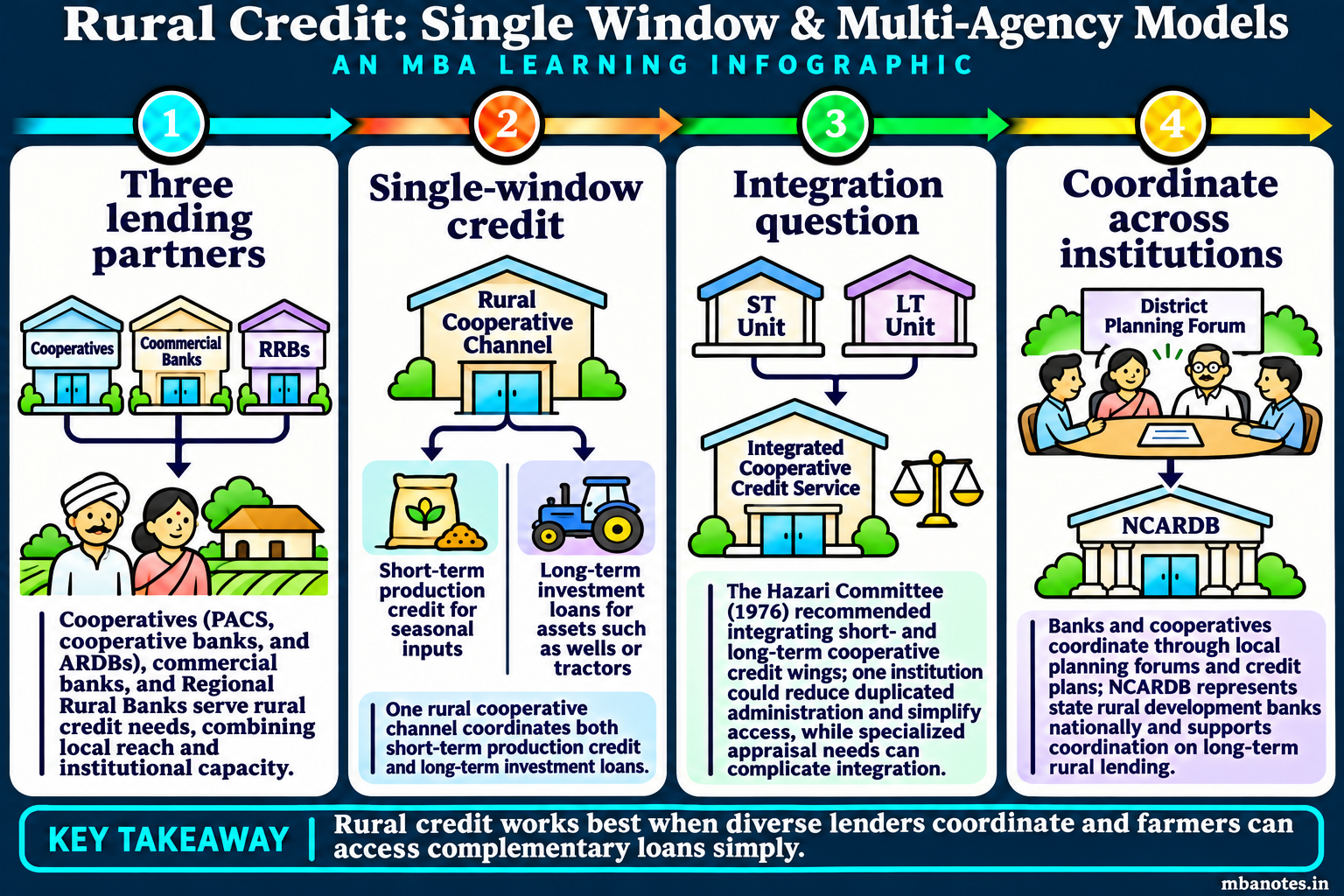
1. The Multi-Agency Rural Credit Architecture in India
Following the All India Rural Credit Review Committee (1969) and the 1969 Bank Nationalization, India abandoned the reliance on cooperatives as the sole rural lender. Today, agricultural credit operates on a Multi-Agency Approach comprising three major institutional pillars:
- Cooperative Banks (PACS, DCCBs, StCBs, ARDBs): Grassroots coverage, localized peer knowledge, and subsidized crop loan delivery.
- Commercial Banks (Public and Private): Immense deposit capital, advanced digital Core Banking technology, and mandatory Priority Sector Lending (PSL) targets (18% to agriculture).
- Regional Rural Banks (RRBs): Specialized rural hybrid banks combining the local feel of cooperatives with the modern operating discipline of commercial banks.
2. The Single Window Credit Delivery Mechanism
Under the conventional bifurcated system, an Indian farmer must visit a PACS for seasonal crop loans, and then travel to a distant taluka PCARDB to apply for a tube-well mortgage loan. This causes double documentation, dual mortgage verification fees, and conflicting repayment cycles.
The Single Window Delivery System unifies credit delivery: a single rural credit society provides the farmer with both Short-Term working capital (seeds/fertilizers) and Long-Term investment credit (borewells/tractors) simultaneously.
3. The Integration Debate: Recommendations of the Hazari Committee
The Hazari Committee (1976) appointed by the RBI recommended full structural integration of the short-term and long-term cooperative credit wings:
Arguments for Integration
Slashes administrative overhead; eliminates duplicate building and staff costs; allows comprehensive farm planning; provides one-stop credit access for smallholders.
State Resistance to Integration
Only Andhra Pradesh fully executed the merger (Single Window Model in 1987). Most states (UP, Maharashtra, Punjab) resisted because mortgage appraisal requires specialized legal cadres distinct from rapid seasonal crop lending.
4. Commercial Banks, RRBs, and Cooperative Inter-Institutional Synergy
Rather than engaging in destructive zero-sum rivalry, institutional lenders coordinate under the Lead Bank Scheme and District Consultative Committees (DCCs) headed by the District Magistrate to disburse credit in accordance with the annual Potential Linked Credit Plan (PLP) prepared by NABARD.
5. The National Cooperative Agriculture and Rural Development Banks Federation (NCARDB)
Headquartered in Navi Mumbai, NCARDB Federation is the national apex promotional organization of all State Cooperative Agriculture and Rural Development Banks:
- Acts as the national spokesman for long-term rural lending before Parliament, RBI, and NABARD.
- Negotiates debenture subscription quotas with institutional investors and government ministries.
- Publishes the quarterly academic journal "Land Bank Journal", circulating empirical research on rural capital formation.
University Examination Question Bank & Model Solutions
Designed as per Dr. A.P.J. Abdul Kalam Technical University (AKTU) MBA Examination Pattern.
Part A: Conceptual 2-Mark Short Answer Questions
Q1 [2 Marks]: What is the 'Multi-Agency Approach' in rural agricultural finance?
Ans: A policy framework deploying Cooperatives, Commercial Banks, and Regional Rural Banks (RRBs) concurrently to meet rural credit demand.
Q2 [2 Marks]: What is the core concept of the 'Single Window Delivery System'?
Ans: Delivering both Short-Term production crop credit and Long-Term investment mortgage loans to farmers through a single cooperative institution.
Q3 [2 Marks]: Which committee recommended the structural integration of the short-term and long-term cooperative credit wings in 1976?
Ans: The Hazari Committee appointed by the Reserve Bank of India.
Q4 [2 Marks]: Which Indian state pioneered the Single Window cooperative credit delivery model in 1987?
Ans: Andhra Pradesh.
Q5 [2 Marks]: What is the role of the NCARDB Federation?
Ans: The national apex federation representing and coordinating all State Cooperative Agriculture & Rural Development Banks.
Part B & C: Analytical 10-Mark Detailed Solutions & Regulatory Frameworks
Question 1 [10/15 Marks]: Analyze the Multi-Agency Approach to rural credit in India and examine the role of the Single Window credit delivery mechanism.
Model Examination Answer Blueprint:
2. The Problem of Bifurcated Credit: Farmers visiting separate institutions for crop loans (PACS) and tractor loans (PCARDB).
3. The Single Window Delivery Vision: Comprehensive credit, input distribution, and marketing through one contact point.
4. Hazari Committee Recommendations (1976): Administrative and financial arguments for merging ST and LT wings.
5. Operational Realities: The Andhra Pradesh Single Window experiment and lessons for other states.
Question 2 [10/15 Marks]: Discuss the mandate, promotional activities, and publications of the National Cooperative Agriculture and Rural Development Banks Federation (NCARDB).
Model Examination Answer Blueprint:
2. Policy Coordination: Negotiating debenture support and interest subvention with Government and NABARD.
3. Institutional Capacity Building: Executive training, project monitoring, and management guidelines.
4. Academic Dissemination: Publishing the 'Land Bank Journal' and empirical statistics.
5. Strategic Roadmap: Modernizing ARDBs into diversified rural mortgage banks.
Strategic Executive Summary: 4. Single Window & Multi-Agency Paradigms
- Strict AKTU Syllabus Parity: Covers BMB CM 03 Unit 4 Topic 4 comprehensively.
- Credit Banking & Statutory Rigor: Exhaustive treatment of DCCBs, deposit mobilization, lending operations, StCBs, ARDB long-term debentures, Sinking Fund formulas, UCBs, and RBI/NABARD supervision.
- Visual Conceptualization: Illustrated with Figure 4.4 capturing banking tiers, Sinking Fund mechanics, and supervisory frameworks.
- Examination Readiness: Features 5 Part A 2-mark conceptual questions and 2 comprehensive 10/15-mark university blueprints.
Frequently Asked Questions (Academic & Statutory FAQ)
Q1. What is the core focus of 4. Single Window & Multi-Agency Paradigms in the AKTU MBA curriculum?
Systematic study of contemporary policy paradigms in rural finance: the Hazari Committee Single Window delivery model, the Multi-Agency Approach (cooperatives + commercial banks + RRBs), and the National Cooperative Agriculture & Rural Development Banks Federation (NCARDB). It equips future banking managers with operational mastery over DCCBs, apex banks, long-term debenture flotation, UCB regulation, and RBI/NABARD supervision.
Q2. How do practitioners apply these principles in cooperative credit institutions?
Executives manage district balancing center operations, structure ALM portfolios, calculate Sinking Fund annuities for debenture redemption, enforce Section 40 payroll deductions, and comply with CAMELSC inspection norms.
Q3. What are the most frequent examination questions asked from this unit?
AKTU examinations frequently focus on the DCCB balancing center role, Sinking Fund mathematical formula, UCB dual regulation under the 2020 Amendment Act, Section 40 payroll deductions, and NABARD's Section 35(6) inspection role.
Discussion & Questions
0 CommentsAcademic insights, questions, and conceptual clarifications from students & faculty.
No questions or comments yet
Have a doubt about this topic, an exam tip, or a conceptual perspective? Start the discussion below!
Leave a Comment / Ask a Question
Your email address will not be published. Required fields are marked *