
Why BPR Initiatives Fail: The 70% Implementation Paradox, Root Causes, and Anti-Patterns
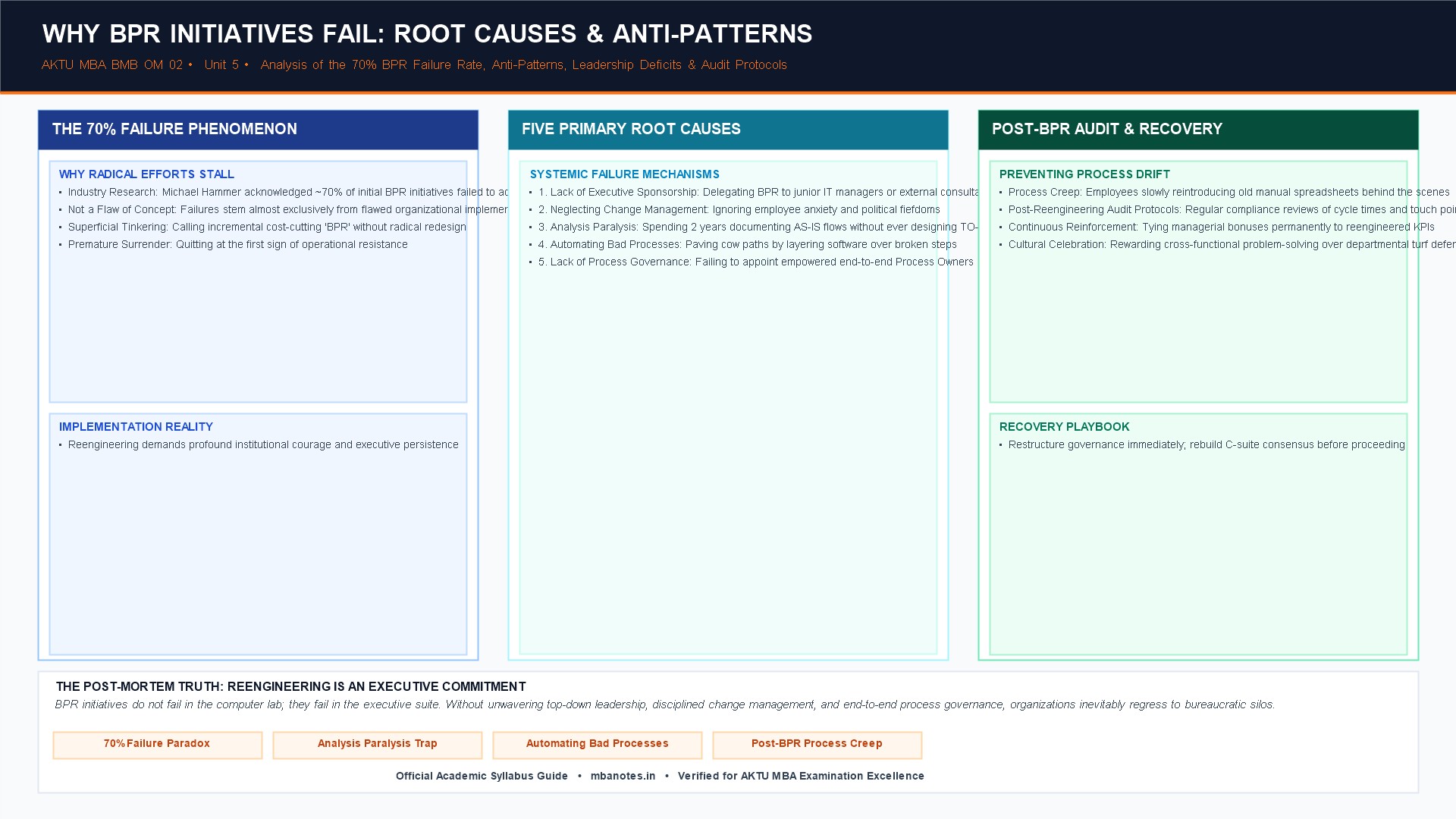
1. The 70% Failure Paradox: Deconstructing the Myth
In 1993, Michael Hammer shocked the business world by acknowledging that as many as 50% to 70% of organizations that undertook reengineering efforts failed to achieve the dramatic breakthroughs they intended. Critics quickly seized on this statistic to brand BPR as an irresponsible consulting fad.
Rigorous academic post-mortems revealed a vital truth: BPR does not fail because the concept is flawed; it fails because organizations violate the core principles of reengineering execution. When companies attempt radical transformation with weak executive sponsorship, superficial redesign, or zero human change management, failure is mathematically guaranteed.
2. The Downsizing Trap: How BPR Was Hijacked
The single most toxic anti-pattern that destroyed BPR’s reputation was the Downsizing Trap. During the 1990s, short-termist corporate executives used "reengineering" as a PR euphemism for mass layoffs, arbitrarily firing 20% of their workforce without redesigning a single workflow.
True BPR redesigns the workflow first to eliminate non-value-added work, freeing up capacity for strategic business growth. When employees realize that "BPR" is merely a code word for layoffs, terror paralyzes the organization: workers conceal inefficiencies, withhold operational insights, and sabotage new IT systems to protect their livelihoods.
3. The Top Eight BPR Failure Anti-Patterns
1. Lack of Sustained Executive Sponsorship
BPR cuts across functional department boundaries. When senior leadership delegates reengineering to middle management, department heads wage turf wars and veto cross-functional collaboration.
2. Paving the Cow Paths (Automating Broken Workflows)
Buying expensive software (SAP, Salesforce) and forcing it to replicate the exact same inefficient 40-year-old manual procedures.
3. Analysis Paralysis
Spending two years meticulously flowcharting thousands of minor variants in the broken AS-IS baseline until the budget runs dry without writing a single line of TO-BE code.
4. Timid Incrementalism
Settling for comfortable 5% to 10% tweaks to avoid political controversy, which causes massive disruption without delivering the 10x breakthrough needed to justify the pain.
5. Neglecting the Human & Cultural Architecture
Treating BPR as an IT installation and failing to invest in retraining, communication, new performance metrics, and emotional change coaching.
6. Declaring Victory Prematurely
Ceasing executive oversight after the first successful pilot, allowing the rest of the organization to slip back into traditional siloed habits.
7. Misaligned Incentives & KPIs
Telling workers to act as unified cross-functional case teams while continuing to award annual bonuses based on narrow individual department metrics.
8. Disconnected Process Governance
Failing to appoint permanent Process Owners with veto authority over rogue departmental modifications to the standardized workflow.
4. The Cultural Rebound & Process Regression Phenomenon
Without continuous post-cutover vigilance, reengineered processes suffer from Cultural Rebound. Department managers gradually re-insert manual approval checkpoints, clerks re-introduce parallel shadow spreadsheets, and the process slowly regresses back into the old functional bureaucracy within 18 to 24 months.
5. Post-BPR Governance & Continuous Calibration Controls
To permanently anchor BPR gains, enterprises establish a three-tiered control governance architecture:
- Process Audits & Conformance Checks: Process mining algorithms continuously monitor transactional event logs to identify and flag unauthorized manual workarounds in real time.
- Outcome-Based Balanced KPIs: Front-line teams are evaluated on end-to-end customer cycle time, first-pass accuracy, and cost-to-serve rather than task volumes.
- Process Center of Excellence (CoE): A permanent internal consulting unit that trains case workers, maintains BPMN repositories, and governs process change requests.
Strategic Executive Summary: 2. Why BPR Initiatives Fail: Root Causes & Anti-Patterns
- The 70% BPR failure rate reflects execution breakdowns and cultural neglect rather than flawed theoretical principles.
- The Downsizing Trap hijacked BPR as a euphemism for headcount cuts, creating employee terror and sabotage.
- Core anti-patterns include analysis paralysis, lack of executive sponsorship, and timid incrementalism.
- Permanent Process Owners and automated process mining audits are required to prevent cultural rebound.
University Examination Question Bank & Model Solutions
Designed as per Dr. A.P.J. Abdul Kalam Technical University (AKTU) MBA Examination Pattern.
Part A: Conceptual 2-Mark Short Answer Questions
Q1 [2 Marks]: Why did Michael Hammer cite a 70% failure rate for BPR?
Ans: Hammer reported that 50-70% of companies failed to achieve their intended breakthrough performance goals due to poor implementation execution, lack of executive sponsorship, and neglect of change management.
Q2 [2 Marks]: What is the "Downsizing Trap" in BPR?
Ans: The Downsizing Trap occurs when management uses BPR as an excuse for mass layoffs without redesigning workflows, triggering severe employee resistance and organizational collapse.
Q3 [2 Marks]: What is "cultural rebound" after a BPR implementation?
Ans: Cultural rebound is the tendency of an organization to slowly revert to old bureaucratic habits, manual approvals, and departmental silos once initial project scrutiny subsides.
Part B & C: Analytical 10-Mark Detailed Solutions & Numerical Blueprints
Question 1 [10/15 Marks]: Critically examine the primary root causes of BPR failures. What lessons must modern operations managers learn from the 70% failure paradox? (AKTU 10 Marks)
Model Examination Answer Blueprint:
- Introduction & Deconstruction: Frame Hammer's 70% failure rate as an execution breakdown rather than an architectural flaw.
- Detailed Anti-Patterns Analysis:
- Executive Failure: Lack of top-level sponsorship; delegating radical change to middle managers who defend silos.
- Technical Myopia: Paving cow paths by computerizing bad processes.
- Analytical Failure: Analysis paralysis in AS-IS modeling.
- Human Failure: The downsizing trap, fear, lack of communication, and failure to reskill. - Actionable Managerial Playbook: How modern leaders deploy agile prototyping, empathetic change management, and outcome-based incentives to guarantee transformation success.
Question 2 [10/15 Marks]: Explain the post-implementation governance mechanisms necessary to prevent reengineered processes from regressing into bureaucratic silos. (AKTU 10 Marks)
Model Examination Answer Blueprint:
- The Threat of Process Regression: Explain why organizations naturally gravitate back to comfortable functional silos.
- Institutionalizing Process Ownership: Permanent role of the Process Owner with budget authority over cross-functional resources.
- Continuous Conformance Telemetry: Using automated process mining to detect shadow spreadsheets and unauthorized manual checkpoints.
- Aligning Organizational Architecture: Redefining compensation structures, career paths, and cultural recognition around end-to-end customer value streams.
Frequently Asked Questions (Academic & Practitioner FAQ)
Q1. Is BPR synonymous with corporate downsizing?
No. Downsizing does less with less. BPR does vastly more with less by eliminating non-value waste and redeploying talent into strategic business expansion.
Q2. How long does a full BPR transformation take to stabilize?
While redesign and pilot rollout typically take 12 to 18 months, full cultural refreezing and behavioral stabilization require 3 to 5 years of consistent executive leadership.
Discussion & Questions
0 CommentsAcademic insights, questions, and conceptual clarifications from students & faculty.
No questions or comments yet
Have a doubt about this topic, an exam tip, or a conceptual perspective? Start the discussion below!
Leave a Comment / Ask a Question
Your email address will not be published. Required fields are marked *