
Management Accounting: Meaning, Nature, Scope & Management vs Financial Accounting
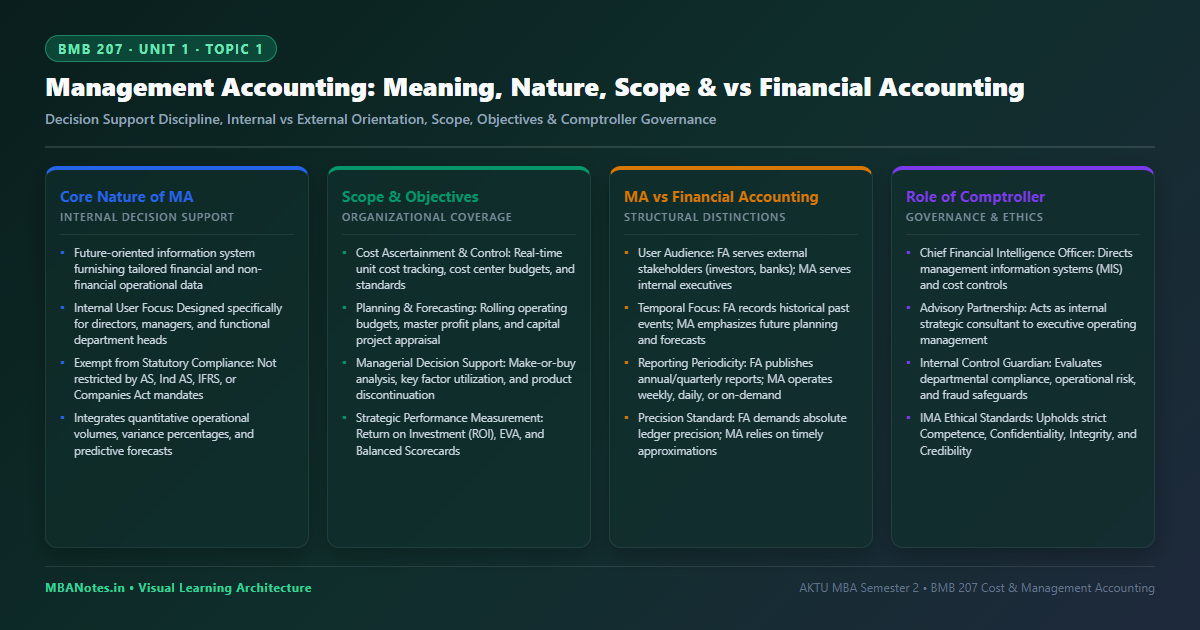
1. Conceptual Meaning, Nature & Objectives of Management Accounting
Management Accounting (also termed Managerial Accounting) represents the application of professional accounting techniques, quantitative analytics, and economic principles to generate strategic financial intelligence for internal organizational leadership. According to the Chartered Institute of Management Accountants (CIMA, London), "Management Accounting is the sourcing, analysis, communication and use of decision-relevant financial and non-financial information to generate and preserve value for organizations."
- Internal Decision-Centric Focus: It is customized strictly for organizational executives, plant managers, and department heads rather than external lenders or shareholders.
- Prospective Future Orientation: While conventional accounting looks backward at historical transactions, managerial accounting projects cash flows, standard costs, and target budgets into the future.
- Absence of Rigid Statutory Frameworks: It operates free from standard statutory constraints (Ind AS, US GAAP, or IFRS); reports are formatted according to management preference.
- Integration of Non-Monetary Data: Blends financial metrics with operational indicators such as defect parts per million (PPM), cycle time, employee turnover, and customer satisfaction index.
- Cause-and-Effect Diagnosis: Examines why variances occur between budgeted expectations and actual outcomes rather than simply recording final net profit figures.
- Selectivity & Relevance: Filters voluminous ledger data to extract only actionable decision-relevant figures, discarding sunk and irrelevant historical overheads.
- Interdisciplinary Synergy: Draws heavily on microeconomics (marginal revenue, elasticity), operations research (linear programming, queuing), psychology (motivation, incentives), and corporate law.
2. Comprehensive Scope & Organizational Functions
Management accounting encompasses an expansive operational scope across both manufacturing and service enterprises:
- Cost Ascertainment & Control: Establishing cost accounting frameworks to compute unit product costs, overhead absorption rates, and job profitability.
- Financial Planning & Budgetary Control: Formulating master budgets, flexible budgets, and rolling operating forecasts to guide resource deployment across divisions.
- Strategic Decision Support: Supplying differential cost analytics for critical choices including make-or-buy, export dumping, special order pricing, and plant shutdown decisions.
- Inventory & Working Capital Optimization: Calculating Economic Order Quantities ($EOQ$), safety stock thresholds, and cash conversion cycle targets to prevent liquidity lock-up.
- Performance Measurement & Responsibility Accounting: Segmenting the enterprise into cost, revenue, profit, and investment centers to assess divisional managerial efficiency.
- Tax Planning & Corporate Governance: Evaluating the after-tax impact of major capital investments, lease-versus-buy alternatives, and compliance reporting.
- Internal Control & Risk Evaluation: Designing robust operational check mechanisms, internal audits, and segregation of duties to prevent fraud and waste.
Management Accounting Analytics & Solved Numerical
Managerial AnalyticsKey Performance & Decision Equations:
2. Return on Capital Employed (ROCE) = $\frac{\text{Operating Profit (EBIT)}}{\text{Capital Employed}} \times 100$
3. Working Capital Turnover Ratio = $\frac{\text{Net Annual Sales}}{\text{Net Working Capital (Current Assets - Current Liabilities)}}$
4. Economic Value Added (EVA) = $\text{NOPAT} - (\text{WACC} \times \text{Invested Capital})$
An industrial manufacturing firm presents the following operational extract for executive appraisal:
• Net Sales Revenue = ₹12,00,000
• Cost of Goods Sold (COGS) = ₹7,20,000
• Operating Expenses (Admin & Selling) = ₹1,80,000
• Total Current Assets = ₹4,50,000; Current Liabilities = ₹2,00,000
• Non-Current Assets (Net Plant & Machinery) = ₹7,50,000; Long-Term Debt = ₹3,00,000
Required: Calculate (a) Operating Profit (EBIT), (b) Operating Margin %, (c) Net Working Capital and Working Capital Turnover Ratio, and (d) Return on Capital Employed (ROCE).
Strict Step-by-Step Mathematical Solution:
$$\text{Gross Profit} = \text{Net Sales} - \text{COGS} = \text{₹}12,00,000 - \text{₹}7,20,000 = \text{₹}4,80,000$$ $$\text{Operating Profit (EBIT)} = \text{Gross Profit} - \text{Operating Expenses} = \text{₹}4,80,000 - \text{₹}1,80,000 = \mathbf{\text{₹}3,00,000}$$
Step 2: Compute Operating Profit Margin
$$\text{Operating Margin} = \left(\frac{\text{EBIT}}{\text{Net Sales}}\right) \times 100 = \left(\frac{3,00,000}{12,00,000}\right) \times 100 = \mathbf{25.0\%}$$
Step 3: Compute Net Working Capital and Working Capital Turnover
$$\text{Net Working Capital (NWC)} = \text{Current Assets} - \text{Current Liabilities} = \text{₹}4,50,000 - \text{₹}2,00,000 = \mathbf{\text{₹}2,50,000}$$ $$\text{Working Capital Turnover} = \frac{\text{Net Sales}}{\text{NWC}} = \frac{12,00,000}{2,50,000} = \mathbf{4.8\text{ times}}$$ Interpretation: The business generates ₹4.80 in revenue for every ₹1.00 invested in liquid working capital.
Step 4: Compute Capital Employed and ROCE
$$\text{Capital Employed} = \text{Non-Current Assets} + \text{Net Working Capital} = \text{₹}7,50,000 + \text{₹}2,50,000 = \mathbf{\text{₹}10,00,000}$$ $$\text{ROCE} = \left(\frac{\text{EBIT}}{\text{Capital Employed}}\right) \times 100 = \left(\frac{3,00,000}{10,00,000}\right) \times 100 = \mathbf{30.0\%}$$
Executive Appraisal: The enterprise achieves a healthy $30\%$ pre-tax return on total capital deployed, providing strong managerial support for future facility expansion.
4. Structural Comparison: Management Accounting vs. Financial Accounting
Understanding the boundaries between management accounting and financial accounting is a foundational requirement in corporate governance:
| Comparison Dimension | Financial Accounting (FA) | Management Accounting (MA) |
|---|---|---|
| Primary Target Audience | External stakeholders (Shareholders, Banks, Income Tax authorities, Creditors) | Internal decision-makers (Board of Directors, CEOs, Factory Supervisors) |
| Temporal Time Orientation | Historical stewardship; records transactions that have already transpired | Future-oriented forecasting, budgetary targets, and predictive modeling |
| Statutory Regulation & Formats | Strictly mandatory under Companies Act, Schedule III, Ind AS, and IFRS | Purely voluntary; customized entirely to operational information needs |
| Reporting Frequency | Periodic intervals (Quarterly, Half-Yearly, Annually) | Continuous, real-time, daily, weekly, or on-demand flash dashboards |
| Level of Aggregation | Macro-level enterprise-wide summary (Balance Sheet & P&L Statement) | Micro-level reporting by product line, machine center, plant, or territory |
| Audit Requirement | Mandatory statutory audit by an independent Chartered Accountant (CA) | No legal requirement for external audit; subject only to internal reviews |
6. Corporate Case Vignette: Tata Motors Passenger Vehicles Turnaround
Tata Motors: Modular Platform Rationalization via Management Accounting
In 2016, Tata Motors' passenger vehicle business was burdened by an unsustainable cost structure, operating across six legacy vehicle architectures with fragmented supply chains, high warranty expenses, and negative operating margins. Standard financial accounting statements reliably registered deep quarterly net losses, but failed to diagnose the operational root cause.
The corporate management accounting unit conducted a comprehensive activity-based cost audit. By implementing a two-platform strategy (ALFA and OMEGA architecture), component commonality soared from 30% to over 70%. Management accounting flash reports tracked target cost deviations on every prototype iteration, slashing development capex by 40% and cutting direct material procurement costs by ₹1,500 Crores annually. This managerial control system facilitated the profitable launches of the Nexon, Harrier, and Punch, restoring the division to market-leading EBITDA margins.
7. AKTU University Examination Question Bank
Q1: Define Management Accounting and state its primary objective.
Model Answer: Management Accounting is the specialized process of identifying, measuring, analyzing, and communicating financial and operational information to internal management. Its primary objective is to assist executives in strategic planning, budgeting, operational control, resource allocation, and decision-making.
Q2: Mention two differences between Financial Accounting and Management Accounting regarding regulation.
Model Answer: Financial Accounting is legally mandatory and strictly governed by statutory accounting standards (Ind AS/GAAP) and the Companies Act, whereas Management Accounting is completely voluntary and free from any statutory format or compliance rules.
Q3: "Management Accounting is an indispensable tool of modern executive management." Discuss its nature, scope, and limitations. Contrast it with Financial Accounting across at least six distinct parameters.
Exam Strategy: Begin with standard CIMA definition. Explain nature (future focus, cause-effect analysis, non-monetary integration). Outline scope (budgets, marginal costing, inventory, performance reporting). Present a structured comparative table covering target users, orientation, legal status, periodicity, level of detail, and audit requirements. Conclude with limitations (reliance on historical figures, subjective judgment, installation cost).
Discussion & Questions
0 CommentsAcademic insights, questions, and conceptual clarifications from students & faculty.
No questions or comments yet
Have a doubt about this topic, an exam tip, or a conceptual perspective? Start the discussion below!
Leave a Comment / Ask a Question
Your email address will not be published. Required fields are marked *