
Cost-Volume-Profit (CVP) Analysis: Marginal Cost and Contribution Explained
1. Conceptual Architecture of Marginal Costing & Cost Behavior
In traditional absorption costing, total factory overheads—both fixed and variable—are apportioned and absorbed into inventory. This conventional practice often creates distorted managerial conclusions because changes in inventory levels alter reported profits: producing goods that remain unsold absorbs fixed overheads into inventory, artificially inflating reported operating income. Marginal Costing (also termed direct costing or variable costing) radically redefines cost reporting by classifying every operational expense strictly based on its behavioral relationship with production volume.
According to the Chartered Institute of Management Accountants (CIMA, London), marginal cost is defined as "the amount at any given volume of output by which aggregate costs are changed if the volume of output is increased or decreased by one unit." In practical managerial terms, marginal cost equals the total variable cost. The operational architecture of marginal costing rests on key behavioral principles:
- Dichotomy of Costs: Every operating cost is separated into variable elements (which vary directly with production volume) and fixed elements (which remain static in total across the relevant range).
- Constant Unit Variable Cost: Variable costs per unit—such as direct raw materials, piece-rate wages, and variable machine power—remain invariant regardless of whether output expands or contracts.
- Fixed Cost as a Period Cost: Fixed costs—such as factory building rent, executive salaries, and administrative depreciation—are incurred due to the passage of time rather than unit creation. They are written off entirely against the income statement of the current accounting period.
- Product Cost vs. Period Cost Distinction: Only variable manufacturing costs are capitalized as product costs and assigned to work-in-progress (WIP) and finished goods inventory. Finished inventory is never burdened with unexpired fixed overheads.
- Elimination of Over/Under-Absorption: Because fixed manufacturing overheads are not absorbed using predetermined overhead recovery rates, the complex accounting adjustments for under-absorbed or over-absorbed factory overheads are entirely eliminated.
- Unambiguous Profit Visibility: Net operating profit becomes an exclusive function of sales volume rather than production volume, preventing plant managers from artificially boosting profits through unneeded overproduction.
- Operational Decision Utility: Provides senior leadership with clear incremental data to evaluate special export orders, optimize scarce machine capacity, and assess make-or-buy trade-offs.
2. The Fundamental Marginal Equation & Contribution Dynamics
The entire conceptual and computational foundation of marginal costing converges on the concept of Contribution. Contribution represents the excess of sales revenue over aggregate variable costs. It is the operational surplus generated by product sales that is dedicated first to covering total fixed period costs; once fixed costs are fully recovered, any additional contribution flows straight to net operating profit.
The Fundamental Marginal Costing Identities
Expressed in algebraic notation:
When operating at a loss: S - V = C = F - L
Contribution per Unit (CPU) = Selling Price per Unit (SP) - Variable Cost per Unit (VC)
Total Contribution = Quantity Sold (Q) × CPU
Managerial Rule: If Contribution > Fixed Cost, business earns an operating profit. If Contribution < Fixed Cost, business incurs a loss. When Contribution = Fixed Cost, business operates at exact Break-Even Point.
Understanding the strategic significance of Contribution provides management with actionable insights that gross margin or net profit figures obscure:
- Protection Against Faulty Product Deletions: A product line may show an accounting net loss under absorption costing due to allocated administrative overhead. However, if it generates a positive contribution, deleting the line would reduce total company profit by the lost contribution, leaving the fixed overhead unrecovered.
- Pricing Power during Recessions: In severe market downturns, management can temporarily accept orders priced below total absorption cost—provided the selling price exceeds variable cost ($SP > VC$), thereby generating positive contribution toward fixed expenses.
- Sensitivity to Volume Expansion: Because fixed costs remain locked in total, every additional unit sold beyond the break-even point increases net profit by exactly 100% of the unit contribution ($CPU$).
- Direct Benchmark for Operating Leverage: Companies with high contribution margins relative to fixed costs experience rapid profit expansion during sales upswings, as well as rapid profit collapse during downturns.
3. Cost-Volume-Profit (CVP) Assumptions & Theoretical Boundaries
Cost-Volume-Profit (CVP) Analysis extends marginal costing into a predictive planning tool. It examines the dynamic interplay between selling prices, sales volume, unit variable costs, total fixed costs, and product sales mix to forecast operational profitability. However, for CVP mathematical models to remain tractable, the framework relies on several rigorous theoretical assumptions:
1. Strict Cost Segregation
Assumes all operational costs can be reliably divided into 100% variable and 100% fixed components. Semi-variable costs are broken down cleanly using the high-low or regression method.
2. Constant Selling Price
Assumes selling price per unit remains perfectly constant across all sales volume ranges. No quantity discounts, price slashing to boost sales, or premium pricing are considered in the baseline model.
3. Constant Factor Productivity
Assumes direct labour productivity, plant operational efficiency, and raw material purchase rates remain constant. Learning curve effects and bulk procurement rebates are assumed away.
4. Invariant Sales Mix
In multi-product companies, the proportion of each product sold in the total revenue basket is assumed to remain strictly constant, enabling the calculation of an aggregate weighted average contribution.
To contrast the two reporting philosophies, the table below highlights the foundational operational and accounting differences between Absorption Costing and Marginal Costing:
4. Mathematical Blueprint, Operating Leverage & Solved Numerical
To quantify operational risk and sensitivity, management evaluates Degree of Operating Leverage (DOL). Operating leverage measures how sensitive an enterprise's operating profit (EBIT) is to changes in sales volume:
Mathematical Formulary: CVP & Operating Leverage
Interpretation: A DOL of 3.0 signifies that a 10% increase in sales volume produces a 30% surge in operating profit (and vice versa for sales declines).
Comprehensive Solved Numerical Illustration
Problem Statement: Precision Autotech Ltd. manufactures an automobile component with an installed capacity of 50,000 units per annum. The operational cost records for the current year reveal the following:
- Selling Price per unit: ₹ 200
- Direct Materials per unit: ₹ 70
- Direct Labour per unit: ₹ 30
- Variable Factory Overheads per unit: ₹ 20
- Variable Selling & Distribution Overheads per unit: ₹ 10
- Total Fixed Factory Overheads per annum: ₹ 18,00,000
- Total Fixed Administration & Selling Overheads: ₹ 6,00,000
- Current Annual Output & Sales Volume: 40,000 units
Required: (a) Compute Marginal Cost per unit and Contribution per unit. (b) Compute Total Contribution, P/V Ratio, and Net Operating Profit at current sales. (c) Calculate the Degree of Operating Leverage (DOL). (d) Determine the revised profit if sales volume increases by 15%. (e) Determine the revised profit if selling price is reduced by 10% while volume increases by 25%.
Step-by-Step Solution Guide
Step 1: Compute Marginal Cost per unit (Variable Cost per unit):
VC = ₹ 70 + ₹ 30 + ₹ 20 + ₹ 10 = ₹ 130 per unit
Step 2: Compute Contribution per unit (CPU):
CPU = ₹ 200 - ₹ 130 = ₹ 70 per unit
Step 3: Total Contribution, P/V Ratio & Net Operating Profit at 40,000 units:
Total Variable Cost = 40,000 units × ₹ 130 = ₹ 52,00,000
Total Contribution = 40,000 × ₹ 70 = ₹ 28,00,000
P/V Ratio = (Contribution / Sales) × 100 = (₹ 28,00,000 / ₹ 80,00,000) × 100 = 35.00%
Total Fixed Costs = ₹ 18,00,000 + ₹ 6,00,000 = ₹ 24,00,000
Net Operating Profit = Total Contribution - Total Fixed Costs = ₹ 28,00,000 - ₹ 24,00,000 = ₹ 4,00,000
Step 4: Degree of Operating Leverage (DOL):
DOL = ₹ 28,00,000 / ₹ 4,00,000 = 7.00
(Significance: A 1% increase in sales expands EBIT by 7% due to the heavy fixed overhead base)
Step 5: Impact of 15% increase in sales volume (Volume = 46,000 units):
New Contribution = 46,000 units × ₹ 70 = ₹ 32,20,000
Less: Fixed Costs = ₹ 24,00,000 (remains constant)
Revised Operating Profit = ₹ 32,20,000 - ₹ 24,00,000 = ₹ 8,20,000
Percentage Profit Increase = [(₹ 8,20,000 - ₹ 4,00,000) / ₹ 4,00,000] × 100 = 105%
(Verification: Volume increased by 15%; 15% × DOL of 7.0 = 105% profit surge!)
Step 6: Price Cut of 10% with 25% Volume Expansion (SP = ₹ 180, Volume = 50,000 units):
Variable Cost per unit = ₹ 130 per unit (unchanged)
Revised CPU = ₹ 180 - ₹ 130 = ₹ 50 per unit
Revised Volume = 40,000 × 1.25 = 50,000 units (full capacity)
Revised Contribution = 50,000 × ₹ 50 = ₹ 25,00,000
Less: Fixed Costs = ₹ 24,00,000
Revised Operating Profit = ₹ 25,00,000 - ₹ 24,00,000 = ₹ 1,00,000
(Managerial Insight: Despite running at 100% capacity, operating profit collapses from ₹ 4,00,000 to ₹ 1,00,000 due to severe unit contribution erosion!)
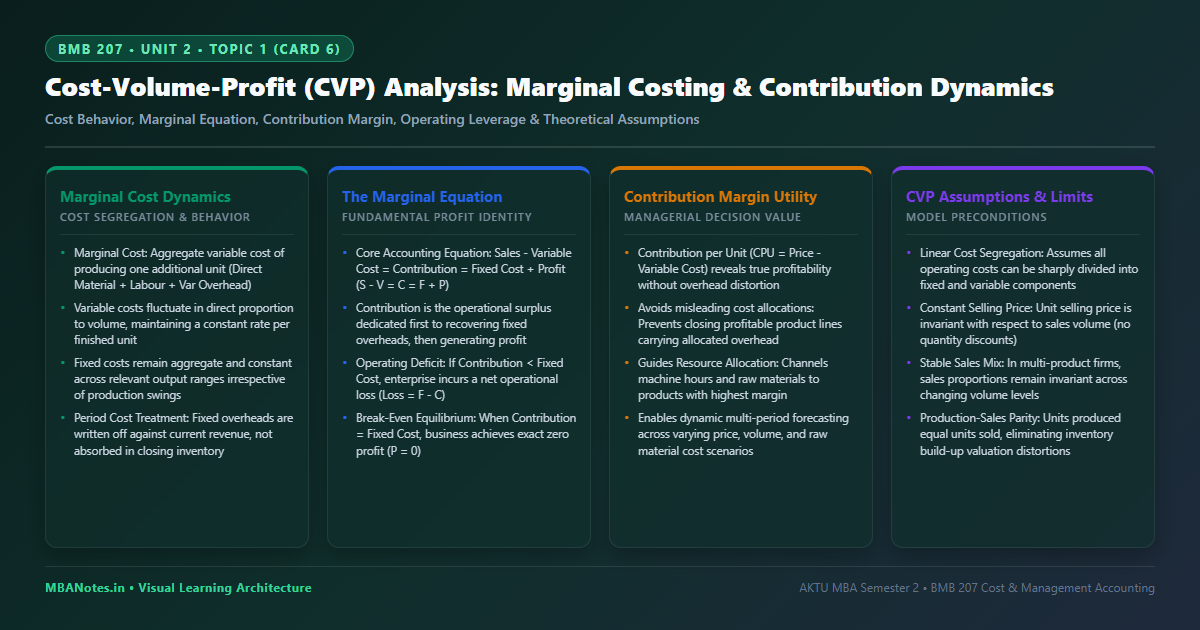
5. Visual Framework: CVP & Marginal Costing Core Dynamics
The following architectural visual guide synthesizes the four structural quadrants of marginal costing: Cost Segregation & Behavior, Fundamental Marginal Profit Identities, Strategic Decision Value of Contribution, and the CVP Operational Assumptions:
6. Corporate Case Vignette: Bharat Forge Capacity Rationalization
Corporate Application: Navigating Cyclical Swings in Automotive Forging
During an international cyclical downturn in global commercial vehicle production, Pune-based automotive forging giant Bharat Forge Ltd. experienced an abrupt 35% decline in domestic truck chassis forging orders. Under traditional absorption costing, the heavy capital-intensive forging presses carried massive fixed depreciation and plant upkeep overheads. Absorption costing calculations indicated that each forging unit was losing ₹ 4,200, prompting regional plant supervisors to recommend shutting down two continuous forging lines.
However, Bharat Forge's executive management accounting team deployed Marginal Costing and CVP differential analysis. They segregated the operations: the marginal variable cost to produce each forging unit was ₹ 11,800 against an international export spot market quote of ₹ 13,500. While the export price was well below the full absorption cost of ₹ 16,000, each export unit yielded a positive unit contribution of ₹ 1,700 ($₹ 13,500 - ₹ 11,800$).
By securing export contracts for 45,000 forging components, Bharat Forge generated an aggregate incremental contribution of ₹ 7.65 Crores. This cash surplus directly absorbed factory fixed overheads that would otherwise have remained completely unrecovered, preserved skilled metallurgy operator talent, and kept forging furnaces hot until domestic automotive demand rebounded.
7. AKTU Exam Orientation: Solved Section A & Section B/C Questions
Section A (2 Marks Conceptual Questions)
Answer: Marginal cost is the incremental cost incurred by producing one additional unit of output. It comprises all direct expenses: Direct Materials + Direct Labour + Direct Chargeable Expenses + Variable Production Overheads. Fixed costs are excluded as they do not vary with incremental production.
Answer: Contribution is the excess of Sales over Variable Costs ($C = S - V$) and represents the operational surplus available to cover fixed costs. Profit is the residual surplus remaining only after all fixed costs have been fully deducted from Contribution ($Profit = Contribution - Fixed Costs$).
Answer: Fixed costs (such as rent, insurance, and executive salaries) are incurred with the passage of calendar time rather than the physical creation of units. Therefore, they are charged as period expenses directly against the current income statement and are never capitalized in unsold inventory.
Answer: (1) The unrealistic assumption that selling price per unit and variable cost per unit remain strictly constant regardless of output volume. (2) The difficulty in cleanly separating semi-variable and stepped fixed costs into rigid binary categories in real-world volatile businesses.
Section B & C (10 Marks Analytical Questions)
Structuring the 10-Mark Answer:
- Definitions & Framework: Define Absorption Costing (full product absorption) and Marginal Costing (variable product costing).
- Tabular Contrast: Provide the 7-parameter comparative table contrasting cost categorization, closing inventory valuation, treatment of fixed factory overheads, and external reporting compliance (Ind AS 2).
- The Profit Reconciliation Mechanism:
- Case 1 (Production = Sales): Both systems report identical operating net profits because all fixed overheads incurred during the period are expensed.
- Case 2 (Production > Sales): Absorption costing reports higher profit than marginal costing because a portion of fixed manufacturing overhead is capitalized in unsold closing stock and deferred to the next period.
- Case 3 (Sales > Production): Marginal costing reports higher profit than absorption costing because opening stock with capitalized fixed overheads is released and expensed under absorption costing.
- Algebraic Proof: Difference in Profit = $(Closing Stock - Opening Stock) \times Fixed Overhead Absorption Rate per Unit$.
Structuring the 10-Mark Answer:
- Why Internal Leadership Relies on Marginal Costing: Explain the elimination of volume-induced profit distortions, clear contribution margin visibility, make-or-buy differential pricing, limiting key resource allocation, and plant shutdown decisions.
- Why External Financial Regulators Prohibit Marginal Costing: Cite Ind AS 2, IAS 2, and US GAAP requirements that inventory must be valued at "cost of purchase and cost of conversion" including fixed production overheads to reflect true balance sheet asset worth. Under-valuing inventory purely at variable cost violates the matching principle for external investors.
- Corporate Synthesis: Conclude by showing how modern multinational enterprises maintain parallel accounting ledgers (ERP systems like SAP S/4HANA): Absorption Costing for statutory tax audits and stock exchange filings, and Marginal Costing for executive MIS dashboards and pricing models.
Discussion & Questions
0 CommentsAcademic insights, questions, and conceptual clarifications from students & faculty.
No questions or comments yet
Have a doubt about this topic, an exam tip, or a conceptual perspective? Start the discussion below!
Leave a Comment / Ask a Question
Your email address will not be published. Required fields are marked *