
Process Costing: Normal Loss, Abnormal Loss and Abnormal Gain
1. Principles of Process Costing & Sequential Stage Flow
Process Costing is an operational costing method applied in industries where standardized, homogeneous goods are produced through continuous, sequential manufacturing stages. In these facilities—such as petroleum refining, chemical synthesis, cement manufacturing, sugar processing, and paper mills—products cannot be distinguished into individual customer jobs. Instead, production costs are accumulated by processing department or stage for a specified calendar period.
The fundamental operational characteristics of process costing include:
- Continuous Sequential Transformation: The finished output of Process 1 serves as the raw material input for Process 2, and so forth, until final finished goods emerge from the terminal process.
- Homogeneous Output: All units passing through a process receive identical amounts of direct materials, labor, and conversion overheads.
- Cost Accumulation by Process: Separate ledger accounts (e.g., Process I A/c, Process II A/c) are maintained for each operational stage.
- Average Unit Cost Computation: Cost per unit is calculated by dividing total process costs incurred during the period by total good units produced: $\text{Unit Cost} = \frac{\text{Total Process Cost}}{\text{Good Output Units}}$.
- Treatment of Inevitable Wastage: Physical processing inevitably causes material evaporation, chemical shrinkage, or physical breakage, requiring structured accounting for normal and abnormal losses.
2. Normal Loss Accounting & Scrap Realization Mechanics
Normal Loss is the unavoidable loss of material that is inherent in the physical or chemical nature of the manufacturing process. It arises under standard operating efficiency from unavoidable causes such as evaporation, chemical shrinkage, trimming waste, or standard heating loss.
Accounting Principles for Normal Loss
Because normal loss is an unavoidable cost of manufacturing, it is treated as a legitimate cost of production. The financial loss is absorbed entirely by the remaining good units produced, effectively increasing the cost per good unit:
Cost per Good Unit = (Total Process Cost - Realizable Scrap Value of Normal Loss) / Normal Output Units
Scrap Realization Rule: If normal loss material has scrap market value, the realizable scrap value (Normal Loss Units × Scrap Rate) is credited to the Process Account and debited to the Scrap / Cash Account.
3. Abnormal Loss and Abnormal Gain Ledger Dynamics
When actual physical wastage diverges from predetermined normal loss expectations, the divergence is treated as either an Abnormal Loss or an Abnormal Gain:
Abnormal Loss Dynamics
Occurs when actual loss exceeds the normal loss allowance: Actual Loss > Normal Loss (Actual Output < Normal Output). Caused by equipment breakdowns, operator negligence, or sub-standard materials.
Credited to Process A/c.
Net loss (Value - Scrap) charged to Costing P&L A/c.
Abnormal Gain Dynamics
Occurs when actual loss is less than normal loss: Actual Loss < Normal Loss (Actual Output > Normal Output). Reflects superior efficiency or exceptional material quality.
Debited to Process A/c.
Net gain transferred to credit of Costing P&L A/c.
4. Unit Cost Formulations & Solved Process Costing Numerical (10-Mark AKTU Parity)
Below is a standard AKTU 10-mark examination problem demonstrating the preparation of a Process Account, Normal Loss Account, and Abnormal Loss Account.
AKTU Exam Problem: Process Account with Normal & Abnormal Loss
During the month of August, 2,000 units of raw material costing ₹ 20 per unit were introduced into Process A. The operating expenses incurred during the month were:
- Direct Raw Materials added: ₹ 18,000
- Direct Wages: ₹ 24,000
- Direct Expenses: ₹ 5,000
- Production Overheads: ₹ 15,000
Process Specifications: Normal wastage in the process is estimated at 10% of total input units. The scrap realized from normal loss is sold in the market at ₹ 5 per unit. Actual completed production transferred to Process B was 1,750 units.
Required: (a) Compute Cost per Unit of finished output; (b) Prepare Process A Account; (c) Prepare Normal Loss Account; and (d) Prepare Abnormal Loss Account.
Step 1: Quantity Reconciliation & Cost per Unit Computation
Normal Loss (10% of 2,000) = 200 units (Scrap Value = 200 × ₹ 5 = ₹ 1,000)
Expected Normal Output = 2,000 - 200 = 1,800 units
Actual Output transferred to Process B = 1,750 units
Abnormal Loss = Normal Output (1,800) - Actual Output (1,750) = 50 units
Total Cost Incurred in Process A:
= Material Input (2,000 × ₹ 20 = ₹ 40,000) + Direct Material (₹ 18,000) + Wages (₹ 24,000) + Expenses (₹ 5,000) + Overheads (₹ 15,000)
Total Debit Cost = ₹ 1,02,000
Cost per Good Unit = (Total Cost - Scrap Value of Normal Loss) / Normal Output
Cost per Unit = (₹ 1,02,000 - ₹ 1,000) / 1,800 units = ₹ 1,01,000 / 1,800 = ₹ 56.111 per unit
Value of Abnormal Loss (50 units × ₹ 56.111) = ₹ 2,806
Value of Output transferred to Process B (1,750 units × ₹ 56.111) = ₹ 98,194
Step 2: Process A Account
| Particulars | Units | Amount (₹) | Particulars | Units | Amount (₹) |
|---|---|---|---|---|---|
| To Material Introduced | 2,000 | 40,000 | By Normal Loss A/c (@ ₹ 5) | 200 | 1,000 |
| To Direct Materials | — | 18,000 | By Abnormal Loss A/c | 50 | 2,806 |
| To Direct Wages | — | 24,000 | By Process B A/c (Transfer) | 1,750 | 98,194 |
| To Direct Expenses | — | 5,000 | — | — | — |
| To Production Overheads | — | 15,000 | — | — | — |
| Total | 2,000 | 1,02,000 | Total | 2,000 | 1,02,000 |
Step 3: Normal Loss A/c & Abnormal Loss A/c
| Abnormal Loss Account | |||||
|---|---|---|---|---|---|
| To Process A A/c | 50 units | ₹ 2,806 | By Cash (Scrap @ ₹ 5) | 50 units | ₹ 250 |
| — | — | — | By Costing P&L A/c (Net Loss) | — | ₹ 2,556 |
| Total | 50 | ₹ 2,806 | Total | 50 | ₹ 2,806 |
5. Visual Framework: Process Costing & Loss Architecture
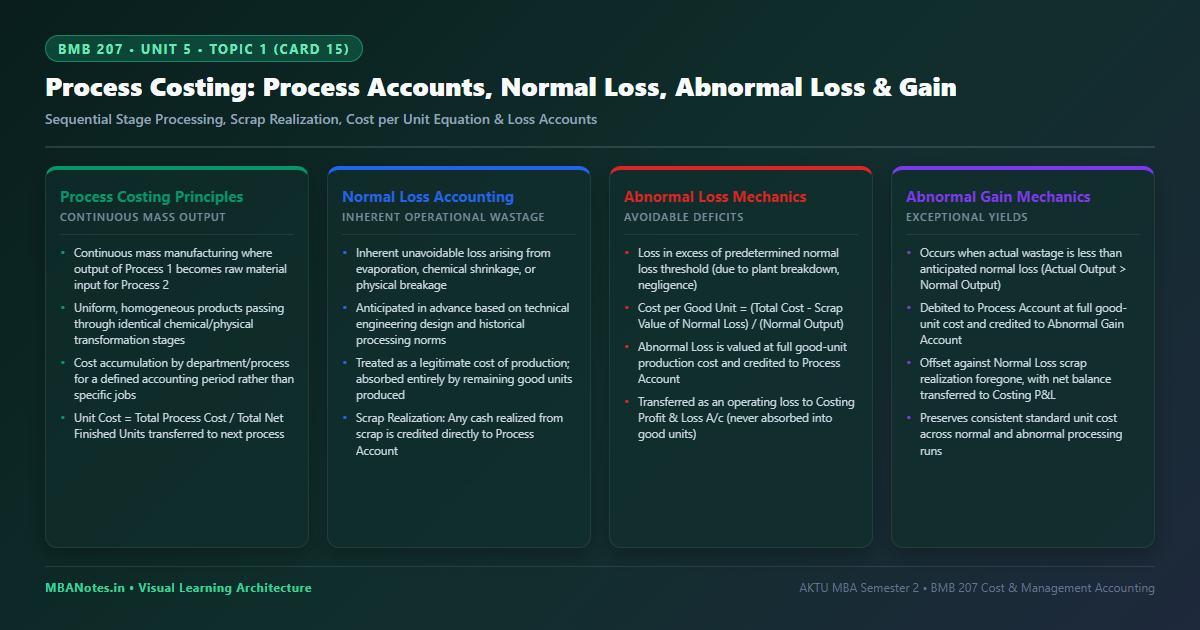
The visual layout below summarizes the core elements of process costing: Continuous Flow Architecture, Normal Loss Absorption, Abnormal Loss Accounting, and Abnormal Gain Ledger Reconciliation:
6. Corporate Case Vignette: Reliance Jamnagar Refinery Cracking Processes
Corporate Application: Multi-Stage Continuous Process Costing in Petroleum Refining
Reliance Industries Ltd. (RIL) operates the world's largest refining complex at Jamnagar, Gujarat, processing 1.4 million barrels of crude oil daily through sequential stages: Atmospheric Distillation, Vacuum Distillation, Fluidized Catalytic Cracking (FCC), and Hydrocracking.
Crude oil distillation incurs inherent thermal evaporation losses (Normal Loss of ~2.5%), which are absorbed into the cost of intermediate petroleum fractions. When unexpected catalyst contamination triggered an Abnormal Loss of valuable propylene gas, refinery cost systems isolated the deficit at good-unit conversion cost rather than inflating the unit inventory valuation of downstream polymers.
By using standardized process costing ledgers, Reliance accounts for refinery fuel gases, tracks abnormal yields across catalytic crackers, and benchmarks unit processing costs against global Singapore refining margin standards.
7. AKTU Exam Orientation: Solved Conceptual & Analytical Questions
Section A (2 Marks Conceptual Questions)
Answer: Normal Loss is the inherent, unavoidable wastage of material that naturally occurs during manufacturing operations due to evaporation, chemical shrinkage, or physical breakage. It is treated as a legitimate cost of production absorbed by good units.
Answer: Abnormal Loss is valued at full good-unit production cost and credited to the Process Account. The scrap value realized from abnormal units is credited to the Abnormal Loss Account, and the remaining net loss is charged to the Costing Profit & Loss Account.
Answer: An Abnormal Gain arises when actual production output exceeds the expected normal output (i.e., actual loss is less than the predetermined normal loss allowance), reflecting superior operating efficiency.
Answer: $\text{Cost per Unit} = \frac{\text{Total Process Cost} - \text{Realizable Scrap Value of Normal Loss}}{\text{Units Introduced} - \text{Normal Loss Units}}$.
Section B & C (10 Marks Analytical Questions)
Structuring the 10-Mark Answer:
- Definition & Scope: Define Process Costing as the method of cost accumulation by processing stage for continuous, homogeneous mass production.
- Detailed Tabular Contrast: Provide the 5-parameter matrix covering nature, predictability, cost absorption, valuation basis, and P&L transfer.
- Ledger Accounting Entries:
- Normal Loss: Debit Normal Loss A/c, Credit Process A/c (with scrap value).
- Abnormal Loss: Debit Abnormal Loss A/c, Credit Process A/c (with full unit cost). On scrap sale: Debit Cash A/c, Credit Abnormal Loss A/c; balance to Costing P&L A/c.
- Abnormal Gain: Debit Process A/c, Credit Abnormal Gain A/c (with full unit cost); offset against normal scrap loss foregone, with net balance credited to Costing P&L A/c.
Structuring the 10-Mark Answer:
- Concept: Explain that an abnormal gain occurs when actual wastage is less than anticipated normal loss ($Actual Output > Normal Output$).
- Rationale for Good-Unit Valuation: Explain that valuing abnormal gain at full unit cost maintains consistency: good units transferred to the next process reflect standard normal unit cost rather than being artificially depressed by temporary windfalls.
- Offsetting Against Normal Scrap Foregone: Explain that producing an abnormal gain means fewer normal scrap units are available to sell. Therefore, the Abnormal Gain Account is debited with the scrap value foregone, and only the net surplus is credited to the Costing Profit & Loss Account.
Discussion & Questions
0 CommentsAcademic insights, questions, and conceptual clarifications from students & faculty.
No questions or comments yet
Have a doubt about this topic, an exam tip, or a conceptual perspective? Start the discussion below!
Leave a Comment / Ask a Question
Your email address will not be published. Required fields are marked *