
Change Management in BPR: Kotter’s 8-Step Model, Overcoming Resistance, and Cultural Transformation
1. The Human Dimension: Why BPR Fails Without Change Management
The technical aspects of BPR—redesigning flowcharts, writing software code, procuring cloud databases—are analytically straightforward. The true battleground of reengineering is the human mind. BPR threatens long-standing power structures, job titles, social cliques, and professional identities.
When organizations treat BPR purely as an engineering project while ignoring organizational psychology, employees respond with passive resistance, malicious compliance, or overt sabotage, ensuring the new design collapses upon deployment.
2. Psychological Sources and Typologies of Employee Resistance
Individual / Psychological Drivers
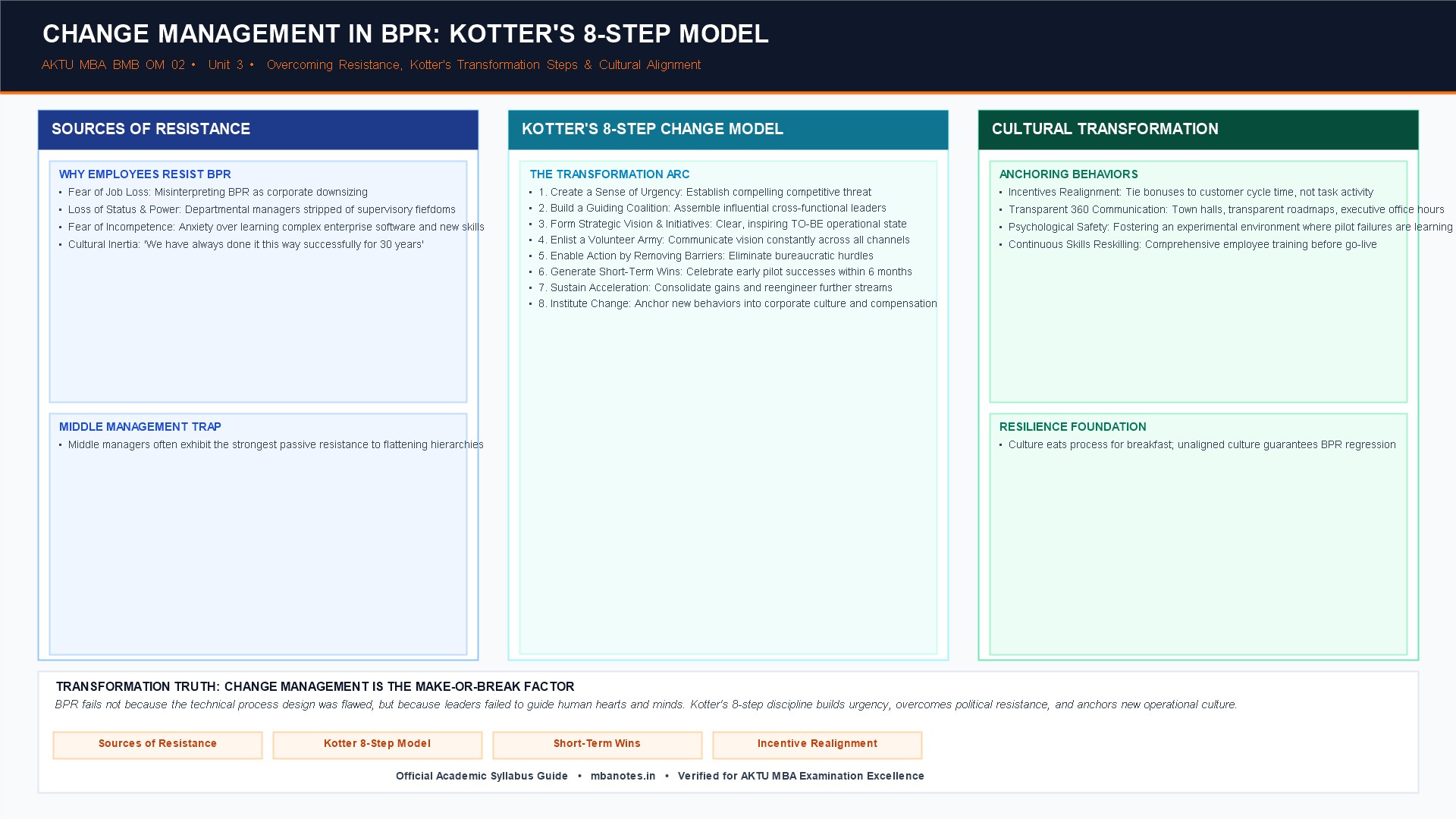
- Fear of Unemployment: Reengineering has a historical reputation for downsizing and layoffs.
- Competency Obsolescence: Workers who spent 20 years mastering manual routines fear looking incompetent under automated digital platforms.
- Loss of Control & Autonomy: Moving into transparent case teams exposes individual work output to real-time scrutiny.
Systemic / Organizational Drivers
- Turf Wars & Loss of Power: Middle managers fiercely defend headcounts and department budgets from process owner centralization.
- Misaligned Reward Systems: Employees are told to cooperate in cross-functional teams, but their annual bonuses still reward individual silo metrics.
- Change Fatigue: Weariness caused by previous failed management fads and half-hearted consulting initiatives.
3. Kurt Lewin’s Force Field Analysis & 3-Stage Change Model
Social psychologist Kurt Lewin established two foundational change models:
- Force Field Analysis: Any organizational state is a dynamic equilibrium held between Driving Forces (competitive pressure, new technology, customer demands) and Restraining Forces (fear, bureaucratic habits, sunk costs). To effect change, managers should reduce restraining forces rather than simply applying more pressure, which only increases internal stress and pushback.
- The 3-Stage Change Model:
- Unfreeze: Disrupt the comfort zone, present undeniable proof of market crisis ("burning platform"), and dismantle complacency.
- Change (Transition): Guide employees through ambiguity toward the new TO-BE operating model with intensive training and coaching.
- Refreeze: Institutionalize the new process into corporate culture, KPIs, promotion criteria, and enterprise habits.
4. John Kotter’s 8-Step Change Acceleration Framework
Harvard Business School Professor John Kotter formulated an 8-stage sequence to navigate large-scale transformations successfully:
Expose competitive realities and negative benchmark gaps to make the status quo seem more dangerous than launching into the unknown.
Assemble an influential cross-functional team with sufficient executive power, expertise, and credibility to lead the change.
Articulate an inspiring, clear future state that can be easily communicated to workers within 5 minutes.
Communicate the vision relentlessly across all media channels; executive leadership must walk the talk consistently.
Dismantle structural obstacles, outdated policies, and misaligned incentives that block employees from adopting new practices.
Deliver unambiguous, highly visible quick wins within 6 to 12 months to silence cynics and build momentum.
Use credibility gained from quick wins to tackle more complex structural bottlenecks; avoid declaring victory too early.
Embed new behaviors into company culture, succession planning, promotion paths, and corporate folklore.
5. Strategies for Overcoming Resistance & Cultural Alignment
Kotter and Schlesinger identified six strategic approaches for handling organizational resistance:
- Education & Communication: Preempt rumors through open town halls, honest data sharing, and regular executive briefings.
- Participation & Involvement: Involve frontline employees in designing the TO-BE process, fostering personal ownership.
- Facilitation & Support: Provide comprehensive reskilling, digital tool training, and emotional counseling to ease the transition.
- Negotiation & Agreement: Offer incentives or guaranteed retraining paths to potential powerful resisters.
- Manipulation & Co-optation: Give influential opinion leaders key advisory roles to gain their public endorsement.
- Explicit & Implicit Coercion: Used as a last resort when speed is critical and resistance threatens company survival (e.g., reassignment or dismissal).
Strategic Executive Summary: 4. Change Management in BPR: Kotter’s 8-Step Transformation
- Change management is the critical determinant of BPR survival; technical designs collapse without human buy-in.
- Resistance stems from individual fears (job loss, obsolescence) and organizational politics (turf wars, lost power).
- Lewin’s Force Field Analysis emphasizes reducing restraining forces rather than just amplifying driving pressure.
- Kotter’s 8-step framework guides organizations systematically from establishing urgency to anchoring culture.
University Examination Question Bank & Model Solutions
Designed as per Dr. A.P.J. Abdul Kalam Technical University (AKTU) MBA Examination Pattern.
Part A: Conceptual 2-Mark Short Answer Questions
Q1 [2 Marks]: Name the three stages of Kurt Lewin’s change management model.
Ans: 1. Unfreeze (creating motivation to change), 2. Change/Transition (learning new behaviors), 3. Refreeze (stabilizing and institutionalizing change).
Q2 [2 Marks]: Why are short-term wins critical in John Kotter’s 8-step framework?
Ans: Short-term wins provide empirical proof that the transformation works, neutralizing skeptics, boosting team morale, and justifying ongoing executive investment.
Q3 [2 Marks]: What is "malicious compliance" in the context of change resistance?
Ans: Malicious compliance occurs when employees follow new procedures to the strict, absurd letter of the rule while knowing it will cause operational failure, deliberately demonstrating that the new system is flawed.
Part B & C: Analytical 10-Mark Detailed Solutions & Numerical Blueprints
Question 1 [10/15 Marks]: Critically analyze John Kotter’s 8-step model for leading change. How should it be applied to a large-scale BPR project? (AKTU 10 Marks)
Model Examination Answer Blueprint:
- Introduction: Outline the high failure rate of BPR and explain why managing organizational psychology is vital.
- Step-by-Step Kotter Sequence:
- Defrosting Complacency: Steps 1-3 (Urgency, Guiding Coalition, Strategic Vision).
- Empowering the Enterprise: Steps 4-6 (Communicating Vision, Removing Barriers, Short-Term Wins).
- Institutionalization: Steps 7-8 (Sustaining Acceleration, Anchoring in Corporate Culture). - Application to BPR: Relate each step to typical reengineering events (e.g., launching an ERP pilot, retraining case workers, retiring legacy green-screen systems).
- Common Pitfalls: Prematurely declaring victory after the first pilot, weak sponsorship, and neglecting cultural refreezing.
Question 2 [10/15 Marks]: Explain Kurt Lewin’s Force Field Analysis. Using an example, demonstrate how managers overcome restraining forces during BPR. (AKTU 10 Marks)
Model Examination Answer Blueprint:
- Theoretical Foundations: Dynamic equilibrium between Driving Forces (market competition, customer demand, efficiency) and Restraining Forces (fear, loss of power, technical inertia).
- The Managerial Dilemma: Why increasing driving forces causes counter-pressure and revolt, making the reduction of restraining forces the superior strategy.
- Operational BPR Scenario: A hospital reengineering patient admissions from 8 paper forms to a digital tablet system.
- Identify driving forces (speed, error reduction, regulatory push).
- Identify restraining forces (nurses' unfamiliarity with tablets, fear of data loss).
- Detail mitigation strategies (hands-on peer training, 24/7 IT floor support, no-blame learning period).
Frequently Asked Questions (Academic & Practitioner FAQ)
Q1. What is the biggest mistake leaders make in BPR change management?
The biggest mistake is declaring victory after the first successful pilot project. Culture takes years to refreeze; removing pressure too early causes the organization to snap back to old habits.
Q2. How does continuous communication mitigate employee rumors during reengineering?
In the absence of clear communication from leadership, fear fills the vacuum with catastrophic rumors. Transparent communication about why change is necessary and how employees will be supported preempts anxiety.
Discussion & Questions
0 CommentsAcademic insights, questions, and conceptual clarifications from students & faculty.
No questions or comments yet
Have a doubt about this topic, an exam tip, or a conceptual perspective? Start the discussion below!
Leave a Comment / Ask a Question
Your email address will not be published. Required fields are marked *