
Organizational Redesign, Process Ownership, and Cross-Functional Case Teams in BPR
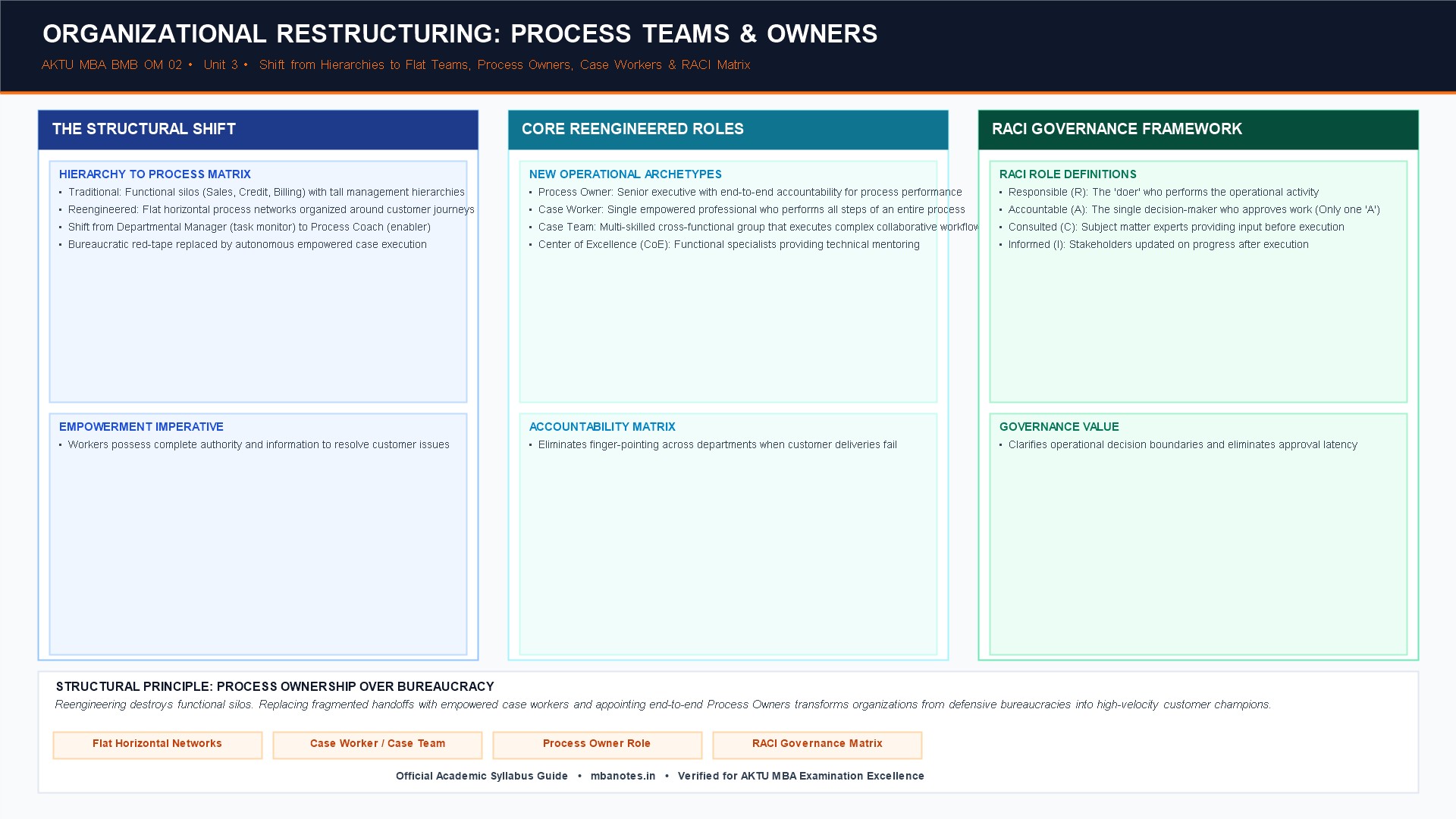
1. The Collapse of the Traditional Functional Pyramid
For two centuries, corporations organized themselves into vertical functional silos: Sales, Purchasing, Engineering, Manufacturing, Quality, and Accounting. While specialization delivered localized functional efficiency, it created severe enterprise liabilities:
- The Handoff Penalty: Work spends 90% of its time sitting idle in queues waiting to be transferred across departmental borders.
- Goal Sub-Optimization: Departments optimize their own internal metrics at the expense of end-to-end customer satisfaction (e.g., Purchasing buys cheap low-grade materials to hit price targets, causing massive factory scrap).
- No One Owns the Customer Outcome: If a customer order is delayed, Sales blames Manufacturing, Manufacturing blames Purchasing, and Purchasing blames Finance.
2. Process-Centered Organization Architecture
BPR rotates the enterprise axis by 90 degrees: shifting from a vertical hierarchical pyramid to a horizontal, process-centered network organized around complete customer value streams (e.g., Concept-to-Market, Order-to-Cash, Procure-to-Pay, Issue-to-Resolution).
Traditional Functional Organization
- Organized around tasks and professional disciplines
- Vertical hierarchy with numerous management layers
- Fragmented responsibilities; high handoffs
- Management acts as bureaucratic supervisory controllers
Reengineered Process Organization
- Organized around end-to-end customer value streams
- Flat networks with minimal intermediary management
- End-to-end process ownership; zero handoffs
- Managers act as supportive coaches and facilitators
3. The Role and Authority of the Process Owner
The most critical organizational innovation in BPR is the Process Owner—a senior executive who holds single-point, end-to-end accountability for the design, performance, and continuous re-calibration of a complete business process across all functional departments.
Unlike traditional department managers who manage people within a silo, the Process Owner controls the workflow architecture, sets enterprise process KPIs, approves IT investments for the value stream, and standardizes operating procedures globally.
4. Case Workers and Cross-Functional Case Teams
To obliterate departmental hand-offs, BPR deploys two frontline execution structures:
1. The Case Worker Model
A single, multi-skilled, empowered individual performs all sequential steps of an entire process from initiation to completion, supported by expert decision systems. Example: IBM Credit replaced 5 specialized clerks with a single "Deal Structurer" who completed credit approval in 4 hours instead of 6 days.
2. The Cross-Functional Case Team Model
When work is too vast or complex for a single individual (e.g., commercial aircraft development, major insurance claims), a dedicated, co-located multi-disciplinary team executes the entire workflow together, eliminating inter-departmental memos and delays.
5. RACI Matrix Framework for BPR Governance
To ensure operational clarity in redesigned workflows, organizations construct a RACI Matrix defining the governance role for every task:
- Responsible (R): The "doer" who executes the specific task.
- Accountable (A): The single individual with ultimate veto and decision authority (only ONE "A" per task).
- Consulted (C): Subject matter experts providing two-way input before work execution.
- Informed (I): Stakeholders kept updated on one-way progress notifications.
Strategic Executive Summary: 3. Organizational Restructuring: Process Teams & Process Owners
- Functional pyramids create severe handoff penalties, sub-optimization, and diffused accountability.
- Process-centered organizations rotate the enterprise axis to focus on horizontal customer value streams.
- The Process Owner provides single-point, end-to-end accountability across functional department lines.
- Case Workers and Case Teams eliminate inter-departmental queues through multi-skilling and software empowerment.
University Examination Question Bank & Model Solutions
Designed as per Dr. A.P.J. Abdul Kalam Technical University (AKTU) MBA Examination Pattern.
Part A: Conceptual 2-Mark Short Answer Questions
Q1 [2 Marks]: What is a Process Owner in BPR governance?
Ans: A Process Owner is a senior leader responsible for the end-to-end design, governance, and operational performance of an entire cross-functional business process.
Q2 [2 Marks]: Distinguish between a Case Worker and a Case Team.
Ans: A Case Worker executes all sequential steps of a workflow individually using software support. A Case Team is a co-located cross-functional group that executes complex work collaboratively.
Q3 [2 Marks]: What does the acronym RACI stand for?
Ans: Responsible (doer), Accountable (decision maker/approver), Consulted (expert input), Informed (notified of results).
Part B & C: Analytical 10-Mark Detailed Solutions & Numerical Blueprints
Question 1 [10/15 Marks]: Explain the organizational restructuring required for successful BPR. Contrast functional silos with horizontal process-oriented organizations. (AKTU 10 Marks)
Model Examination Answer Blueprint:
- Pathology of Functional Silos: Departmental boundaries, handoff queues, communication breakdown, and lack of end-to-end accountability.
- The Horizontal Rotation: Transition to core value streams (Order-to-Cash, Procure-to-Pay). Flattening of hierarchies and eliminating intermediary bureaucratic checkers.
- Organizational Building Blocks:
- Process Owner: Mandate, authority, and cross-functional governance.
- Case Workers & Teams: Empowerment, multi-skilling, and shared outcome metrics. - Cultural & Management Evolution: Shift from autocratic supervision to facilitative leadership and coaching.
Question 2 [10/15 Marks]: Develop a RACI governance matrix for a reengineered Order-to-Delivery process across Sales, Warehouse, Logistics, and Process Owner. (AKTU 10 Marks)
Model Examination Answer Blueprint:
- RACI Theory: Define Responsible, Accountable, Consulted, and Informed. Emphasize the cardinal rule: Exactly one "A" per activity.
- Matrix Construction:
- Activity 1: Order Validation (Sales = R, Process Owner = A, Credit = C, Customer = I).
- Activity 2: Inventory Allocation (Warehouse = R, Process Owner = A, Sales = I).
- Activity 3: Dispatch & Logistics (Logistics = R, Process Owner = A, Warehouse = C, Customer = I).
- Activity 4: Process Continuous Improvement (Process Owner = A & R, Functional Heads = C). - Governance Insights: Explain how RACI eliminates role confusion and prevents buck-passing in high-speed workflows.
Frequently Asked Questions (Academic & Practitioner FAQ)
Q1. Does appointing a Process Owner eliminate traditional department managers?
Not necessarily. In a matrix structure, department managers act as centers of excellence responsible for hiring, coaching, and professional standards, while Process Owners manage how workflows execute across those resources.
Q2. Why can there only be ONE "Accountable" role in a RACI row?
If multiple people share accountability, no one is truly accountable, recreating the classic corporate blame game when failures occur.
Discussion & Questions
0 CommentsAcademic insights, questions, and conceptual clarifications from students & faculty.
No questions or comments yet
Have a doubt about this topic, an exam tip, or a conceptual perspective? Start the discussion below!
Leave a Comment / Ask a Question
Your email address will not be published. Required fields are marked *