
International Trade Theories: Mercantilism, Absolute Advantage, Comparative Cost, Heckscher-Ohlin, Leontief Paradox, and Porter’s Diamond
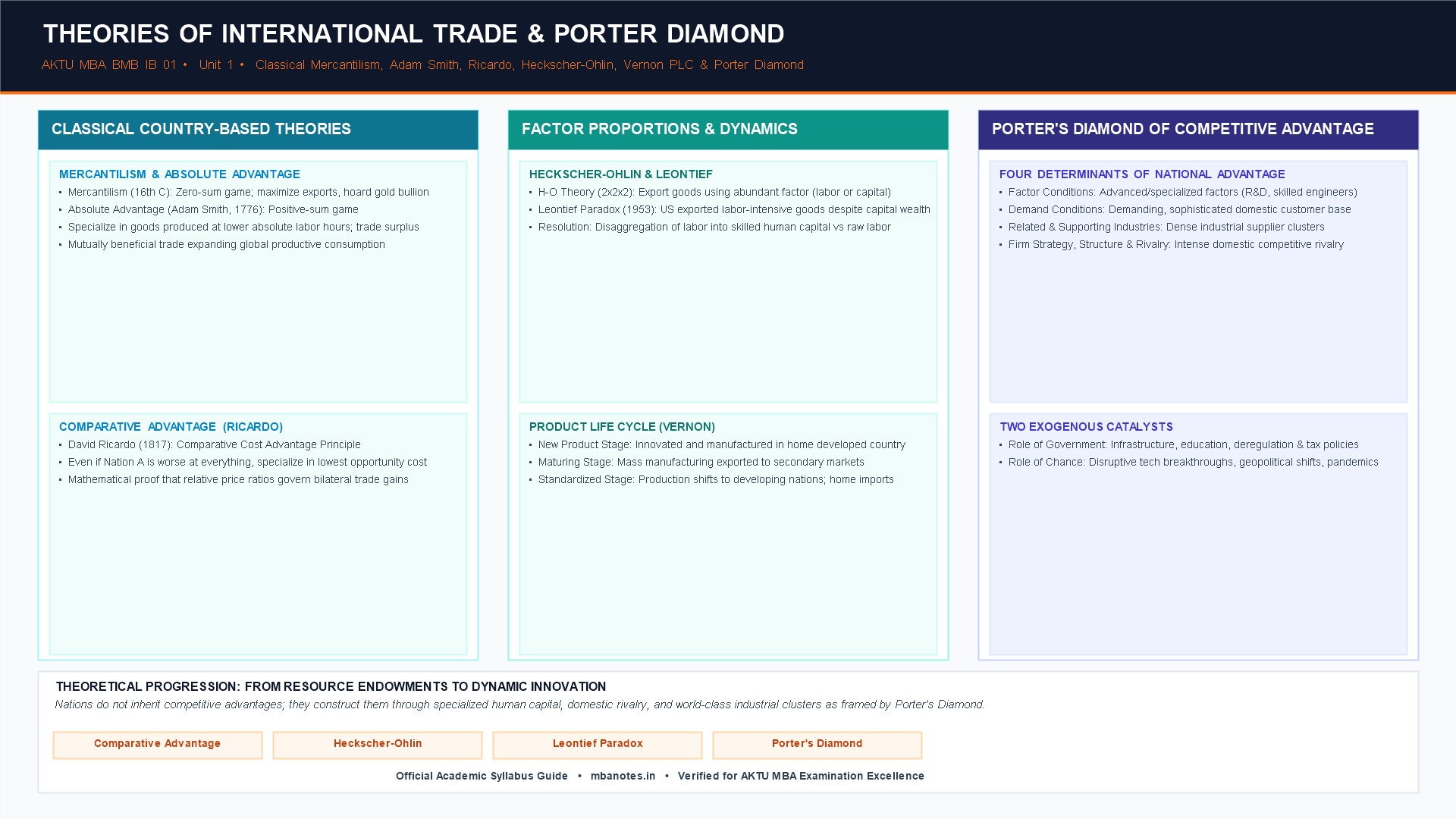
1. Classical Trade Theories: Mercantilism & Adam Smith
The evolution of international trade theory explains why nations trade, which goods they export and import, and how cross-border specialization generates aggregate global welfare:
- Mercantilism (16th–18th Century): An economic philosophy holding that national wealth is measured strictly by the accumulation of gold and silver bullion. Mercantilists viewed international trade as a zero-sum game—one nation can gain only if another loses. Governments aggressively intervened by subsidizing exports and imposing punitive tariffs on imports.
- Adam Smith’s Theory of Absolute Advantage (1776): In The Wealth of Nations, Smith attacked mercantilist doctrine, proving that international trade is a positive-sum game. He proposed that a nation should specialize exclusively in producing goods that it can manufacture with fewer physical labor hours than any other nation (Absolute Advantage), trading its surplus for commodities in which other nations hold an absolute advantage.
2. David Ricardo’s Theory of Comparative Advantage
In 1817, David Ricardo demonstrated in Principles of Political Economy and Taxation that mutually beneficial trade does not require an absolute advantage. Even if one nation can produce every commodity with fewer labor hours than its trading partner, mutually profitable trade remains possible provided nations specialize according to Comparative Advantage—meaning they produce the good in which they possess the lowest relative opportunity cost.
Ricardian 2-Country, 2-Commodity Numerical Model
Consider England and Portugal producing Wine and Cloth with labor requirements per unit:
| Country | Wine (Labor Hours / Unit) | Cloth (Labor Hours / Unit) | Domestic Price Ratio (Opportunity Cost) |
|---|---|---|---|
| Portugal | 80 hours | 90 hours | 1 Wine = 80/90 = 0.89 Cloth (Lower opportunity cost in Wine) |
| England | 120 hours | 100 hours | 1 Cloth = 100/120 = 0.83 Wine (Lower opportunity cost in Cloth) |
Outcome: Although Portugal possesses an absolute advantage in both commodities (requiring fewer labor hours for both), Portugal has a comparative advantage in Wine (0.89 vs 1.20 in England), while England has a comparative advantage in Cloth (0.83 vs 1.12 in Portugal). Both nations gain if Portugal specializes in Wine and England specializes in Cloth, trading at terms between the two domestic price ratios.
3. Heckscher-Ohlin (H-O) Factor Proportions Theory
Swedish economists Eli Heckscher and Bertil Ohlin extended Ricardian theory by explaining why comparative cost differences exist. The Heckscher-Ohlin (H-O) Theory (2x2x2 Model) attributes comparative advantage to national differences in factor endowments (capital vs. labor):
- The Factor Proportions Theorem: A country will export commodities whose production requires the intensive use of that nation's relatively abundant and cheap factor of production, and import commodities whose production requires the intensive use of its relatively scarce and expensive factor.
- Application: A capital-abundant nation (e.g., Germany, Japan) will export capital-intensive goods (automobiles, advanced robotics) and import labor-intensive goods (textiles, footwear) from labor-abundant economies (e.g., Bangladesh, Vietnam).
4. The Leontief Paradox & Human Capital Resolution
In 1953, Nobel laureate Wassily Leontief tested the H-O theory empirically using US input-output tables. Because the United States was the world's most capital-abundant country, H-O theory predicted that US exports would be capital-intensive and imports labor-intensive.
The Empirical Paradox & Its Resolution
Leontief found that US exports were actually more labor-intensive than its import-competing goods. This startling contradiction became known as the Leontief Paradox.
Theoretical Resolution: Leontief and subsequent trade economists solved the paradox by decomposing 'labor' into unskilled raw labor vs. highly educated human capital (engineers, scientists, managers). When human capital and R&D expenditures are included in capital metrics, the US was revealed to be exporting goods intensive in advanced knowledge and skilled labor, thereby vindicating factor endowment principles.
5. Raymond Vernon’s International Product Life Cycle (PLC)
Harvard professor Raymond Vernon proposed the International Product Life Cycle (IPLC) theory, asserting that the location of production shifts dynamically across three stages as a product matures:
- Stage 1: New Product Stage: Innovated and produced in the high-income home country (e.g., USA) close to affluent customers; price elasticity is low, production is unstandardized, and rapid design changes occur.
- Stage 2: Maturing Product Stage: Domestic demand expands and mass production begins. Exporting increases to other developed markets. Overseas competitors emerge, prompting the innovating firm to set up assembly plants in secondary developed nations to defend market share.
- Stage 3: Standardized Product Stage: Production becomes totally routine, automated, and commoditized. Cost minimization becomes the sole competitive driver. Production shifts entirely to low-cost developing countries. The original innovating home country becomes a net importer of its own product.
6. Michael Porter’s Diamond of National Competitive Advantage
In 1990, Harvard Business School professor Michael Porter published The Competitive Advantage of Nations, introducing a dynamic, firm-based framework. Porter argued that national competitive advantage is not inherited through raw factor endowments (land, unskilled labor), but created through a self-reinforcing diamond of four interlinked determinants:
1. Factor Conditions
Differentiates between basic factors (natural resources, climate) and advanced/specialized factors (research universities, high-speed fiber infrastructure, specialized engineering pools). Advanced specialized factors are crucial for sustainable competitive advantage.
2. Demand Conditions
The nature of home-market demand. Sophisticated, demanding, and uncompromising domestic consumers pressure local firms to innovate faster, upgrade quality, and anticipate future global needs.
3. Related & Supporting Industries
The presence of world-class domestic supplier networks and complementary industrial clusters (e.g., German precision toolmakers supporting automotive manufacturers; Silicon Valley venture capital and component firms).
4. Firm Strategy, Structure & Rivalry
The conditions governing how companies are organized and managed, and the intensity of domestic competition. Intense domestic rivalry forces firms to innovate and seek operational excellence, preparing them to win globally.
Porter supplements the diamond with two exogenous catalysts: The Role of Government (regulations, subsidies, antitrust enforcement, education investments) and The Role of Chance (random major technological breakthroughs, wars, financial shocks, raw material spikes).
University Examination Question Bank & Model Solutions
Designed as per Dr. A.P.J. Abdul Kalam Technical University (AKTU) MBA Examination Pattern.
Part A: Conceptual 2-Mark Short Answer Questions
Q1 [2 Marks]: State Adam Smith's Absolute Advantage Principle.
Ans: A nation should specialize in and export goods that it can produce with fewer physical labor hours than other nations, trading for goods in which it has an absolute labor disadvantage.
Q2 [2 Marks]: Explain the Leontief Paradox.
Ans: Wassily Leontief's 1953 empirical finding that the capital-abundant United States was exporting labor-intensive goods and importing capital-intensive goods, contradicting the Heckscher-Ohlin model.
Q3 [2 Marks]: List the four determinants of Michael Porter's Diamond model.
Ans: 1) Factor Conditions, 2) Demand Conditions, 3) Related and Supporting Industries, and 4) Firm Strategy, Structure, and Rivalry.
Part B & C: Analytical 10-Mark Detailed Solutions & Strategic Frameworks
Question 1 [10/15 Marks]: Explain David Ricardo's Theory of Comparative Advantage with a numerical illustration. How does Michael Porter's Diamond model advance our understanding of national competitive advantage?
Model Examination Answer Blueprint:
2. Ricardian Comparative Cost Theory: State assumptions and prove mathematically using a 2-country, 2-commodity matrix (e.g., England cloth vs Portugal wine) that trade gains occur via lowest opportunity cost.
3. Factor Proportions & Leontief Paradox: Explain the Heckscher-Ohlin theorem and how the Leontief Paradox was resolved via human capital and R&D differentiation.
4. Michael Porter's Diamond Architecture: Detail the 4 core determinants (Factor conditions, Demand conditions, Related industries, Firm rivalry) plus the two catalysts (Government and Chance).
5. Modern Relevance: Explain how Porter's Diamond applies to modern global industrial clusters (e.g., German automotive, Indian IT clusters in Bengaluru).
Strategic Executive Summary: 4. Classical & Modern Trade Theories & Porter Diamond
- Classical trade theories progressed from Mercantilist bullion hoarding to Adam Smith's Absolute Advantage and David Ricardo's foundational Comparative Cost Advantage principle.
- Ricardo proved mathematically that mutually beneficial trade occurs when nations specialize in goods where their domestic opportunity cost is lowest, irrespective of absolute productivity levels.
- The Heckscher-Ohlin theorem attributes comparative advantage to national factor endowments (capital vs labor), while the Leontief Paradox was resolved by recognizing human capital and R&D.
- Michael Porter's Diamond model shifts trade theory from passive inherited endowments to four active, self-reinforcing determinants of national competitive advantage.
Frequently Asked Questions (Academic & Practitioner FAQ)
Q1. What is the core intuition of the Comparative Advantage principle?
The core principle states that nations gain from trade by specializing in goods where they have the lowest relative opportunity cost of production, even if another nation possesses an absolute productivity advantage in all commodities.
Q2. What is the Leontief Paradox and why is it important?
The Leontief Paradox was the empirical discovery in 1953 that the capital-abundant United States exported labor-intensive goods and imported capital-intensive goods, challenging the simple Heckscher-Ohlin model and prompting economists to account for human capital and technological knowledge.
Q3. How does domestic rivalry in Porter's Diamond benefit national firms globally?
Vigorous domestic competition prevents companies from becoming complacent. It forces local rivals to constantly innovate, reduce costs, improve product quality, and develop robust capabilities, preparing them to compete successfully on the global stage.
Discussion & Questions
0 CommentsAcademic insights, questions, and conceptual clarifications from students & faculty.
No questions or comments yet
Have a doubt about this topic, an exam tip, or a conceptual perspective? Start the discussion below!
Leave a Comment / Ask a Question
Your email address will not be published. Required fields are marked *