
Concurrency Control Protocols: Two-Phase Locking (2PL), Timestamp Ordering, and Deadlock Handling
1. Why Concurrency Control Protocols are Essential
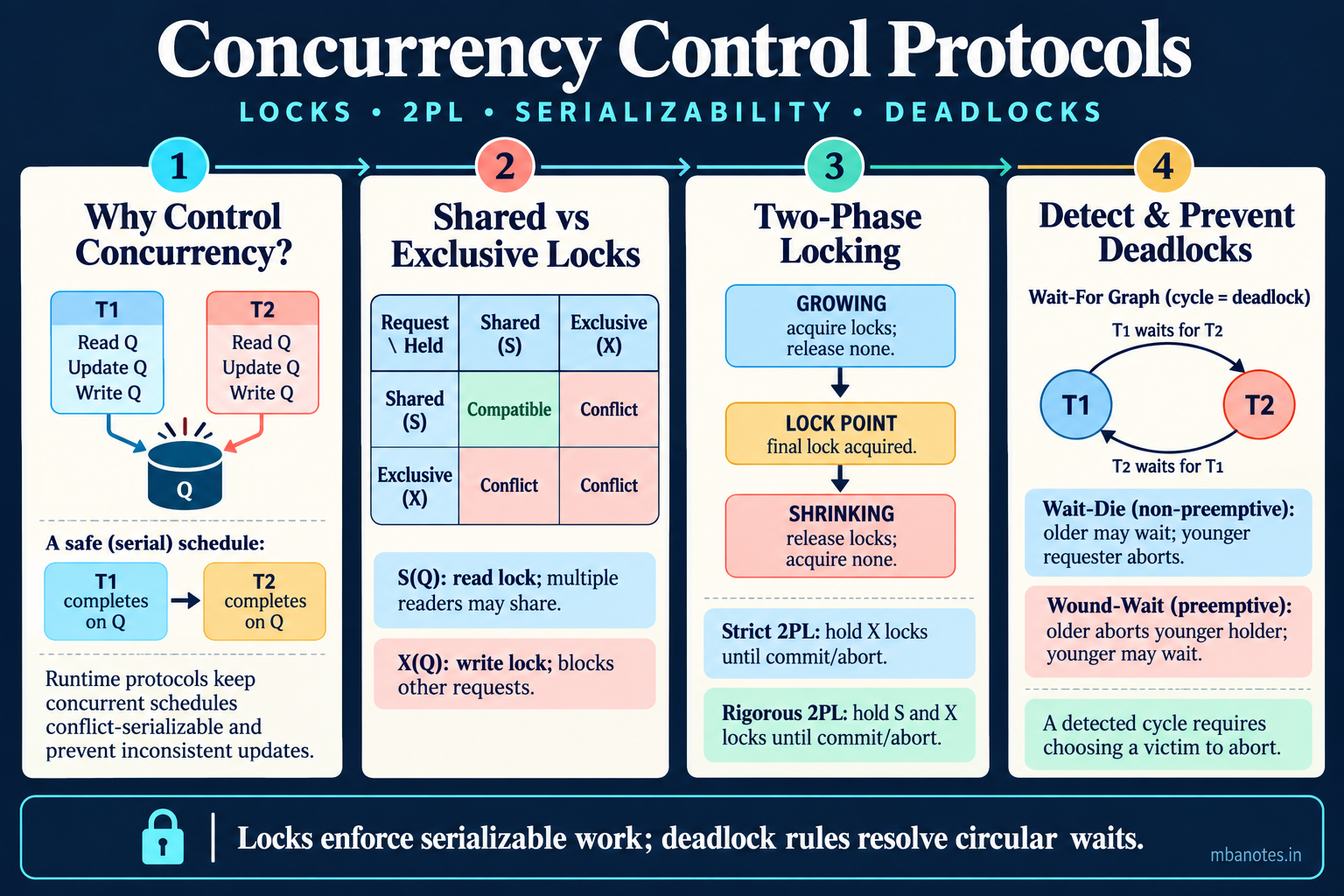
Testing a schedule for conflict serializability after execution is impractical in production systems processing thousands of requests per second. Instead, database systems deploy Concurrency Control Protocols—algorithmic rules enforced dynamically during runtime that guarantee all generated execution schedules are automatically serializable without post-facto checking.
2. Lock-Based Protocols & Lock Compatibility Matrix
A lock is a variable associated with a data item describing its operational status:
- Shared Lock ((S)): Acquired for reading data. Multiple transactions can simultaneously hold shared locks on the same data item ((S)-(S) compatibility).
- Exclusive Lock ((X)): Acquired for writing data. Strictly one transaction can hold an exclusive lock on an item; all other concurrent requests are blocked ((X)-(X) and (S)-(X) conflict).
3. Two-Phase Locking (2PL), Strict 2PL & Rigorous 2PL
The canonical protocol guaranteeing conflict serializability is Two-Phase Locking (2PL):
- Growing Phase: The transaction may obtain locks, but cannot release any lock.
- Shrinking Phase: The transaction may release locks, but cannot obtain any new lock.
- Lock Point: The point in time where the transaction obtains its final lock.
- Strict 2PL: Mandates that all exclusive locks held by a transaction be held until the transaction commits or aborts. Prevents cascading rollbacks.
- Rigorous 2PL: Mandates that all locks (both shared and exclusive) be held until commit/abort. Guarantees schedule serializability matching commit order.
4. Deadlock Detection, Prevention & Recovery Strategies
A Deadlock occurs when two or more transactions are in a circular wait state, each holding a lock that the other transaction requires to proceed.
| Scheme | Operational Mechanism | Preemption Status |
|---|---|---|
| Wait-Die Scheme | If older transaction (T_{old}) requests data held by younger (T_{young}), (T_{old}) is allowed to WAIT. If younger requests data held by older, younger DIES (aborts and restarts). | Non-Preemptive (Holding transactions never killed) |
| Wound-Wait Scheme | If older requests data held by younger, older WOUNDS younger (forces younger to abort). If younger requests data held by older, younger is allowed to WAIT. | Preemptive (Younger holding transaction preempted) |
| Wait-For Graph (WFG) | Periodic cycle detection in directed wait graph. When cycle found, system picks a victim transaction to abort. | Post-Facto Detection & Recovery |
University Examination Question Bank & Model Solutions
Designed as per Dr. A.P.J. Abdul Kalam Technical University (AKTU) MBA Examination Pattern.
Part A: Conceptual 2-Mark Short Answer Questions
Q1 [2 Marks]: Define the primary distinction relevant to Concurrency Control & Deadlocks in business operations.
Ans: It represents a core database engine subsystem ensuring physical storage access is optimized, transactions maintain absolute ACID integrity, and concurrent executions never corrupt corporate records.
Q2 [2 Marks]: What is the significance of Lock Modes in modern corporate management?
Ans: It establishes the architectural foundation enabling high-throughput transaction processing, sub-second query execution, and robust isolation across concurrent corporate users.
Part B & C: Analytical 10-Mark Detailed Solutions & Technical Frameworks
Question 1 [10/15 Marks]: Explain the architectural framework of Concurrency Control & Deadlocks. Detail its components, implementation methodologies, and enterprise strategic impact. (10/15 Marks)
Model Examination Answer Blueprint:
Strategic Executive Summary: 16. Concurrency Control Protocols
- Physical I/O Minimization: Utilizing balanced B+ Tree indexes and dynamic hashing to slash disk block transfers.
- Cost-Based Query Planning: Leveraging catalog statistics to select optimal physical join algorithms for complex queries.
- Uncompromising ACID Integrity: Enforcing atomicity and durability via transaction managers and write-ahead logs.
- Robust Concurrency Orchestration: Enforcing Strict Two-Phase Locking and deadlock prevention to guarantee conflict serializability.
Frequently Asked Questions (Academic & Technical FAQ)
Q1. What makes Concurrency Control & Deadlocks critical for modern enterprise managers?
It guarantees that the enterprise database can process millions of concurrent financial transactions without data anomalies, unexpected blackouts, or transactional race conditions.
Q2. How do practitioners apply these principles in corporate environments?
Systems architects configure optimal B+ Tree indexes, select appropriate transaction isolation levels, and tune concurrency parameters to balance multi-user throughput against strict serializability.
Q3. What are the most frequent examination questions asked from this topic in AKTU?
AKTU examinations frequently require comparing B-Trees vs B+ Trees, explaining ACID properties, drawing precedence graphs to test conflict serializability, and contrasting Wait-Die vs Wound-Wait deadlock prevention protocols.
Discussion & Questions
0 CommentsAcademic insights, questions, and conceptual clarifications from students & faculty.
No questions or comments yet
Have a doubt about this topic, an exam tip, or a conceptual perspective? Start the discussion below!
Leave a Comment / Ask a Question
Your email address will not be published. Required fields are marked *