
Physical Database Storage Architecture: Indexing Structures, B-Trees, B+ Trees, and Static/Dynamic Hashing
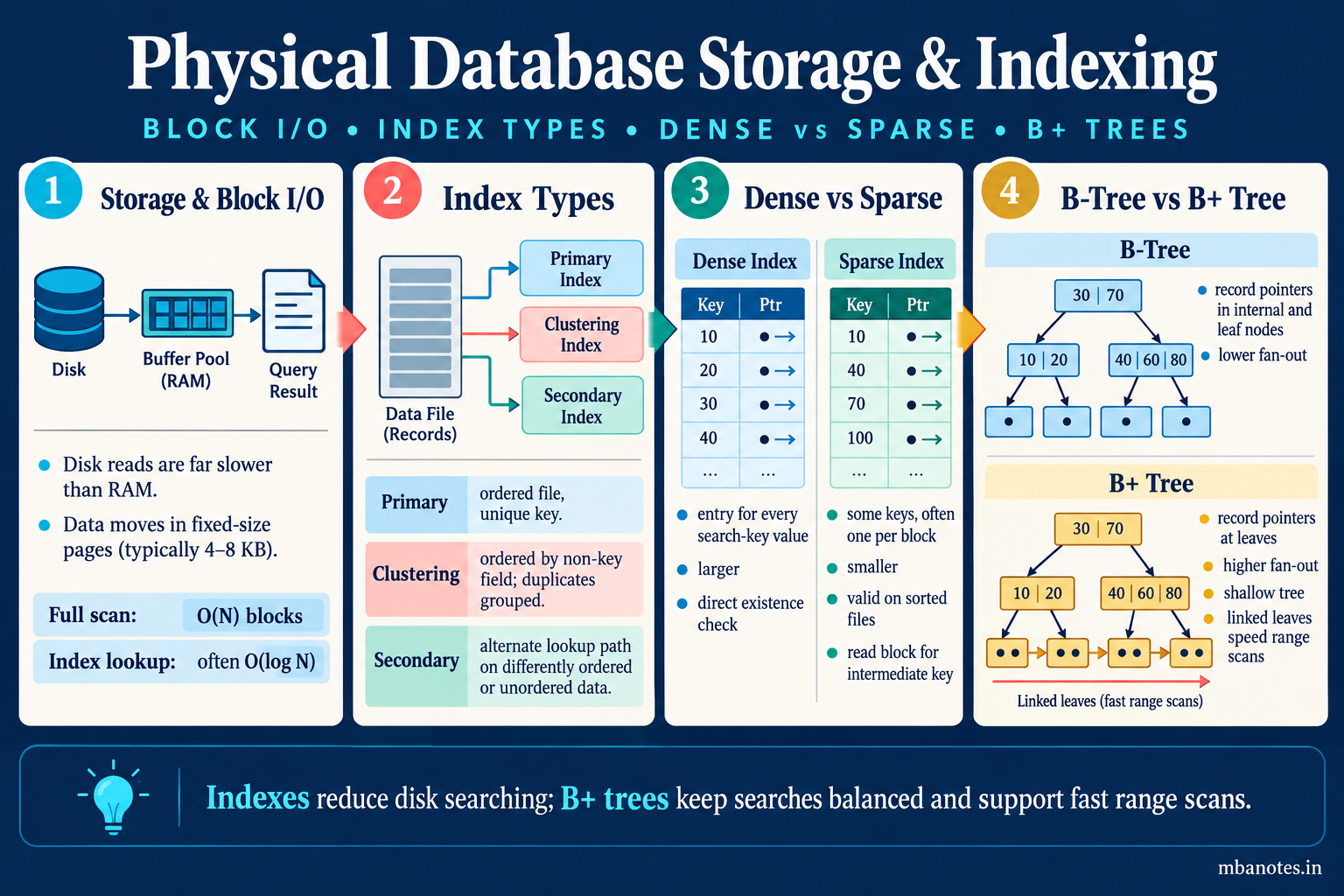
1. The Physical Storage Bottleneck & Block I/O Mechanics
In database systems engineering, disk access (I/O) is roughly 100,000 times slower than main memory RAM access. Consequently, relational database performance is governed almost entirely by minimizing physical disk block reads. Data between non-volatile disk storage and the DBMS memory buffer is transferred in fixed-size units called Blocks (Pages), typically ranging from 4 KB to 8 KB in size.
Without an index, finding a specific tuple requires a Full Table Scan (reading every data block from disk sequentially), requiring (O(N)) block transfers. An Index is an auxiliary physical access structure that maps search key values directly to disk block addresses, reducing retrieval cost to (O(log N)) or (O(1)).
2. Index Architecture: Primary, Clustering & Secondary Indices
Physical database indexes are classified based on the ordering of the underlying data file:
- Primary Index: Built on an ordered data file where the search key is a candidate/primary key (each key value is unique).
- Clustering Index: Built on an ordered data file where the search key is a non-key field (multiple records share the identical search key value, grouped physically together on disk).
- Secondary Index: Built on an unordered or differently ordered data file. Provides an alternative, secondary access path (e.g., searching by
LastNameon a table physically sorted byEmpId). A table can possess only ONE primary/clustering index, but dozens of secondary indexes.
3. Dense vs Sparse Indexing Tradeoffs
Indexes differ in the granularity of their index entries:
Dense Index
Contains an index record for every single search key value present in the data file. Can answer existence queries directly from the index without reading the data file. Requires larger disk storage footprint. Secondary indexes are mandatory dense.
Sparse Index
Contains an index record only for some search key values (typically one entry per data block). Requires less storage and fits easily in RAM, but requires reading the actual data block to find non-indexed intermediate keys. Valid strictly on sorted files.
4. B-Trees vs B+ Trees: Architectural Deep-Dive
Multi-level indexing using static files incurs high re-indexing overhead during frequent insertions and deletions. B-Trees and B+ Trees solve this by maintaining self-balancing tree structures:
| Architectural Factor | Standard B-Tree | B+ Tree (Industry Standard) |
|---|---|---|
| Data Pointer Placement | Data record pointers stored in BOTH internal routing nodes and leaf nodes | Internal nodes store strictly routing search keys; ALL data record pointers reside in leaf nodes |
| Fan-Out & Tree Height | Lower fan-out (pointers consume internal node space); taller tree | Extremely high fan-out (hundreds of keys per 4KB node); shallow tree height (3–4 levels for millions of rows) |
| Range Queries | Inefficient; requires expensive in-order tree traversal up and down levels | Extremely fast; leaf nodes form a continuous doubly-linked list enabling linear range scanning |
| Search Time | Variable: fast if key is near root; slower if at leaf | Completely uniform: every search traverses exact same path length to leaf |
University Examination Question Bank & Model Solutions
Designed as per Dr. A.P.J. Abdul Kalam Technical University (AKTU) MBA Examination Pattern.
Part A: Conceptual 2-Mark Short Answer Questions
Q1 [2 Marks]: Define the primary distinction relevant to Storage, Indexing & B-Trees in business operations.
Ans: It represents a core database engine subsystem ensuring physical storage access is optimized, transactions maintain absolute ACID integrity, and concurrent executions never corrupt corporate records.
Q2 [2 Marks]: What is the significance of Storage Hierarchy in modern corporate management?
Ans: It establishes the architectural foundation enabling high-throughput transaction processing, sub-second query execution, and robust isolation across concurrent corporate users.
Part B & C: Analytical 10-Mark Detailed Solutions & Technical Frameworks
Question 1 [10/15 Marks]: Explain the architectural framework of Storage, Indexing & B-Trees. Detail its components, implementation methodologies, and enterprise strategic impact. (10/15 Marks)
Model Examination Answer Blueprint:
Strategic Executive Summary: 13. Physical Storage & Indexing
- Physical I/O Minimization: Utilizing balanced B+ Tree indexes and dynamic hashing to slash disk block transfers.
- Cost-Based Query Planning: Leveraging catalog statistics to select optimal physical join algorithms for complex queries.
- Uncompromising ACID Integrity: Enforcing atomicity and durability via transaction managers and write-ahead logs.
- Robust Concurrency Orchestration: Enforcing Strict Two-Phase Locking and deadlock prevention to guarantee conflict serializability.
Frequently Asked Questions (Academic & Technical FAQ)
Q1. What makes Storage, Indexing & B-Trees critical for modern enterprise managers?
It guarantees that the enterprise database can process millions of concurrent financial transactions without data anomalies, unexpected blackouts, or transactional race conditions.
Q2. How do practitioners apply these principles in corporate environments?
Systems architects configure optimal B+ Tree indexes, select appropriate transaction isolation levels, and tune concurrency parameters to balance multi-user throughput against strict serializability.
Q3. What are the most frequent examination questions asked from this topic in AKTU?
AKTU examinations frequently require comparing B-Trees vs B+ Trees, explaining ACID properties, drawing precedence graphs to test conflict serializability, and contrasting Wait-Die vs Wound-Wait deadlock prevention protocols.
Discussion & Questions
0 CommentsAcademic insights, questions, and conceptual clarifications from students & faculty.
No questions or comments yet
Have a doubt about this topic, an exam tip, or a conceptual perspective? Start the discussion below!
Leave a Comment / Ask a Question
Your email address will not be published. Required fields are marked *