
Financial Sector Reforms & Cooperative Banking: Narasimham Committee Recommendations, Capital Adequacy, CRR/SLR & Prudential Norms (IRAC)
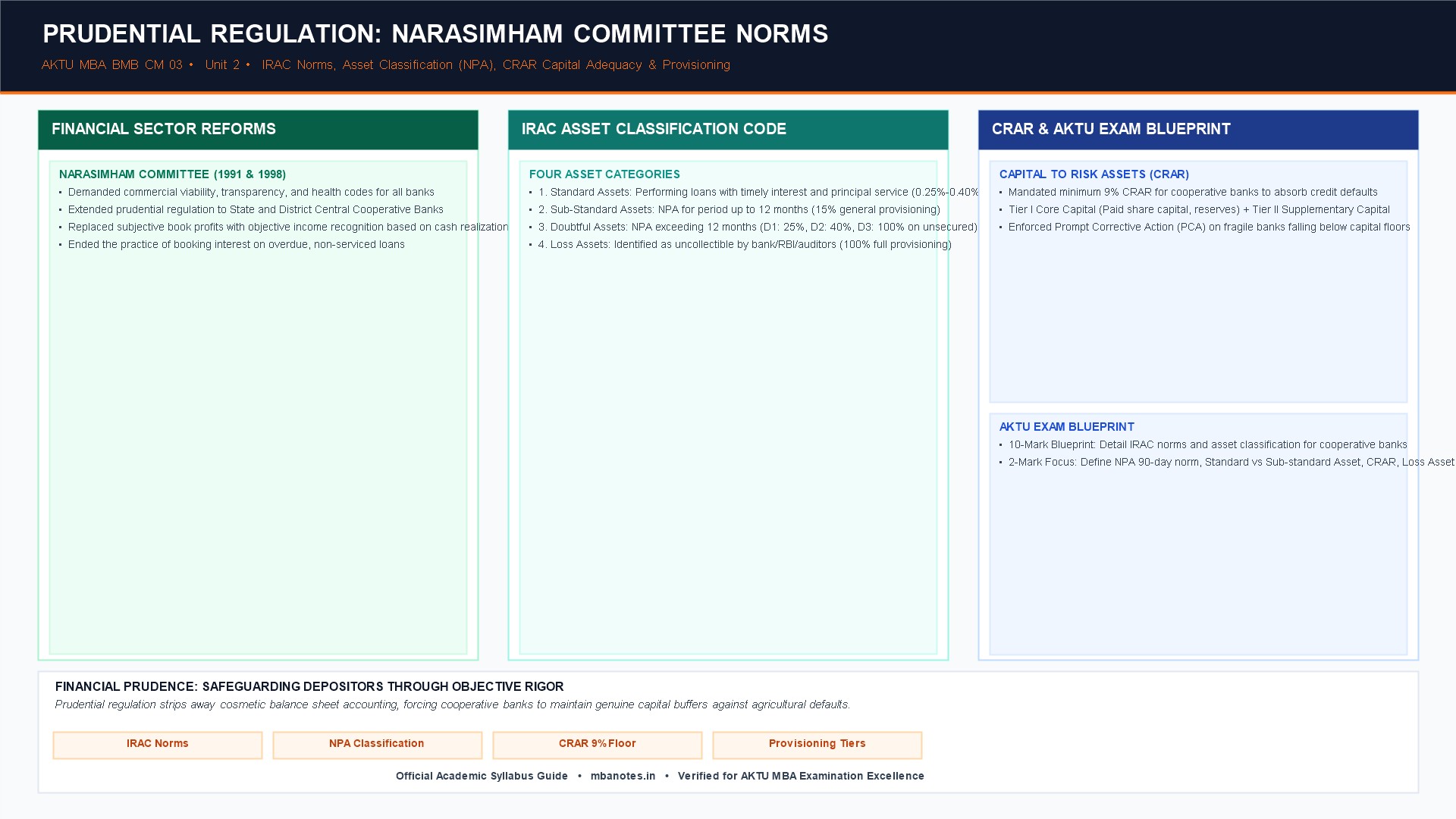
1. The Paradigm Shift in Indian Banking Regulation (1991)
Following the balance of payments crisis of 1991, India dismantled its state-controlled financial system. The Committee on the Financial System (1991) and the Committee on Banking Sector Reforms (1998), chaired by former RBI Governor M. Narasimham, heralded a new era of prudential regulation.
Cooperative banks, which had long operated under lax accounting rules with hidden losses, were systematically brought under the discipline of Income Recognition, Asset Classification, and Provisioning (IRAC) norms.
2. The Narasimham Committee Recommendations on Cooperative Banks
- Deregulating Interest Rates: Permitting cooperative banks to set deposit and lending rates based on cost of funds and market risk.
- Level Playing Field: Subjecting cooperative banks to the same prudential, disclosure, and capital adequacy standards as commercial banks.
- Ending Dual Regulatory Deadlock: Recommending that banking functions be regulated exclusively by the Reserve Bank of India, leaving only administrative registration to state registrars.
3. Asset Classification: Standard, Sub-Standard, Doubtful and Loss Assets
Under RBI prudential guidelines, an agricultural advance is classified as a Non-Performing Asset (NPA) if interest or principal installment remains overdue for:
- Two (2) crop seasons for short duration crops; or
- One (1) crop season for long duration crops (e.g., sugarcane).
| Asset Category | Statutory Criteria / Overdue Period | Mandatory Provisioning Requirement |
|---|---|---|
| 1. Standard Asset | Zero overdue; regular debt service. | 0.25% to 0.40% general provision. |
| 2. Sub-Standard Asset | Remained NPA for a period $le$ 12 months. | 15% (secured) / 25% (unsecured). |
| 3. Doubtful Asset | Remained sub-standard for > 12 months. | D1 (up to 1 yr): 25%; D2 (1-3 yrs): 40%; D3 (>3 yrs): 100% of secured portion + 100% unsecured. |
| 4. Loss Asset | Uncollectible, identified by bank/auditor/RBI. | 100% of entire outstanding advance. |
4. Income Recognition and Provisioning Mandates
Under the Income Recognition Principle, banks are legally barred from recognizing accrued interest on NPAs on an accrual basis. Income on non-performing loans can be booked only when cash is actually realized.
5. Capital Adequacy Ratio (CRAR) Formula & Reserve Maintenance
Cooperative banks must maintain capital adequacy under the Basel framework:
Furthermore, cooperative banks must maintain Cash Reserve Ratio (CRR) with RBI under Section 18 of the BR Act (typically 4.5% of Net Demand and Time Liabilities) and Statutory Liquidity Ratio (SLR) in unencumbered government securities under Section 24 (currently 18% of NDTL) to ensure liquid solvency.
University Examination Question Bank & Model Solutions
Designed as per Dr. A.P.J. Abdul Kalam Technical University (AKTU) MBA Examination Pattern.
Part A: Conceptual 2-Mark Short Answer Questions
Q1 [2 Marks]: Who chaired the landmark 1991 and 1998 Committees on Banking Sector Reforms?
Ans: M. Narasimham, former Governor of the Reserve Bank of India.
Q2 [2 Marks]: What does the acronym IRAC stand for in cooperative banking?
Ans: Income Recognition, Asset Classification, and Provisioning norms.
Q3 [2 Marks]: When does an agricultural loan become a Non-Performing Asset (NPA)?
Ans: When installment of principal or interest remains unpaid for 2 crop seasons (short crops) or 1 crop season (long crops).
Q4 [2 Marks]: What is the mandatory provisioning required for a Doubtful Asset (D1) in its secured portion?
Ans: Twenty-five percent (25%).
Q5 [2 Marks]: What is the minimum Capital to Risk-Weighted Assets Ratio (CRAR) mandated for cooperative banks?
Ans: Nine percent (9%) under the Basel/RBI regulatory framework.
Part B & C: Analytical 10-Mark Detailed Solutions & Regulatory Frameworks
Question 1 [10/15 Marks]: Analyze the impact of financial sector reforms and the Narasimham Committee recommendations on cooperative banking in India.
Model Examination Answer Blueprint:
2. Narasimham Framework (1991/1998): Phasing out directed credit subsidies, interest rate deregulation, level regulatory playing field.
3. Application of Banking Regulation Act 1949: Bringing cooperative banks under RBI prudential discipline.
4. Capital Adequacy & Governance: CRAR 9% mandate, Basel alignment, professionalizing boards.
5. Structural Transformation: Transitioning cooperative banks into competitive, sound commercial banking units.
Question 2 [10/15 Marks]: Detail the Income Recognition, Asset Classification (IRAC), and Provisioning norms applicable to rural and urban cooperative banks.
Model Examination Answer Blueprint:
2. Four-Tier Asset Classification: Standard, Sub-Standard ($le$12 months), Doubtful (D1, D2, D3), and Loss assets.
3. Provisioning Scale: Standard (0.25-0.40%), Sub-Standard (15%), Doubtful (25% to 100%), Loss (100%).
4. Cash-Basis Income Recognition: Absolute bar on booking unrealized interest on NPAs.
5. Capital Adequacy Formula: Calculation of Tier I, Tier II capital against Risk-Weighted Assets (CRAR $ge$ 9%).
Strategic Executive Summary: 4. Financial Reforms & Prudential Norms (IRAC)
- Strict AKTU Syllabus Parity: Covers BMB CM 03 Unit 2 Topic 4 comprehensively.
- Credit Banking & Prudential Rigor: Integrates STCCS/LTCCS architectures, Scale of Finance formulas, KCC mechanics, review committees (Gorwala, CRAFICARD, Vaidyanathan), and IRAC norms.
- Visual Conceptualization: Illustrated with Figure 2.4 capturing credit flows, committee timelines, and asset classification tables.
- Examination Readiness: Features 5 Part A 2-mark conceptual questions and 2 comprehensive 10/15-mark university blueprints.
Frequently Asked Questions (Academic & Statutory FAQ)
Q1. What is the core focus of 4. Financial Reforms & Prudential Norms (IRAC) in the AKTU MBA curriculum?
Systematic study of financial sector deregulation in cooperative banking: Narasimham Committee (1991 & 1998), Income Recognition, Asset Classification (IRAC), Provisioning Norms, CRR/SLR, and CRAR adequacy. It equips future banking managers with complete command over credit delivery mechanisms, committee reforms, and prudential banking regulations.
Q2. How do practitioners apply these principles in rural cooperative banking?
Managers formulate annual crop loan limits using Scale of Finance formulas, administer KCC revolving credit with interest subvention, classify assets under IRAC guidelines, and maintain mandatory 9% CRAR.
Q3. What are the most frequent examination questions asked from this unit?
AKTU examinations frequently focus on the three-tier vs two-tier structure, the Scale of Finance formula, KCC subvention, CRAFICARD and the creation of NABARD, the Vaidyanathan Revival Package, and IRAC provisioning percentages.
Discussion & Questions
0 CommentsAcademic insights, questions, and conceptual clarifications from students & faculty.
No questions or comments yet
Have a doubt about this topic, an exam tip, or a conceptual perspective? Start the discussion below!
Leave a Comment / Ask a Question
Your email address will not be published. Required fields are marked *