
Landmark Institutional Review Committees: All India Rural Credit Survey Committee (Gorwala), AIRCRC (Venkatappiah), CRAFICARD (Sivaraman) & ACRC (Khusro)
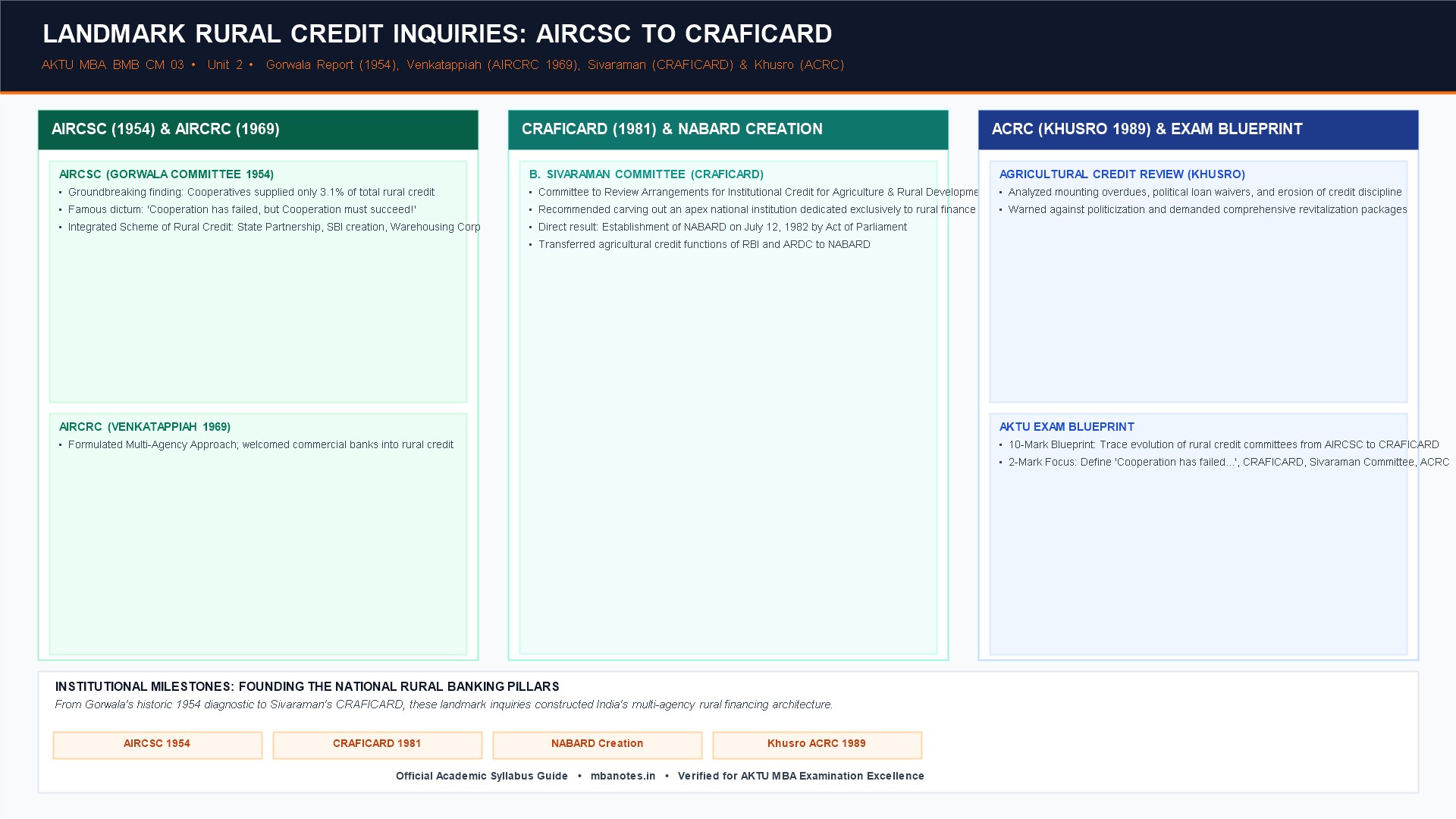
1. The Chronology of Seminal Rural Credit Inquiries
The evolution of institutional rural finance in India has been guided by four monumental national review committees appointed by the Reserve Bank of India and Government of India over a span of four decades.
2. AIRCSC 1954 (A.D. Gorwala): Integrated Scheme of Rural Credit
The All India Rural Credit Survey Committee (1954), chaired by A.D. Gorwala, revealed that informal moneylenders controlled 93% of total rural credit, while cooperatives provided a meager 3.1%. The Committee coined the immortal dictum: "Cooperation has failed, but Cooperation must succeed."
- The Integrated Scheme of Rural Credit: A three-pronged strategy: 1) Massive State partnership in share capital; 2) Integration between credit and agricultural marketing; 3) Training professional cadres.
- Institutional Outcome: Nationalization of Imperial Bank of India into State Bank of India (SBI) in 1955 to expand rural branch banking and support cooperatives.
3. AIRCRC 1969 (B. Venkatappiah): Multi-Agency Framework
The All India Rural Credit Review Committee (1969), chaired by B. Venkatappiah, recognized that cooperatives alone could not bridge the massive rural credit gap created by the Green Revolution:
- The Multi-Agency Approach: Mandated commercial banks to enter agricultural credit alongside cooperatives (leading to the 1969 Bank Nationalization).
- Specialized Agencies for Weak Farmers: Recommended establishment of the Small Farmers Development Agency (SFDA) and Marginal Farmers and Agricultural Labourers Agency (MFAL).
- Creation of Rural Electrification Corporation (REC): To finance energized agricultural irrigation.
4. CRAFICARD 1981 (B. Sivaraman): The Creation of NABARD
The Committee to Review Arrangements for Institutional Credit for Agriculture and Rural Development (CRAFICARD, 1981), chaired by B. Sivaraman, concluded that the RBI's dual role as monetary authority and agricultural lender created operational conflicts.
The Founding of NABARD
CRAFICARD recommended the creation of a dedicated apex development bank. Consequently, Parliament enacted the NABARD Act 1981, and NABARD was established on July 12, 1982, absorbing the Agricultural Credit Department (ACD) and Rural Planning and Credit Cell (RPCC) of RBI along with the entire Agricultural Refinance and Development Corporation (ARDC).
5. ACRC 1989 (A.M. Khusro): Agricultural Credit Review
The Agricultural Credit Review Committee (ACRC, 1989), chaired by Prof. A.M. Khusro, delivered a comprehensive diagnostic report:
- Overdue Epidemic: Identified pervasive loan defaults caused by political interference and populist loan write-offs.
- Interest Rate Deregulation: Recommended freeing cooperative lending rates from artificial ceilings to ensure cost recovery.
- Institutional Health: Proposed mandatory merger of non-viable PACS and recapitalization of DCCBs with strict recovery conditionalities.
University Examination Question Bank & Model Solutions
Designed as per Dr. A.P.J. Abdul Kalam Technical University (AKTU) MBA Examination Pattern.
Part A: Conceptual 2-Mark Short Answer Questions
Q1 [2 Marks]: What percentage of rural credit was supplied by cooperatives according to the AIRCSC (1954)?
Ans: Only 3.1%, while informal moneylenders controlled over 93% of the rural credit market.
Q2 [2 Marks]: What was the landmark dictum coined by the A.D. Gorwala Committee (1954)?
Ans: 'Cooperation has failed, but Cooperation must succeed.'
Q3 [2 Marks]: What major institutional policy was introduced following the AIRCRC 1969 (Venkatappiah)?
Ans: The 'Multi-Agency Approach', bringing commercial banks into agricultural credit alongside cooperatives.
Q4 [2 Marks]: Which committee recommended the establishment of NABARD in 1981?
Ans: The CRAFICARD Committee chaired by B. Sivaraman.
Q5 [2 Marks]: What was the focus of the ACRC 1989 chaired by Prof. A.M. Khusro?
Ans: Investigating the epidemic of overdues, political loan waivers, and demanding interest rate deregulation.
Part B & C: Analytical 10-Mark Detailed Solutions & Regulatory Frameworks
Question 1 [10/15 Marks]: Critically evaluate the contribution of the All India Rural Credit Survey Committee (1954) and the CRAFICARD Committee (1981) to the evolution of India's rural banking architecture.
Model Examination Answer Blueprint:
2. Evolution of Credit Demand: Green revolution credit pressures requiring specialized national refinance.
3. CRAFICARD 1981 (Sivaraman): Resolving RBI's dual operational conflict; inception of NABARD on July 12, 1982.
4. Institutional Legacy: Establishing the modern two-tier national refinance and regulatory model.
5. Enduring Lessons: Balancing state capital support with institutional autonomy.
Question 2 [10/15 Marks]: Discuss the recommendations of the All India Rural Credit Review Committee (1969) and the Agricultural Credit Review Committee (1989) on rural credit delivery.
Model Examination Answer Blueprint:
2. ACRC 1989 (Khusro): Comprehensive diagnostic of the overdue disease, politicized loan waivers, and financial fragility.
3. Khusro Recommendations: Freeing lending rates, professionalizing audit, recapitalizing DCCBs.
4. Paradigm Shift: Transition from credit rationing to prudential solvency.
Strategic Executive Summary: 2. Landmark Review Committees: 1954 to 1989
- Strict AKTU Syllabus Parity: Covers BMB CM 03 Unit 2 Topic 2 comprehensively.
- Credit Banking & Prudential Rigor: Integrates STCCS/LTCCS architectures, Scale of Finance formulas, KCC mechanics, review committees (Gorwala, CRAFICARD, Vaidyanathan), and IRAC norms.
- Visual Conceptualization: Illustrated with Figure 2.2 capturing credit flows, committee timelines, and asset classification tables.
- Examination Readiness: Features 5 Part A 2-mark conceptual questions and 2 comprehensive 10/15-mark university blueprints.
Frequently Asked Questions (Academic & Statutory FAQ)
Q1. What is the core focus of 2. Landmark Review Committees: 1954 to 1989 in the AKTU MBA curriculum?
Comprehensive study of India’s seminal rural credit inquiries: AIRCSC 1954 (Gorwala), AIRCRC 1969 (Venkatappiah), CRAFICARD 1981 (Sivaraman - creation of NABARD), and ACRC 1989 (Khusro). It equips future banking managers with complete command over credit delivery mechanisms, committee reforms, and prudential banking regulations.
Q2. How do practitioners apply these principles in rural cooperative banking?
Managers formulate annual crop loan limits using Scale of Finance formulas, administer KCC revolving credit with interest subvention, classify assets under IRAC guidelines, and maintain mandatory 9% CRAR.
Q3. What are the most frequent examination questions asked from this unit?
AKTU examinations frequently focus on the three-tier vs two-tier structure, the Scale of Finance formula, KCC subvention, CRAFICARD and the creation of NABARD, the Vaidyanathan Revival Package, and IRAC provisioning percentages.
Discussion & Questions
0 CommentsAcademic insights, questions, and conceptual clarifications from students & faculty.
No questions or comments yet
Have a doubt about this topic, an exam tip, or a conceptual perspective? Start the discussion below!
Leave a Comment / Ask a Question
Your email address will not be published. Required fields are marked *