

Foundations of Data Warehousing: Enterprise Value, Inmon Defining Characteristics, and OLTP vs OLAP
1. Conceptual Evolution and Definition of Data Warehousing
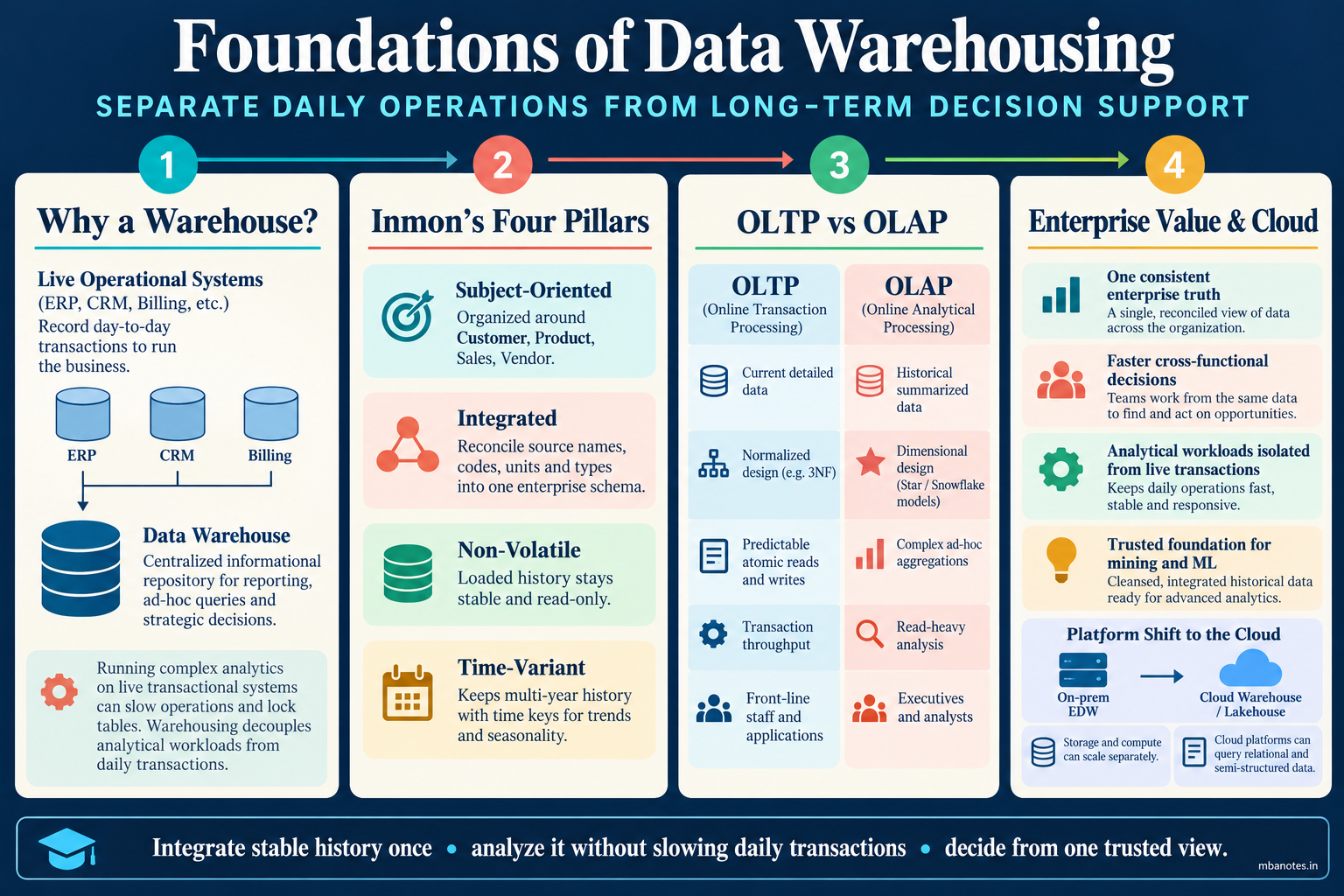
In modern enterprise ecosystems, operational databases (such as ERP, CRM, and billing systems) excel at recording day-to-day business transactions with high concurrency and microsecond latency. However, running complex analytical queries—such as multi-year trend analysis or cross-departmental customer lifetime value assessments—directly against live operational databases causes catastrophic performance degradation and locks transactional tables. A Data Warehouse (DW) resolves this fundamental tension by establishing a dedicated, centralized informational repository specifically architected for analytical reporting, ad-hoc querying, and strategic decision support.
2. Bill Inmon’s Four Defining Characteristics
William H. Inmon, universally recognized as the "Father of Data Warehousing," established four canonical characteristics that distinguish a data warehouse from operational transaction systems:
- Subject-Oriented: Operational databases are organized around ongoing business processes (e.g. order processing, invoicing, inventory tracking). In contrast, a data warehouse is organized around major high-level business subjects of interest to executive leadership (e.g., Customer, Product, Sales, Vendor). It focuses on the modeling and analysis of data for decision-makers rather than daily transaction execution.
- Integrated: Data is extracted from disparate, heterogeneous operational sources (legacy relational databases, flat files, ERP logs, cloud APIs). Integration resolves naming conflicts (e.g., "Cust_ID" vs "Client_No"), unifies conflicting encoding structures (e.g., "M/F" vs "1/0"), standardizes measurement units (currency conversions, metric vs imperial), and enforces consistent data types into a single enterprise-wide schema.
- Non-Volatile: Operational data is subject to frequent updates, inserts, and deletions. Data warehouse data, once loaded, is stable and permanent. Historical data is never overwritten or deleted; it is accessed purely via read-only queries. This operational stability guarantees that analytical queries executed today yield mathematically identical results to queries executed tomorrow over the same historical period.
- Time-Variant: Operational systems maintain only current, active data (typically 30 to 90 days of transactions for optimal performance). A data warehouse explicitly tracks historical changes over an extended multi-year time horizon (5 to 10+ years). Every key structure in a data warehouse explicitly contains an element of time (e.g., day, week, quarter, year) to facilitate longitudinal trend forecasting, seasonality detection, and historical comparisons.
3. Comparative Architecture: OLTP versus OLAP Systems
Understanding the structural dichotomy between Online Transaction Processing (OLTP) and Online Analytical Processing (OLAP) is fundamental to data architecture:
| Evaluation Parameter | OLTP (Operational Systems) | OLAP (Informational Systems) |
|---|---|---|
| Primary Objective | Automating and recording day-to-day business transactions | Multi-dimensional analysis and strategic decision support |
| Data Scope | Current, granular, highly detailed real-time records | Historical, summarized, consolidated multi-year data |
| Database Design | Normalized (3NF/BCNF) to eliminate update anomalies | Denormalized dimensional models (Star & Snowflake schemas) |
| Query Characteristics | Simple, predefined, highly predictable atomic lookups | Complex, ad-hoc, multi-table aggregations spanning millions of rows |
| Operations | High volume of read, write, update, and delete transactions | Periodic bulk batch loads; overwhelmingly read-only queries |
| User Community | Clerks, tellers, operational front-line staff, automated apps | Business analysts, executives, data scientists, managers |
| Performance Metric | Transaction throughput (TPS) and sub-second response time | Query execution throughput and complex computational response |
4. Enterprise Business Value and Strategic Decision Support
Deploying an enterprise data warehouse delivers strategic organizational advantages:
- Single Version of the Truth: Eliminates contradictory departmental reports (e.g., Marketing reporting 10,000 active accounts while Finance records 8,500 due to differing definitions of "active").
- Enhanced Decision Quality & Velocity: Business executives query cross-functional metrics without submitting custom IT reporting tickets that take weeks to fulfill.
- Operational System Decoupling: Isolates resource-heavy analytical workloads from live customer-facing transactional databases, ensuring zero downtime in retail checkout or banking operations.
- Foundational Substrate for Advanced Analytics: Provides the rigorously cleaned, integrated data substrate essential for machine learning model training and data mining.
5. Technological Trends: From On-Premise EDW to Cloud Lakehouse
While traditional on-premise appliances (such as Teradata and Oracle Exadata) dominated earlier decades, modern enterprises are migrating to cloud-native analytical platforms (Snowflake, Google BigQuery, Amazon Redshift, and Databricks Lakehouse). These modern architectures decouple storage from compute, allowing corporations to scale query clusters elastically while querying semi-structured JSON and unstructured audio/video logs alongside classical relational facts.
University Examination Question Bank & Model Solutions
Designed as per Dr. A.P.J. Abdul Kalam Technical University (AKTU) MBA Examination Pattern.
Part A: Conceptual 2-Mark Short Answer Questions
Q1 [2 Marks]: Define the primary distinction relevant to Foundations of Data Warehousing in corporate intelligence systems.
Ans: It represents a foundational data engineering and mining paradigm governing how historical enterprise records are integrated, modeled, and algorithmically processed for strategic decision support.
Q2 [2 Marks]: What is the significance of Inmon Four Pillars in enterprise data architecture?
Ans: It establishes the formal structural mechanisms—such as non-volatile historical stability, three-tier physical topology, or multi-phase scientific lifecycles—that guarantee reliable analytical intelligence.
Part B & C: Analytical 10-Mark Detailed Solutions & Technical Frameworks
Question 1
Model Examination Answer Blueprint:
Strategic Executive Summary: 1. Foundations of Data Warehousing
- Architectural Decoupling: Separating operational transaction workloads (OLTP) from informational analytics (OLAP) to ensure zero operational downtime.
- Rigorous Preprocessing: Investing 60% to 80% of project effort in data cleaning, transformation, and staging to prevent "Garbage In, Garbage Out".
- Standardized Process Models: Following CRISP-DM and KDD pipelines to ensure analytical investigations align strictly with business success criteria.
- Actionable Knowledge Focus: Filtering out trivial correlations and evaluating models against objective accuracy and subjective business actionability.
Frequently Asked Questions (Academic & Technical FAQ)
Q1. What makes Foundations of Data Warehousing critical for modern enterprise managers?
It equips leadership with a unified, trusted single version of truth, eliminating conflicting departmental reports and enabling predictive business strategy.
Q2. How do practitioners apply these principles in corporate environments?
Data engineers architect centralized staging pipelines, build Kimball dimensional marts with conformed dimensions, and run iterative CRISP-DM machine learning sprints.
Q3. What are the most frequent examination questions asked from this topic in AKTU?
AKTU examinations frequently require comparing OLTP vs OLAP, explaining Bill Inmon’s four characteristics, detailing the Three-Tier DW architecture, contrasting Inmon vs Kimball, and drawing the CRISP-DM and KDD pipelines.
Discussion & Questions
0 CommentsAcademic insights, questions, and conceptual clarifications from students & faculty.
No questions or comments yet
Have a doubt about this topic, an exam tip, or a conceptual perspective? Start the discussion below!
Leave a Comment / Ask a Question
Your email address will not be published. Required fields are marked *