Foundations of E-Governance: Definitions, Conceptual Frameworks, and Strategic Vision
1. Conceptual Definition of E-Governance
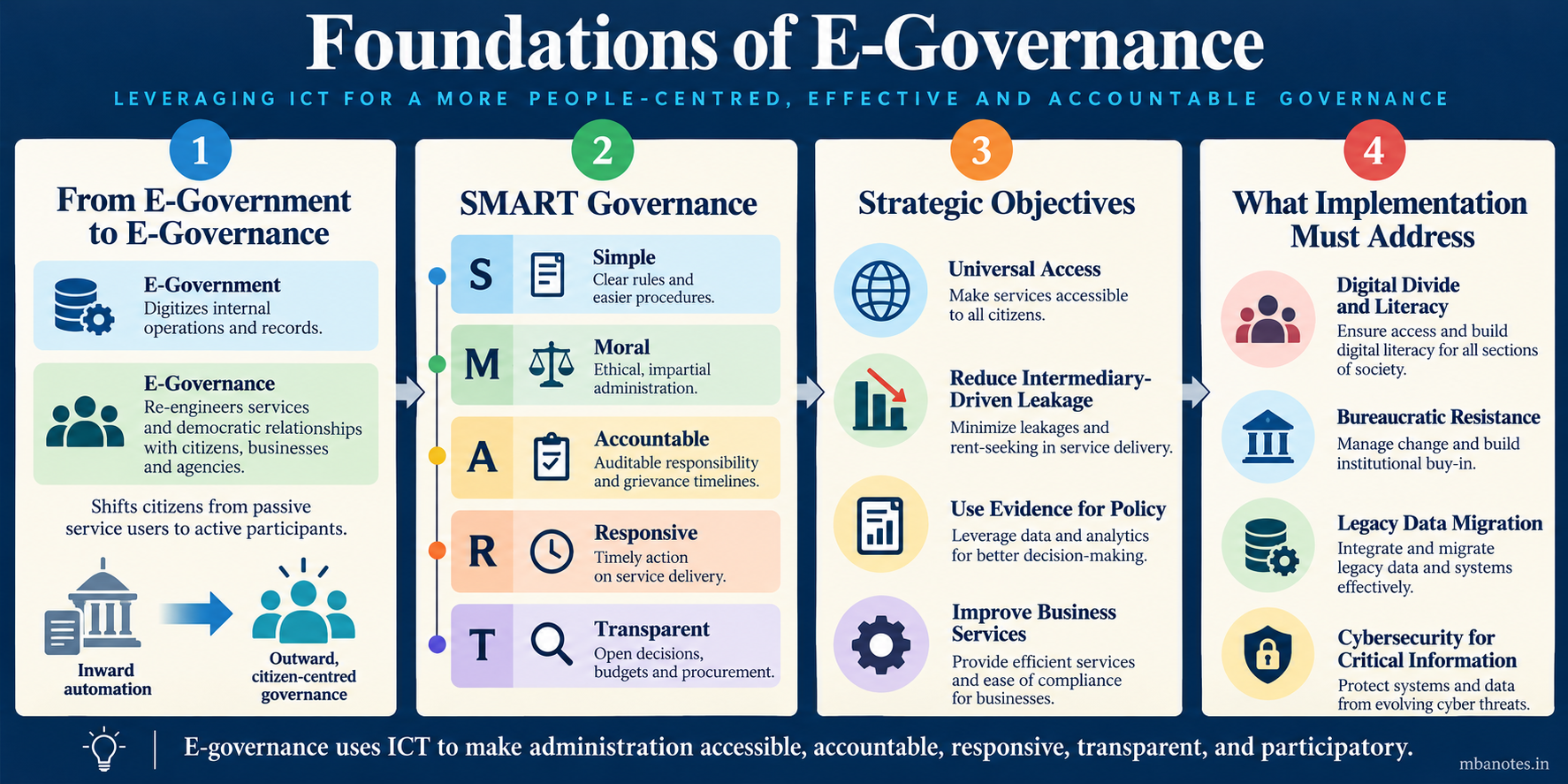
Electronic Governance (E-Governance) is the strategic application of Information and Communication Technologies (ICT) by government institutions to transform external relationships with citizens (G2C), businesses (G2B), and inter-agency state entities (G2G). Far beyond computerizing paper-based office processes, e-Governance fundamentally re-engineers administrative workflows, institutional transparency, public service accessibility, and democratic participation.
2. E-Government versus E-Governance: Structural Distinctions
Although frequently used interchangeably in informal discourse, public administration scholars draw a precise academic distinction between these two concepts:
| Dimension | E-Government | E-Governance |
|---|---|---|
| Scope | Technological conversion of internal governmental operations | Holistic transformation of societal governance and democratic engagement |
| Orientation | Inward-looking: Automating routine back-office workflows and record systems | Outward-looking: Empowering citizens, ensuring civil liberties, and participation |
| Primary Objective | Operational efficiency, departmental paper reduction, cost containment | Accountability, institutional transparency, and participatory democracy |
| Stakeholder Role | Citizens as passive consumers of digitized administrative outputs | Citizens as active co-creators of policy decisions and civic monitors |
3. The SMART Governance Paradigm
The SMART framework provides the normative blueprint for public administrative reforms in India:
- S - Simple: Simplification of administrative rules, rationalization of procedures, elimination of convoluted bureaucracy, and user-friendly bilingual citizen portals.
- M - Moral: Infusion of ethical governance principles, anti-corruption monitoring, algorithmic objectivity, and impartial statutory service delivery.
- A - Accountable: Establishment of verifiable audit trails, clear public grievance redressal timeframes, and institutional responsibility for service delays.
- R - Responsive: Streamlined delivery mechanisms responding rapidly to citizen requests, service bottlenecks, and disaster management crises.
- T - Transparent: Public access to governmental decisions, open budget expenditures, public procurement tenders, and proactive compliance with the Right to Information (RTI) Act.
4. Strategic Vision and Core Objectives of E-Governance
The strategic objectives guiding national e-governance policy encompass:
- Universal Accessibility: Ensuring public welfare services reach the most marginalized socio-economic segments without geographic or economic exclusion.
- Disintermediation of Rent-Seeking Intermediaries: Direct digital beneficiary transfers eliminate unscrupulous middlemen and leakage in subsidy allocations.
- Evidence-Based Policy Making: Aggregating real-time socio-economic data across districts to guide macroeconomic resource allocation and targeted infrastructure investments.
- Enhancement of Commercial Competitiveness (Ease of Doing Business): Streamlined business incorporations, digital single-window clearance, and automated GST/tax compliance portals.
5. Institutional Drivers and Socio-Technical Challenges
Deploying e-governance across continental-scale developing nations requires navigating critical friction points: the digital divide (disparities in broadband connectivity and digital literacy between urban and rural populations), bureaucratic resistance to change, complex legacy data migration, and stringent cybersecurity imperatives to protect national critical information infrastructure.
University Examination Question Bank & Model Solutions
Designed as per Dr. A.P.J. Abdul Kalam Technical University (AKTU) MBA Examination Pattern.
Part A: Conceptual 2-Mark Short Answer Questions
Q1 [2 Marks]: Define the primary objective of Foundations of E-Governance in modern public administration.
Ans: It represents a strategic public sector informatics paradigm designed to leverage digital networks and open architectures to deliver transparent, accessible, and citizen-centric governance.
Q2 [2 Marks]: What is the significance of Core Paradigm in national digital transformation?
Ans: It establishes the fundamental shared infrastructure rails—such as high-speed broadband, secure data hosting, or identity protocols—that eliminate duplicated governmental capital expenditures.
Part B & C: Analytical 10-Mark Detailed Solutions & Technical Frameworks
Question 1 [10/15 Marks]: Explain the architectural and operational framework of Foundations of E-Governance. Detail its components, implementation methodologies, and national socio-economic impact. (10/15 Marks)
Model Examination Answer Blueprint:
Strategic Executive Summary: 13. Foundations of E-Governance
- Public Infrastructure as a Commodity: Treating digital identity, payment rails, and document verification as open digital public goods (DPI).
- Business Process Reengineering (BPR): Mandating administrative workflow restructuring before digitizing public systems to prevent automating bureaucratic inefficiencies.
- Unbundled Network Architectures: Deploying open protocols (ONDC, Beckn) to prevent platform monopolies and democratize small merchant commerce.
- Last-Mile Inclusion: Leveraging rural optical fiber (BharatNet) and Common Service Centres (CSCs) to bridge the digital divide for rural populations.
Frequently Asked Questions (Academic & Technical FAQ)
Q1. What makes Foundations of E-Governance critical for modern enterprise managers?
It enables corporate managers to navigate government regulatory filings seamlessly, capitalize on open public API rails (India Stack), and participate in large-scale public procurement.
Q2. How do practitioners apply these principles in corporate environments?
Fintechs and enterprises integrate Aadhaar e-KYC, UPI payment APIs, Account Aggregators, and ONDC buyer/seller nodes to lower customer onboarding costs by up to 90%.
Q3. What are the most frequent examination questions asked from this topic in AKTU?
AKTU examinations frequently require distinguishing E-Government vs E-Governance, detailing the SMART governance model, analyzing NeGP core pillars (SWAN, SDC, CSC), and explaining the layers of the India Stack.
Discussion & Questions
0 CommentsAcademic insights, questions, and conceptual clarifications from students & faculty.
No questions or comments yet
Have a doubt about this topic, an exam tip, or a conceptual perspective? Start the discussion below!
Leave a Comment / Ask a Question
Your email address will not be published. Required fields are marked *