Launching an E-Business Venture: Strategic Planning, Monolithic vs Headless Stacks, and Platform Sizing
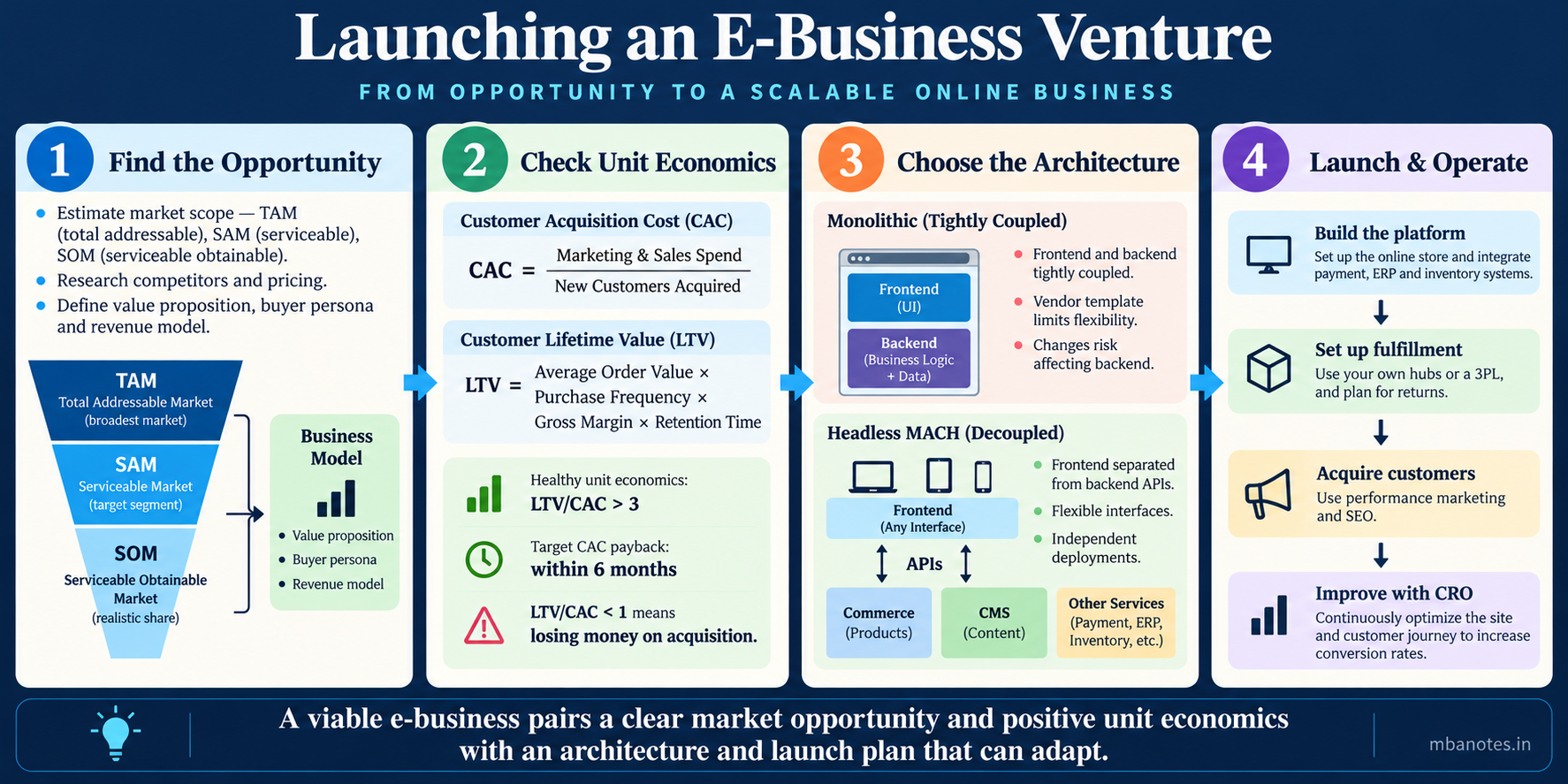
1. The E-Business Venture Launch Lifecycle
Launching a successful e-business venture requires far more than launching a web domain. It demands a structured, multi-stage engineering and managerial methodology:
- Stage 1: Opportunity Identification & Market Research: Quantifying Total Addressable Market (TAM), Serviceable Addressable Market (SAM), and Serviceable Obtainable Market (SOM). Analyzing competitor digital footprints and pricing elasticity.
- Stage 2: Strategic Business Modeling: Formulating the core value proposition, identifying buyer personas, and selecting the optimal transaction and revenue model (e.g., subscription, marketplace, D2C).
- Stage 3: Technology Architecture & Platform Engineering: Choosing between hosted SaaS and headless composable architectures, configuring payment gateways, and integrating ERP/inventory feeds.
- Stage 4: Supply Chain & Fulfillment Setup: Establishing physical fulfillment hubs, partnering with third-party logistics (3PL) carriers, and configuring reverse logistics (returns).
- Stage 5: Digital Go-to-Market & Customer Acquisition: Executing multi-channel performance marketing, organic search engine optimization (SEO), and conversion rate optimization (CRO).
2. Business Case Formulation & Financial Modeling (CAC vs LTV)
The financial viability of any e-commerce venture is governed by two decisive metrics:
Customer Acquisition Cost (CAC)
\[ \text{CAC} = \frac{\text{Total Marketing \& Sales Ad Spend}}{\text{Total Number of New Customers Acquired}} \] Measures the capital required to convert an anonymous browser into a paying buyer.
Customer Lifetime Value (LTV)
\[ \text{LTV} = \text{Avg Order Value} \times \text{Purchase Frequency} \times \text{Gross Margin} \times \text{Retention Time} \] The total net profit contributed by an individual customer throughout their lifecycle.
The Golden Unit Economics Ratio
In healthy e-businesses, the ratio of (\text{LTV} / \text{CAC}) must exceed 3.0, with the CAC payback period occurring within 6 months. An LTV/CAC ratio below 1.0 indicates that the company loses capital on every customer acquired.
3. Technology Architecture: Monolithic vs Headless (MACH)
E-commerce technology architecture has experienced a major structural paradigm shift:
| Architectural Aspect | Traditional Monolithic Architecture | Modern Headless (MACH) Architecture |
|---|---|---|
| Frontend-Backend Coupling | Tightly coupled; presentation layer (UI) and business logic reside in one codebase | Completely decoupled; frontend "head" communicates with backend via REST/GraphQL APIs |
| Frontend Flexibility | Restricted to vendor’s proprietary templating engine (PHP, Liquid) | Infinite flexibility; deploy modern React, Next.js, mobile apps, or smart IoT displays |
| Page Performance Speed | Slower; server-side rendering of monolithic HTML pages | Blazing fast; static edge generation and incremental static regeneration (ISR) |
| Maintenance Overhead | Updating UI requires recompiling and risking backend database integrity | Independent deployments; frontend developers iterate rapidly without touching backend |
University Examination Question Bank & Model Solutions
Designed as per Dr. A.P.J. Abdul Kalam Technical University (AKTU) MBA Examination Pattern.
Part A: Conceptual 2-Mark Short Answer Questions
Q1 [2 Marks]: Define the primary distinction relevant to Launching an E-Business in business operations.
Ans: It represents a core operational capability enabling scalable digital venture strategy, high-converting web engineering, automated customer retention, or secure fintech payment settlement.
Q2 [2 Marks]: What is the significance of Strategic Planning in modern corporate management?
Ans: It establishes the essential structural foundation ensuring e-business platforms operate with positive unit economics, superior user experience, and robust transactional security.
Part B & C: Analytical 10-Mark Detailed Solutions & Technical Frameworks
Question 1 [10/15 Marks]: Explain the architectural framework of Launching an E-Business. Detail its components, implementation methodologies, and enterprise strategic impact. (10/15 Marks)
Model Examination Answer Blueprint:
Strategic Executive Summary: 5. Launching an E-Business
- Composable Architecture: Adopting headless MACH principles to decouple fast-iterating frontends from stable backend commerce engines.
- Frictionless UX Design: Optimizing checkout funnels, supporting guest checkout, and improving Core Web Vitals to maximize conversion rates.
- Data-Driven Retention: Utilizing E-CRM 360-degree telemetry and RFM segmentation to maximize customer lifetime value (LTV).
- Airtight Payment Security: Enforcing PCI-DSS compliance, card tokenization, and real-time AI fraud detection across checkout flows.
Frequently Asked Questions (Academic & Technical FAQ)
Q1. What makes Launching an E-Business critical for modern enterprise managers?
It allows organizations to scale digital revenue profitably, reduce customer acquisition waste, and build secure, compliant transactional platforms.
Q2. How do practitioners apply these principles in corporate environments?
E-commerce managers optimize CAC/LTV ratios, test checkout conversion flows, implement RFM email/WhatsApp nurture sequences, and integrate certified payment aggregators.
Q3. What are the most frequent examination questions asked from this topic in AKTU?
AKTU examinations frequently require comparing Monolithic vs Headless commerce, analyzing cart abandonment causes, detailing RFM segmentation, and explaining the working mechanism of Payment Gateways and PCI-DSS.
Discussion & Questions
0 CommentsAcademic insights, questions, and conceptual clarifications from students & faculty.
No questions or comments yet
Have a doubt about this topic, an exam tip, or a conceptual perspective? Start the discussion below!
Leave a Comment / Ask a Question
Your email address will not be published. Required fields are marked *