
Global Leadership Competencies and the GLOBE Study Framework: Cultural Dimensions and Leadership Typologies
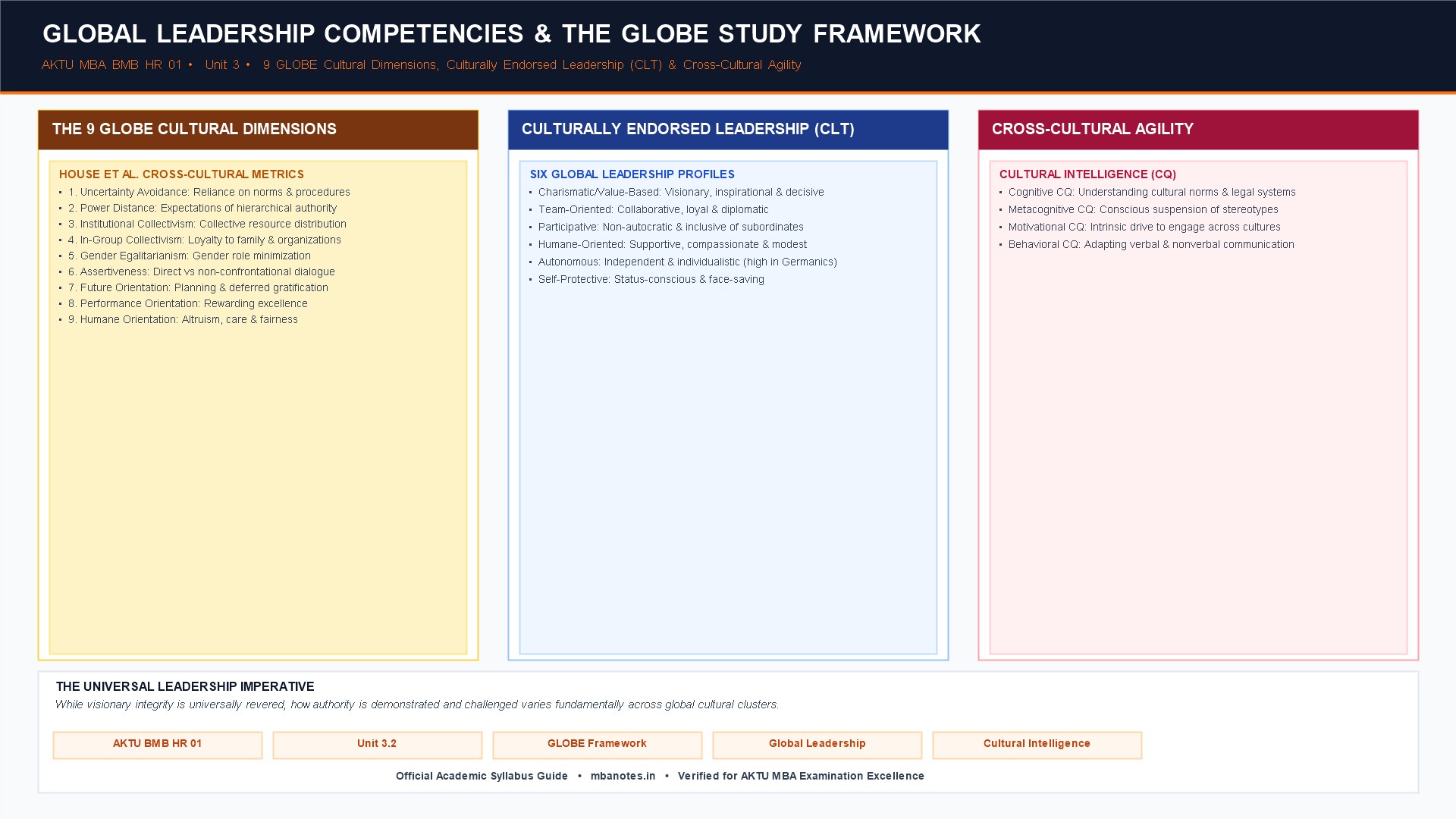
Figure 3.2: Global Leadership Framework - 9 GLOBE Cultural Dimensions, CLT Leadership Typologies, and 4-Factor Cultural Intelligence.
1. Foundations of Global Leadership & Cross-Cultural Complexity
Global Leadership is the capability to inspire, influence, coordinate, and align diverse human stakeholders across geographical, institutional, cultural, and linguistic boundaries. Unlike domestic leadership, global leadership requires mastering cognitive ambiguity and balancing global integration with local responsiveness.
1.1 The Triad of Global Leadership Competencies
Research across international organizations identifies three foundational competency clusters necessary for global leadership effectiveness:
- Cognitive Complexity: The intellectual bandwidth to interpret paradoxical market signals, manage ambiguity without premature closure, and think simultaneously in local and global systems perspectives.
- Cross-Cultural Relational Competence: The emotional ability to establish genuine trust, active listening, and psychological safety with stakeholders holding fundamentally divergent cultural worldviews.
- Global Business Acumen: Deep understanding of geopolitical risk, macroeconomic currency shifts, international trade law, and multi-hub supply chain resilience.
2. The GLOBE Study: 9 Cultural Dimensions Taxonomy
Initiated by Robert J. House in 1991, the GLOBE Research Project studied over 17,000 managers across 62 global societies. GLOBE expanded beyond Hofstede's classical model to identify 9 Cultural Dimensions, measuring both cultural Practices ("As Is") and cultural Values ("Should Be"):
| GLOBE Dimension | Societal Definition & Core Meaning | High Scoring Cultural Cluster | Low Scoring Cultural Cluster | Workplace Leadership Implication |
|---|---|---|---|---|
| 1. Assertiveness | Degree to which individuals are forceful, confrontational, and aggressive in social relationships. | Germanic Europe, USA | Nordic Europe, Japan | Direct debate valued in high-assertive cultures; indirect harmony preserved in low-assertive cultures. |
| 2. Future Orientation | Degree to which a society engages in long-range planning, investing, and delaying gratification. | Singapore, Switzerland | Russia, Latin America | High cultures prioritize 5-year strategic roadmaps; low cultures emphasize immediate tactical agility. |
| 3. Performance Orientation | Extent to which a community encourages and rewards performance improvement, innovation, and excellence. | USA, Taiwan, Singapore | Eastern Europe, Greece | Meritocracy, aggressive KPIs, and variable pay are accepted and celebrated in high-scoring societies. |
| 4. Humane Orientation | Degree to which an organization rewards fairness, altruism, generosity, caring, and kindness. | Southern Asia (India), Sub-Saharan Africa | Germanic Europe, France | Paternalistic care, personal relationship support, and emotional empathy are expected of leaders. |
| 5. In-Group Collectivism | Degree to which individuals express pride, loyalty, and cohesiveness in their families and close organizations. | India, China, Middle East | Nordic Europe, Anglo (UK/USA) | Nepotism vs. institutional loyalty; high in-group loyalty requires relational vetting before doing business. |
| 6. Institutional Collectivism | Degree to which organizational and societal institutional practices encourage collective resource distribution. | Nordic Europe (Sweden), Japan | Anglo cluster, Greece | Group rewards, consensus decision-making, and egalitarian structures triumph over solo star culture. |
| 7. Gender Egalitarianism | Extent to which a collective minimizes gender inequality and role differences in society. | Nordic Europe (Norway, Denmark) | Middle East, South Asia | High presence of female executives; low gender wage gaps; family-supportive parental leave policies. |
| 8. Power Distance | Degree to which members expect and accept power to be distributed unequally and hierarchically. | Southern Asia, Middle East | Nordic Europe, Netherlands | In high power distance, subordinates do not publicly challenge leaders; in low, flat questioning is standard. |
| 9. Uncertainty Avoidance | Extent to which a society relies on established social norms, rituals, and strict procedures to mitigate unpredictability. | Switzerland, Germany, Austria | Russia, Latin America | High societies demand rigorous documentation, contracts, and SOPs; low societies tolerate ambiguity. |
3. Real Corporate Case: Carlos Ghosn & The Renault-Nissan Alliance
In 1999, Japanese automotive giant Nissan was on the brink of bankruptcy, crushed under $20 billion in debt, operating with archaic keiretsu supplier cartels, and paralyzed by consensus-driven management. French automaker Renault acquired a 36.8% stake and dispatched Carlos Ghosn as Chief Operating Officer.
The Cross-Cultural Leadership Strategy
Ghosn (a Brazilian-born executive of Lebanese descent educated in France) entered an insular Japanese corporate culture with immense cross-cultural sensitivity:
- Cross-Functional Teams (CFTs): Instead of dictating European solutions, Ghosn assembled 9 cross-functional Japanese teams comprising 200 middle managers. He gave them the mandate to diagnose operational waste and propose turnaround actions themselves.
- Respecting Face While Shattering Inefficiency: Ghosn abolished lifetime employment (Shushinkoyo) and dismantled the traditional seniority-based pay system, shifting Nissan to performance-based incentives. Crucially, he framed these painful moves not as Western impositions, but as essential sacrifices to save an iconic Japanese institution.
- Accountability Covenant: Ghosn publicly pledged to resign along with his entire executive committee if Nissan failed to return to operating profitability within one fiscal year.
Outcome: Nissan returned to profitability in just one year, eliminating its entire $20 billion debt within three years. The Nissan Revival Plan became the canonical business school case study on navigating high power distance, collectivism, and uncertainty avoidance in an international corporate rescue.
4. Culturally Endorsed Leadership (CLT) Profiles & Cultural Intelligence (CQ)
The GLOBE study aggregated leadership behaviors into six universal Culturally Endorsed Leadership (CLT) Dimensions:
- Charismatic / Value-Based: Ability to inspire, motivate, and expect high performance based on firmly held core values (universally endorsed globally).
- Team-Oriented: Emphasizes effective team building, collaboration, and common purpose (high in Latin America, Confucian Asia).
- Participative: Degree to which managers involve others in making and executing decisions (high in Germanic Europe and Nordic Europe; low in Middle East).
- Humane-Oriented: Reflects supportive, considerate, compassionate, and generous leadership (high in Southern Asia and Sub-Saharan Africa).
- Autonomous: Independent and individualistic leadership attributes (moderate in Germanic Europe; low in Latin America).
- Self-Protective: Focuses on ensuring the safety and security of the individual or group through status-consciousness and face-saving (viewed negatively across most western clusters; tolerated in some hierarchical clusters).
4.1 Cultural Intelligence (CQ) - Earley & Ang's 4-Factor Model
Cultural Intelligence (CQ) is an individual's capability to function and manage effectively in culturally diverse settings. It comprises four distinct, measurable capabilities:
- Cognitive CQ: Knowledge of cultural norms, values, legal systems, and social conventions in different societies.
- Metacognitive CQ: Conscious awareness of one's own cultural assumptions, actively monitoring and adjusting mental maps during cross-cultural interactions.
- Motivational CQ: The leader's drive, self-efficacy, and interest in adapting to culturally unfamiliar environments.
- Behavioral CQ: The verbal and non-verbal behavioral flexibility to adapt body language, tone, speed, and gestures to fit foreign cultural expectations.
5. Visual Knowledge Blueprint: Global Leadership & Cultural Architecture
The visual blueprint below details the 9 GLOBE cultural dimensions, CLT leadership profiles, and the 4-factor Cultural Intelligence (CQ) architecture.
6. AKTU Examination Focus: High-Frequency Questions & Model Answers
Section A: Short Technical Concept Drill (2 Marks Each)
Q1: What is the full form and primary purpose of the GLOBE study?
Answer: Global Leadership and Organizational Behavior Effectiveness. It examines the cross-cultural relationships between societal culture, organizational culture, and culturally endorsed leadership styles across 62 societies.
Q2: Differentiate between In-Group Collectivism and Institutional Collectivism in GLOBE.
Answer: In-Group Collectivism measures loyalty, pride, and cohesion in small family or work groups, whereas Institutional Collectivism measures societal-level practices that encourage collective resource distribution and collective action.
Q3: Name two leadership dimensions that are universally endorsed across all global cultures in the GLOBE study.
Answer: Charismatic/Value-Based leadership (integrity, vision, decisiveness) and Team-Oriented leadership (collaborative, team-builder).
Q4: What are the four dimensions of Cultural Intelligence (CQ) defined by Earley and Ang?
Answer: Cognitive CQ (knowledge), Metacognitive CQ (cultural awareness/monitoring), Motivational CQ (drive/interest), and Behavioral CQ (verbal and non-verbal adaptability).
Q5: Why did Carlos Ghosn utilize Cross-Functional Teams (CFTs) during the Nissan turnaround?
Answer: Ghosn deployed CFTs to empower internal Japanese middle managers to diagnose their own operational inefficiencies, thus overcoming hierarchical barriers and preserving cultural buy-in.
Section B & C: Comprehensive Analytical Questions (10 Marks Each)
Q6: Detail the 9 cultural dimensions of the GLOBE Research Project. How do these dimensions influence managerial behavior and leadership effectiveness across diverse global clusters? (10 Marks)
Model Answer Structure:
- Introduction to the GLOBE Project: Trace its genesis under Robert J. House, distinguishing it from Hofstede's work by highlighting its 62-society sample and differentiation between cultural practices ("As Is") and values ("Should Be").
- Exhaustive Coverage of the 9 Dimensions:
- Assertiveness, Future Orientation, Performance Orientation, Humane Orientation, In-Group Collectivism, Institutional Collectivism, Gender Egalitarianism, Power Distance, Uncertainty Avoidance.
- Managerial & Leadership Implications: Contrast specific clusters (e.g., Anglo vs. Germanic vs. Southern Asian vs. Nordic), explaining how low power distance cultures require participative decision-making, while high humane-orientation cultures require paternalistic leadership care.
- Synthesis: Conclude with the importance of contextual adaptability—leaders must avoid ethnocentric assumptions when managing global teams.
Q7: Explain the Culturally Endorsed Leadership Theory (CLT) profiles identified by the GLOBE study. How can multinational enterprises develop Cultural Intelligence (CQ) in their expatriate leadership cadre? (10 Marks)
Model Answer Structure:
- CLT Profiles Overview: Define the 6 leadership profiles: Charismatic/Value-Based, Team-Oriented, Participative, Humane-Oriented, Autonomous, and Self-Protective.
- Universal vs. Culturally Contingent Leadership: Explain which behaviors are universally positive (integrity, visionary), universally negative (loner, dictatorial), and culturally contingent (participative styles, status-consciousness).
- Developing Cultural Intelligence (The 4 CQ Factors):
- Cognitive CQ: Cultural training curricula, institutional knowledge.
- Metacognitive CQ: Coaching on self-awareness, active debiasing.
- Motivational CQ: Expatriate selection based on resilience and openness.
- Behavioral CQ: Role-playing simulations, language acquisition, non-verbal etiquette.
- Case Benchmark: Highlight Carlos Ghosn's leadership of the Renault-Nissan alliance as a real-world demonstration of cross-cultural adaptation and leadership effectiveness.
7. Strategic Summary & Key Takeaways
- No Universal Leadership Blueprint: What represents charismatic decisiveness in New York or Frankfurt may be perceived as rude arrogance in Tokyo or Stockholm.
- The Power of Cultural Intelligence: High IQ and technical competence are insufficient for global success; leaders must possess high Cultural Intelligence (CQ) to thrive across diverse markets.
- Local Ownership Drives Global Change: The greatest global transformations occur when foreign leaders empower local talent to co-create solutions within their cultural context.
Discussion & Questions
0 CommentsAcademic insights, questions, and conceptual clarifications from students & faculty.
No questions or comments yet
Have a doubt about this topic, an exam tip, or a conceptual perspective? Start the discussion below!
Leave a Comment / Ask a Question
Your email address will not be published. Required fields are marked *