
Global Talent Practices: Comparative Architecture Across India, USA, Europe, and Asia
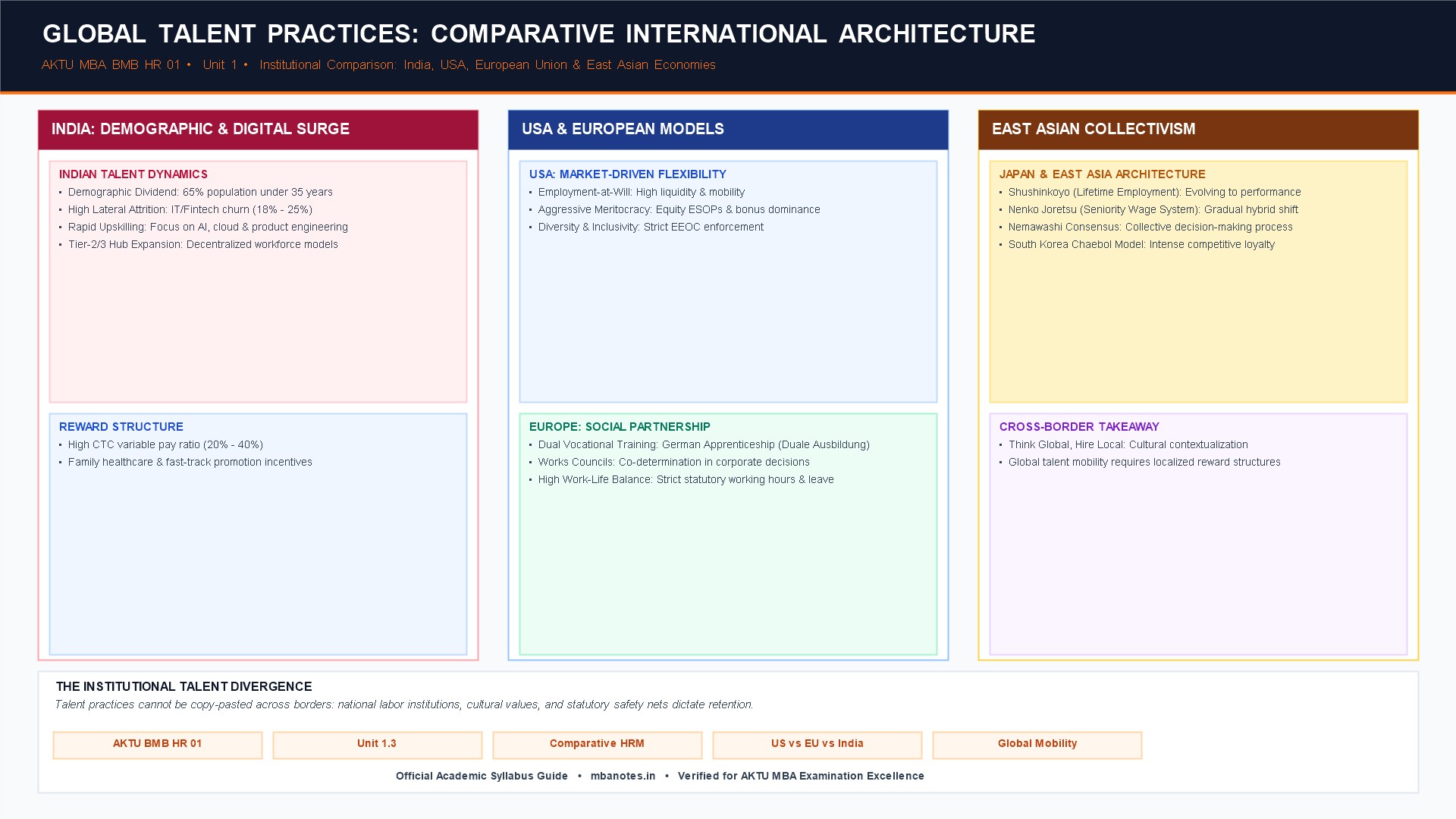
Figure 1.3: Comparative International HRM – Institutional Dynamics across India, USA, Europe, and East Asian Economies.
1. Institutional Foundations: Comparative International Human Resource Management (IHRM)
Comparative Human Resource Management examines how national institutions, legal frameworks, labor market structures, and cultural values shape organizational human capital practices across geographic borders. Under the National Business Systems (NBS) framework, corporate talent architecture is not an isolated organizational choice, but an adaptive response to local institutional constraints.
1.1 Institutional Theory & Divergence in Global Talent
According to Institutional Theory (DiMaggio & Powell), multinational enterprises face dual pressures:
- Isomorphic Pressures for Global Integration: Corporate headquarters seeks global standardization of performance appraisals, leadership competencies, and executive total rewards to maintain brand consistency and facilitate frictionless cross-border executive transfers.
- Pressures for Local Responsiveness (National Institutional Pressures): Host country subsidiaries must conform to local labor legislation (e.g., German co-determination laws, Indian maternity mandates), national educational pipelines, trade union frameworks, and socio-cultural expectations.
1.2 Regional Talent Ecosystems
Global talent management diverges into four distinct regional archetypes:
- The Indian Talent Ecosystem: Anchored by a massive young demographic dividend (over 65% of the population below age 35). Characterized by hyper-competitive university entrance, rapid technical upskilling in digital engineering, high lateral attrition (18% – 25% in IT and SaaS sectors), and compensation structures featuring substantial variable pay (20% – 40% of CTC) and family health coverage.
- The United States Talent Ecosystem: Governed by the legal doctrine of Employment-at-Will (allowing termination without cause, absent contractual restrictions). Focuses on fluid labor mobility, aggressive meritocratic pay differentiation, stock options (ESOPs/RSUs), and strict non-discrimination compliance under the Equal Employment Opportunity Commission (EEOC).
- The European Social Partnership Ecosystem: Built on statutory employee representation, industry-wide collective agreements, and high employee welfare. In Germany and Northern Europe, the Duale Ausbildung (Dual Vocational Training) system integrates classroom vocational theory with corporate apprenticeships. Works Councils (Betriebsrat) hold legally mandated co-determination rights over hiring, restructuring, and working hours.
- The East Asian Collectivist Ecosystem: Historically dominated by Japan’s “Three Sacred Treasures” of employment: Shushinkoyo (lifetime employment guarantee), Nenko Joretsu (seniority-based wage and promotion progression), and enterprise unions. While globalization has forced Japanese and Korean firms toward hybrid performance models, decision-making remains anchored in Nemawashi (consensus building) and deep organizational loyalty.
2. Comparative Architecture: Talent Systems Across India, USA, Europe, and Asia
Table 1.3 contrasts the four global talent archetypes across employment relations, compensation philosophy, developmental architecture, and mobility dynamics.
| Dimension | India (High-Growth Market) | United States (Liberal Market) | Germany / EU (Coordinated Market) | Japan / East Asia (Relational Market) |
|---|---|---|---|---|
| Employment Contract & Tenure | Contractual notice periods (30 to 90 days); high lateral mobility and churn. | Employment-at-Will; high liquidity; instant termination and voluntary mobility. | Indefinite contracts; extensive statutory notice periods and severance protections. | Long-term employment orientation; low mid-career lateral labor liquidity. |
| Compensation Philosophy | Cost-to-Company (CTC) model; high variable performance bonus; tax allowances. | High base + aggressive equity grants (ESOPs/RSUs); wide star-performer pay dispersion. | Standardized collective wage tariffs; low CEO-to-worker pay ratios; rich pensions. | Seniority-weighted base pay; biannual corporate profit-sharing bonuses. |
| Skill Formation & Training | Corporate onboarding bootcamps (e.g., Infosys, TCS); continuous digital self-learning. | Individual-financed education; employer tuition assistance; on-the-job experiential learning. | Dual vocational system (state-certified apprenticeship); structured guild training. | Comprehensive in-house rotative training; generalist cross-functional development. |
| Governance & Employee Voice | Consultative management; limited formal unionization in services; emerging ERM. | Management-led direct communication; non-union tech culture; individual bargaining. | Institutional Co-determination; Works Councils possess statutory veto on key HR actions. | Ringisho / Nemawashi consensus process; enterprise unions work collaboratively with board. |
3. Real Corporate Case: Siemens Dual Vocational Training vs. TCS Campus Engine
Comparing Siemens AG (Germany) and Tata Consultancy Services (TCS) (India) highlights how global conglomerates tailor their talent generation engines to distinct national institutional environments.
Corporate Case Study: Siemens Dual Apprenticeship vs. TCS Campus-to-Career Engine
Siemens AG (Germany) – The Dual Vocational Architecture: Siemens, a global powerhouse in industrial automation and medical engineering, relies on Germany’s Duale Ausbildung system. Siemens sponsors over 10,000 apprentices globally. Young adults spend 3 years splitting their time: 60% working inside Siemens manufacturing plants under certified master craftsmen (Meister) and 40% in state-funded vocational schools. Siemens covers all tuition and pays a monthly stipend. Over 85% of apprentices transition into permanent engineering roles, creating a reliable pipeline of precision technical capability with near-zero initial recruitment turnover.
TCS (India) – The National Campus-to-Career Engine: Tata Consultancy Services, employing over 600,000 professionals, operates in a completely different institutional landscape. Confronted with a vast, fragmented university system, TCS pioneered the National Qualifier Test (NQT), screening over 300,000 engineering applicants annually across hundreds of Indian cities. Selected candidates enter the Initial Learning Program (ILP), a multi-week intensive digital bootcamp. TCS pairs this pipeline with digital self-learning platforms (iON and Elevate), allowing employees to leapfrog wage bands upon clearing difficult coding hackathons.
Comparative Strategic Takeaways: While Siemens leverages Germany’s institutional state-vocational nexus to build high-precision, low-turnover lifelong specialists, TCS leverages India’s demographic scale and digital testing platforms to manufacture agile, scalable software talent. Both models demonstrate that global talent excellence requires deep institutional alignment with host-country strengths.
4. Strategic Framework for Global Mobility & Expatriate Deployment Governance
In multinational enterprises, managing global talent mobility requires orchestrating complex cross-border assignments while safeguarding expatriate motivation, purchasing power, and career progression. A successful global deployment framework balances international strategic alignment with equitable personal incentives.
4.1 Theoretical Models of Expatriate Staffing
International HRM identifies four foundational philosophical approaches to staffing overseas subsidiaries (The Heenan and Perlmutter EPRG Model):
- Ethnocentric Orientation: Key management positions in foreign affiliates are reserved exclusively for parent-country nationals (PCNs). Favored during initial international expansion to enforce headquarters control and technical standardization.
- Polycentric Orientation: Host-country nationals (HCNs) manage local operations, recognizing that local leaders possess superior cultural, regulatory, and market fluency. Reduces cross-cultural conflict but risks headquarters isolation.
- Regiocentric Orientation: Staffing is organized across geographical regions (e.g., ASEAN, EMEA, Latin America), fostering regional synergies while balancing local autonomy.
- Geocentric Orientation: Global search for the best candidate regardless of nationality, creating a unified corporate identity and trans-national talent capability.
4.2 The Balance Sheet Approach to Expatriate Welfare
To ensure expatriates neither gain an unearned financial windfall nor suffer an unfair economic penalty while serving overseas, multinationals utilize the Balance Sheet Approach:
- Equalizing Purchasing Power: Providing Cost of Living Allowances (COLA) and housing adjustments so the expatriate maintains their home-country standard of living in expensive global capitals.
- Tax Equalization Policy: Deducting a hypothetical home-country tax while the corporation absorbs all host-country income tax liabilities.
- Hardship and Mobility Premiums: Offering structured allowances for difficult, geographically remote, or hazardous postings.
- Repatriation and Career Re-entry Management: Formulating structured career paths to prevent post-return disillusionment and high turnover among returning international assignees.
5. Visual Knowledge Blueprint: Comparative Global Talent Architecture
Figure 1.3 presents the comparative institutional architecture of global talent practices, contrasting the regulatory and cultural frameworks of India, the USA, Europe, and East Asia.
Key Structural Pillars Illustrated in Figure 1.3:
- Regional Institutional Archetypes: Compares the Indian demographic surge and high churn against US employment-at-will, European social co-determination, and Japanese relational consensus.
- Skill Formation Systems: Highlights the contrast between Germany’s dual vocational apprenticeship model and corporate university/campus bootcamps in India and the US.
- Expatriate Balance Sheet Framework: Depicts the mechanics of purchasing power parity adjustments, housing stipends, and tax equalization in international mobility.
6. AKTU Examination Focus: High-Frequency Questions & Model Answers
AKTU Examination Drill: Section A (2-Mark Questions)
Q1: What is the “Employment-at-Will” doctrine in US human resource management?
Model Answer: Employment-at-Will is a US legal doctrine allowing either employer or employee to terminate the employment relationship at any time, for any reason or no reason, without advance notice or severance, provided it does not violate anti-discrimination statutes.
Q2: Describe the German Dual Vocational Training System (Duale Ausbildung).
Model Answer: The German Dual System combines classroom theoretical instruction in state vocational schools (Berufsschule) with paid, practical on-the-job apprenticeship inside certified corporate plants over a 2 to 3.5 year curriculum.
Q3: What are the “Three Sacred Treasures” of traditional Japanese employment?
Model Answer: The three traditional pillars are: (1) Shushinkoyo (lifetime employment); (2) Nenko Joretsu (seniority-based wage and promotion progression); and (3) Enterprise unionism.
Q4: What is the primary purpose of Tax Equalization in expatriate compensation?
Model Answer: Tax Equalization ensures that an expatriate pays no more and no less income tax on assignment than they would have paid had they remained in their home country, neutralizing host country tax variances.
Q5: What is a Works Council (Betriebsrat) in European employee relations?
Model Answer: A Works Council is a legally mandated institutional body elected by employees in European enterprises that exercises statutory co-determination and consultation rights over working hours, layoffs, and workplace conditions.
AKTU Examination Drill: Section B & C (10-Mark Comprehensive Questions)
Q6: Compare and contrast the talent management models of the United States, Germany, and Japan. How does institutional context dictate corporate staffing and reward strategies?
Model Answer Framework:
- Theoretical Foundation: Define Institutional Theory and Hall & Soskice’s Varieties of Capitalism (Liberal Market Economies vs. Coordinated Market Economies).
- In-Depth Comparison across 3 Economies:
- United States: Individualistic, market-driven; employment-at-will; aggressive equity/ESOP bonuses; fast lateral mobility; high performance dispersion.
- Germany: Coordinated, social market; strong labor unions; Works Councils (co-determination); Dual Vocational Training; standardized wage tariffs; long-term job security.
- Japan: Relational, collectivist; historical lifetime employment; seniority-weighted pay; consensus-driven (Nemawashi); enterprise unions; generalist rotational development.
- Convergence vs. Divergence: Discuss how globalization and digital disruption are forcing hybrid models (e.g., Japanese firms adopting merit bonuses; US firms offering better parental leave).
- Conclusion: Summarize why multinational corporations must adopt a “glocal” approach (global consistency + local institutional adaptation).
Q7: Explain the Balance Sheet Approach for expatriate compensation. Detail the components of an international assignment package and discuss common causes of expatriate failure.
Model Answer Framework:
- Concept & Philosophy: Define the Balance Sheet (Home-Country Based) approach; its core principle of preserving home-country purchasing power parity.
- Detailed Breakdown of Package Components:
- Base Salary & Disposable Income: Tied to home pay structure.
- Cost of Living Allowance (COLA): Adjusted via comparative CPI index.
- Hardship & Hazard Premiums: Compensating for physical, political, or climatic dislocation.
- Direct Allowances: Furnished executive housing, international schooling for children, annual home leave flights.
- Tax Equalization: Employer absorbs host tax spikes to ensure tax neutrality.
- Expatriate Failure Analysis: Cite empirical research showing 20% to 40% failure rates; primary cause is not technical incompetence, but spouse and family cultural adjustment failure (the Cultural W-Curve).
- Managerial Mitigation: Pre-departure language and cultural training, host mentors, and structured repatriation career planning.
7. Strategic Summary & Key Takeaways
- Institutional Divergence: National labor institutions, legal doctrines, and cultural expectations dictate talent strategy; monolithic global HR policies inevitably fail when imposed without local adaptation.
- Market Flexibility vs. Social Security: The US model prioritizes labor market liquidity and aggressive performance bonuses, while the European model emphasizes co-determination, social partnership, and vocational apprenticeships.
- Evolving Asian Paradigms: Japan and East Asian economies are transitioning from rigid seniority and lifetime guarantees toward hybrid meritocracies while preserving corporate loyalty and consensus.
- Expatriate Cost Realities: International executive deployments cost between 3x to 4x domestic salary, demanding rigorous purchasing power parity calculations and clear strategic assignment ROI.
- Family Acculturation Priority: Cross-border assignment success hinges primarily on family and spouse adaptation rather than executive technical skills alone.
Discussion & Questions
0 CommentsAcademic insights, questions, and conceptual clarifications from students & faculty.
No questions or comments yet
Have a doubt about this topic, an exam tip, or a conceptual perspective? Start the discussion below!
Leave a Comment / Ask a Question
Your email address will not be published. Required fields are marked *