
International Product Strategy: Standardization vs. Adaptation Trade-Offs, Product Life Cycle, and Global Brand Equity
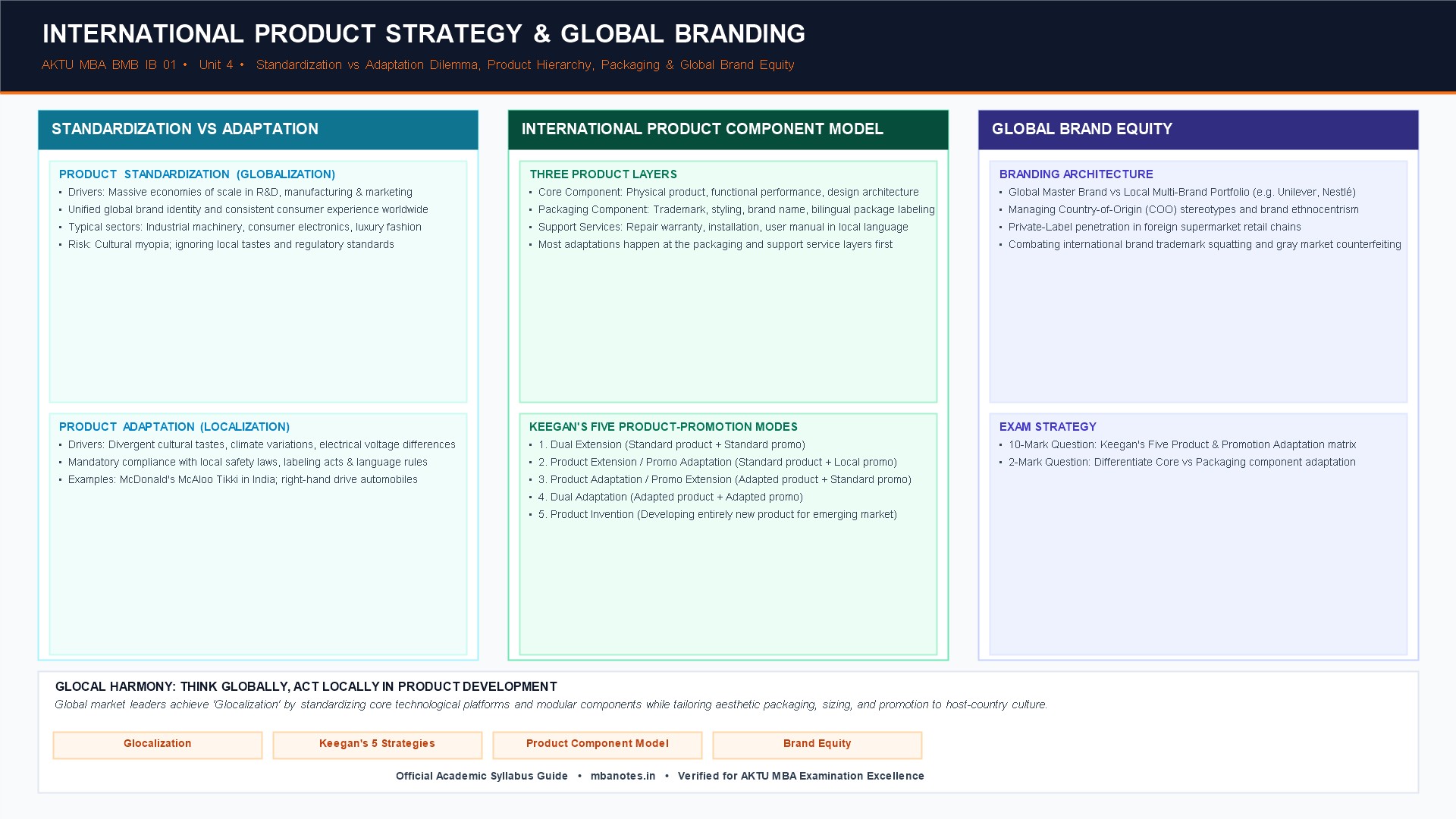
1. The Central Product Dilemma: Standardization vs. Adaptation
When launching products into foreign markets, multinational corporations confront the fundamental strategic trade-off between Product Standardization and Product Adaptation:
Forces Favoring Standardization
- Enormous Scale Economies: Long manufacturing production runs and unified R&D eliminate redundant design costs.
- Consistent Global Brand Image: Customers encounter an identical, recognizable offering worldwide.
- Reduced Inventory Complexity: Lower safety stocks and interchangeable modular components.
- Prevalence of Global Standards: Industrial equipment and B2B tech require uniform technical specs.
Forces Compelling Adaptation
- Divergent Cultural Tastes: Deep-seated food preferences, color symbolisms, and religious dietary laws.
- Mandatory Legal & Safety Norms: National labeling laws, emission regulations, electrical voltage differences.
- Varying Economic Purchasing Power: Downsizing package sizes (e.g., single-use shampoo sachets in India).
- Climatic & Infrastructure Extremes: Operating in high humidity, extreme heat, or unpaved rural roads.
2. The International Product Component Model
To systematically evaluate where adaptation is required without redesigning the entire product, firms analyze the Product Component Model across three distinct structural layers:
- 1. Core Component: The underlying physical product, base functional technology, performance architecture, and chemical formula. Adaptations here are the most capital-intensive and costly.
- 2. Packaging Component: Visual trademark styling, package dimensions, container shape, protective materials, bilingual labeling instructions, and safety warnings. Adaptations here are highly frequent and moderately inexpensive.
- 3. Support Services Component: Installation guidance, repair warranties, availability of spare parts, local customer service call centers, and user manuals translated into local vernaculars.
3. Warren Keegan’s Five Product-Promotion Strategies
Renowned international marketing scholar Warren Keegan formulated a 5-strategy matrix coordinating product and promotion adaptations:
| Strategy | Product Dimension | Promotion Dimension | Real-World Enterprise Example |
|---|---|---|---|
| 1. Dual Extension | Standardized Product | Standardized Promotion | Apple iPhone, Rolex watches (universal global appeal) |
| 2. Product Extension / Promo Adaptation | Standardized Product | Adapted Promotion | Bicycles (promoted for recreation in USA; basic transport in India) |
| 3. Product Adaptation / Promo Extension | Adapted Product | Standardized Promotion | ExxonMobil motor oil (tailored viscosity for cold climates; universal performance ad) |
| 4. Dual Adaptation | Adapted Product | Adapted Promotion | Unilever detergent formulations tailored to hard water; localized messaging |
| 5. Product Invention | Entirely New Product | New Targeted Promotion | Godrej ChotuKool (low-cost battery-operated cooler for rural India) |
4. International Product Life Cycle (IPLC) Management
Products rarely mature simultaneously worldwide. A product entering the decline phase in mature Western economies may be in the high-growth introductory stage in developing nations. International product managers execute staggered global rollouts, transferring capital machinery and marketing templates to emerging markets to extend the overall economic life of mature product lines.
5. Global Brand Equity Architecture & Brand Architecture Models
Managing corporate identity across borders requires balancing corporate master branding against local brand equity:
- Corporate Master Brand (Branded House): Single powerful identity across all markets and categories (e.g., Sony, Virgin, Samsung). Maximizes marketing efficiency and instant recognition.
- Multi-Brand Strategy (House of Brands): Independent, standalone brand names tailored to individual product categories and national cultures (e.g., Procter & Gamble, Unilever). Insulates corporate reputation if a single brand encounters reputational backlash.
University Examination Question Bank & Model Solutions
Designed as per Dr. A.P.J. Abdul Kalam Technical University (AKTU) MBA Examination Pattern.
Part A: Conceptual 2-Mark Short Answer Questions
Q1 [2 Marks]: What is Product Standardization in international marketing?
Ans: Selling an identical, uniform product with unchanged features, styling, and packaging across all international markets to maximize manufacturing and marketing economies of scale.
Q2 [2 Marks]: Explain Warren Keegan's Dual Adaptation Strategy.
Ans: Adapting both the physical product and the promotional communication message to fit the unique cultural, environmental, and usage conditions of a foreign market.
Q3 [2 Marks]: What are the three components of the International Product Component Model?
Ans: 1) Core Component (physical product/technology), 2) Packaging Component (trademark, label, styling), and 3) Support Services Component (installation, warranty, service).
Part B & C: Analytical 10-Mark Detailed Solutions & Strategic Frameworks
Question 1 [10/15 Marks]: Critically evaluate the Product Standardization vs. Adaptation dilemma. Detail Warren Keegan's Five Global Product-Promotion Strategies with real-world examples.
Model Examination Answer Blueprint:
2. Product Component Model: Analyze the Core, Packaging, and Support Service layers, identifying where adaptations occur most cost-effectively.
3. Warren Keegan's 5 Strategies: Draw the full 2x2+1 matrix: Dual Extension, Product Extension/Promo Adaptation, Product Adaptation/Promo Extension, Dual Adaptation, and Product Invention with enterprise examples.
4. International Product Life Cycle: Discuss staggered product rollouts across developing and developed nations.
5. Global Brand Equity: Compare the 'Branded House' master corporate brand strategy with the 'House of Brands' decentralized architecture.
Strategic Executive Summary: 3. Product Strategy: Standardization vs Adaptation
- The standardization vs adaptation dilemma balances massive production scale economies against cultural, legal, and climatic host-market realities.
- The Product Component Model divides offerings into Core, Packaging, and Support Services, showing that packaging and support services are adapted most frequently.
- Warren Keegan's five product-promotion strategies range from Dual Extension (Apple iPhone) to Product Invention (low-cost products tailored for emerging markets).
- Multinational brand architecture balances centralized corporate master branding (Branded House) with localized risk-isolated brands (House of Brands).
Frequently Asked Questions (Academic & Practitioner FAQ)
Q1. When is Product Standardization most appropriate?
Standardization is optimal for industrial B2B equipment, high-technology goods, and global luxury items where consumer needs are universal, technical specifications are standardized, and significant economies of scale can be realized in production.
Q2. What is Keegan's 'Product Invention' strategy?
Product invention involves developing an entirely new product from the ground up to address the unique economic, infrastructural, or cultural needs of emerging market consumers at an affordable price point (e.g., low-power appliances for rural regions).
Q3. Why is adapting the packaging component easier than the core component?
Modifying labels, packaging dimensions, and language instructions involves minimal retooling of manufacturing lines, whereas altering the core component requires expensive redesigns of physical platforms, tooling, and chemical formulations.
Discussion & Questions
0 CommentsAcademic insights, questions, and conceptual clarifications from students & faculty.
No questions or comments yet
Have a doubt about this topic, an exam tip, or a conceptual perspective? Start the discussion below!
Leave a Comment / Ask a Question
Your email address will not be published. Required fields are marked *