
Management by Objective (MBO): Meaning, Process, Benefits & Limitations
What is Management by Objectives (MBO)?
A participative management philosophy introduced by Peter Drucker (1954) where managers and subordinates jointly negotiate measurable performance targets and evaluate results against agreed criteria.
Shifts workplace mindset from merely being busy with daily tasks to delivering verifiable business outcomes.
Replaces authoritarian supervision with personal responsibility, self-monitoring, and internal motivation.
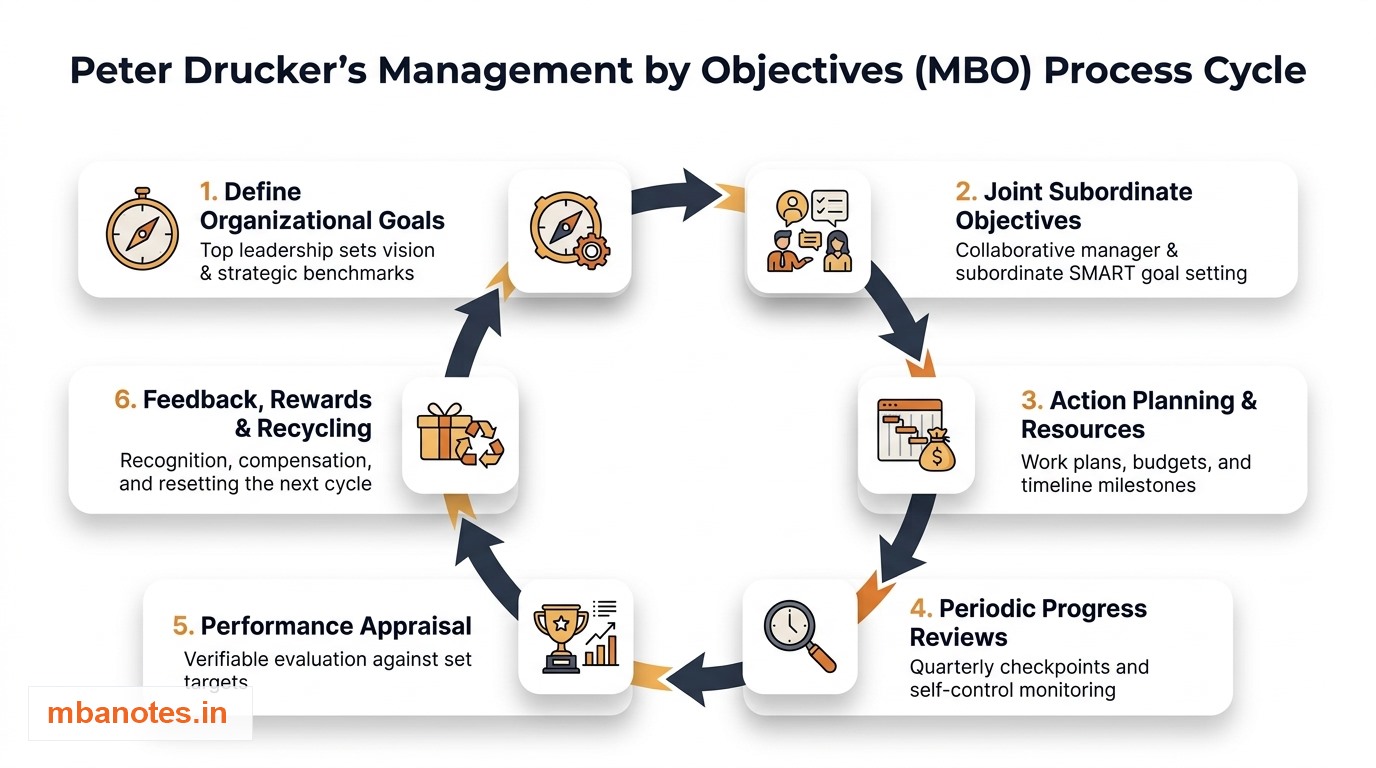
Operates continuously: Corporate Goals → Individual Targets → Action Plans → Reviews → Appraisal → Feedback.
Direct precursor to Google and Intel's Objectives & Key Results (OKR) framework used across global tech.
1. Meaning and Concept of MBO
Prior to the 1950s, traditional industrial management relied heavily on Classical command-and-control structures (Taylorism and Fayolism). Superiors handed down rigid rules, and subordinates were judged on obedience, personality traits, and hours clocked at their desks rather than actual business outcomes achieved.
In his 1954 landmark book The Practice of Management, management guru Peter Drucker warned against the "Activity Trap"—where employees become so preoccupied with daily administrative routines that they completely forget the overarching purpose of their enterprise. Drucker proposed Management by Objectives and Self-Control, asserting that when employees participate in setting their own measurable targets, they assume psychological ownership of their performance.
2. SMART Objectives in MBO
In an MBO system, vague instructions such as "increase company profits" or "improve customer satisfaction" are strictly prohibited because they cannot be objectively appraised. Objectives must adhere to the SMART criteria:
Specific
Target a clear, unambiguous operational area. Bad: "Improve sales." Good: "Increase enterprise B2B software subscriptions in North India."
Measurable
Must include a concrete quantitative metric or KPI. Example: "Achieve ₹2.5 Crores in new recurring annual revenue."
Achievable
Challenging enough to inspire peak effort, but realistic within market resources to avoid demoralizing team members.
Relevant
Directly aligned with divisional milestones and corporate strategic vision, preventing time wasted on vanity metrics.
Time-Bound
Defined by an explicit calendar milestone or deadline. Example: "Completed by the close of Q3 (December 31st)."
Integrated SMART Goal
"Acquire 25 enterprise B2B accounts generating ₹2.5 Cr ARR across NCR by December 31, 2026."
3. The MBO Process (6 Steps)
Figure 1.7The diagram below synthesizes Peter Drucker's 6-stage closed-loop managerial cycle, highlighting how top-down organizational goals cascade into participative individual targets, self-monitored execution, and ongoing reward feedback:
4. Benefits and Limitations of MBO
- Enhanced Intrinsic Motivation: Subordinates commit deeply to goals they actively helped formulate rather than targets dictated top-down (Herzberg's motivator factor).
- Absolute Role Clarity: Eliminates overlapping duties, departmental conflict, and office politics through transparent objective sheets.
- Objective Performance Evaluation: Removes supervisor bias and the halo effect by measuring performance strictly against agreed quantitative metrics.
- Decentralization & Self-Control: Superiors manage by exception, empowering employees with operational autonomy in daily execution.
- Excessive Paperwork & Bureaucracy: Documenting objectives, quarterly progress logs, and revision forms can overwhelm managers with red tape.
- Short-Term Quota Bias: Teams focus obsessively on hitting quarterly numerical targets while neglecting long-term R&D, mentoring, and ethics.
- Inflexibility in Fast-Changing Markets: Rigid annual goal cycles become quickly obsolete during technological disruption or economic volatility.
- Authoritarian Coercion: If poorly executed, authoritarian leaders use MBO as a punitive weapon to force unrealistic quotas onto subordinates.
5. MBO vs. Traditional Appraisal
| Evaluation Dimension | Management by Objectives (MBO) | Traditional Top-Down Appraisal |
|---|---|---|
| Goal Formulation | Participative; mutually negotiated between superior and subordinate. | Autocratic; imposed unilaterally by top leadership. |
| Evaluation Focus | Verifiable results and quantifiable outputs (Outcomes). | Subjective personal traits: loyalty, attitude, obedience, punctuality. |
| Time Orientation | Future-oriented (Developmental coaching, capability enhancement). | Past-oriented (Judicial fault-finding and blame allocation). |
| Manager's Role | Coach, facilitator, and resource enabler. | Judge, disciplinarian, and inspector. |
| Subordinate Reaction | Self-control, commitment, and high accountability. | Defensiveness, resentment, and minimal compliance. |
In 1999, venture capitalist John Doerr introduced early-stage Google to the Objectives and Key Results (OKR) framework, which Andrew Grove had originally adapted from Drucker's MBO at Intel.
Google founders set high-level company Objectives, which subordinate engineering teams translated into negotiated, verifiable Key Results (e.g., "Launch Chrome and reach 20 million active users"). Employees tracked performance via quarterly self-reviews, fostering self-control and transparent alignment across autonomous technical squads without micromanagement.
"What is Management by Objectives (MBO)? Who introduced this concept?"
Management by Objectives (MBO) was introduced by Peter F. Drucker in 1954 in his classic book The Practice of Management. It is a participative management system where superiors and subordinates jointly formulate measurable goals, determine operational responsibilities, and periodically evaluate results against pre-agreed targets, emphasizing results and self-control over direct supervision.
"Critically analyze the Management by Objectives (MBO) philosophy. Diagrammatically illustrate the steps in the MBO process. Why do MBO programs frequently fail in modern corporations, and how can managers overcome these pitfalls?"
- Introduction & Philosophy (2 Marks): Credit Peter Drucker (1954); explain the paradigm shift from the activity trap to results orientation and self-control.
- The 6-Step Cycle Flowchart (3 Marks): Neatly draw the circular/closed-loop flowchart showing: Corporate Goals → Individual Objectives → Action Plans → Periodic Reviews → Performance Appraisal → Rewards & Feedback.
- SMART Goals with Examples (2 Marks): State the SMART acronym and provide at least one clear corporate KPI example (e.g., revenue, cost reduction, or production yield).
- Why MBO Fails & Solutions (3 Marks): Detail the real pitfalls: top-management lip-service, excessive paperwork, short-term quarterly focus, and arbitrary target-setting. Provide managerial remedies: ongoing training, agile quarterly reviews (like Google's OKRs), and supportive coaching leadership.