

Semester 1 • BMB 101
Management Concepts • Unit 1
Core Subject
Different Levels of Management
Authored by mbanotes.in Academic Editorial Team
Target Score: 10/10 Marks (Section B/C)
What are Levels of Management?
The demarcation of managerial authority, decision-making responsibility, and functional scope arranged in a hierarchical pyramid across an organization.
Board, CEO, President. Formulates enterprise vision, 3–5 year strategic goals, policy, and external stakeholder relationships.
Department Heads, Plant Managers. Serves as a bidirectional buffer, translating corporate strategy into departmental operations.
Supervisors, Foremen, Team Leads. Oversees daily operative execution, task assignments, worker safety, and quality assurance.
Conceptual skills dominate at Top; Technical skills dominate at Lower; Human/Interpersonal skills remain uniformly vital across ALL levels.
AKTU Tip: Always sketch the 3-tier organizational pyramid accompanied by Katz’s horizontal skill distribution diagram for maximum exam marks.
1. Meaning and Levels of Management
In any enterprise exceeding single-person proprietorship, the complexity of operations necessitates a systematic division of authority. The term Levels of Management refers to the line of demarcation that separates different managerial positions within an organization.
The number of management levels determines the vertical structure of the enterprise, dictating the scalar chain (chain of command) and the span of control (the number of direct subordinates a manager supervises). Historically established in organizational theory, management is universally categorized into three sequential tiers:
Top-Level Management
Long-term visionaries setting enterprise direction, culture, capital structure, and broad corporate policies.
Middle-Level Management
Translational leaders converting strategic blueprints into functional departmental programs and cross-unit cohesion.
Supervisory / First-Line
Frontline managers directly guiding, motivating, and controlling operative employees at the point of product delivery.
2. Top-Level Management
Top-level management constitutes the ultimate governing authority within an enterprise. It is composed of senior executives responsible for the comprehensive performance, survival, and competitive positioning of the entire organization.
Fiduciary Level
Standard Corporate Designations: Board of Directors, Non-Executive Chairman, Chief Executive Officer (CEO), Managing Director (MD), President, Executive Vice Presidents (EVPs), and C-Suite Chiefs (CFO, COO, CTO, CMO).
Vital Functions of Top Management:
- Formulating Corporate Vision & Philosophy: Defining core corporate values, long-term strategic roadmaps, and enterprise purpose.
- Master Strategic Planning & Goal Setting: Architecting 3-to-5+ year plans, identifying market entry/exit strategies, and managing M&A transactions.
- Capital & Resource Allocation: Sourcing long-term debt and equity financing, approving multi-crore capital expenditures, and dividend payouts.
- External Environmental Interface: Managing strategic liaisons with regulatory authorities, stock exchanges, institutional investors, and media.
- Appointing & Evaluating Executive Leadership: Selecting department heads and establishing succession pipelines for key executive seats.
3. Middle-Level Management
Middle-level management functions as the indispensable operational bridge between top-level strategic ambition and shop-floor execution. Without strong middle management, strategic plans remain abstract concepts that never translate into actual business outcomes.
Execution Level
Standard Corporate Designations: General Managers, Functional Department Heads (HR, Marketing, Production, R&D, Finance), Regional Sales Directors, Plant/Factory Managers, and Zonal Heads.
Vital Functions of Middle Management:
- Policy Interpretation & Cascading: Deciphering broad board directives into unambiguous, measurable departmental objectives (KPIs / OKRs).
- The “Buffer” & Liaison Function: Protecting top leadership from operational distraction while insulating frontline staff from corporate anxiety.
- Inter-Departmental Synergy: Harmonizing competing priorities across functions (e.g., resolving conflicts between Sales demand and Production batch limits).
- Talent Development & Training: Identifying high-potential junior supervisors and organizing formal managerial training.
- Performance Monitoring: Reviewing quarterly budget variances, sales targets, and scrap rates, submitting corrective reports to top executives.
4. Lower-Level Management
Also designated as First-Line, Supervisory, or Operational Management, this tier directly touches the physical point of production, customer service delivery, and operative workforce management. They are the only managers who directly supervise non-managerial employees.
Operational Level
Standard Corporate Designations: Shift Supervisors, Foremen, Line In-Charges, Team Leads, Section Officers, Office Superintendents, and Customer Care Supervisors.
Vital Functions of First-Line Management:
- Direct Work Assignment: Distributing daily shift tasks, scheduling machines, and allocating operative labor to specific workstations.
- Quality Assurance & Standard Adherence: Enforcing strict standard operating procedures (SOPs), minimizing defect rates, and maintaining safety protocols.
- Workplace Discipline & Morale: Ensuring punctuality, managing unauthorized absenteeism, and fostering camaraderie on the production line.
- First-Line Grievance Redressal: Listening to immediate employee concerns and resolving micro-disputes before they escalate into formal labor union disputes.
- On-the-Job Guidance: Demonstrating correct technical procedures, operating equipment, and onboarding apprentice technicians.
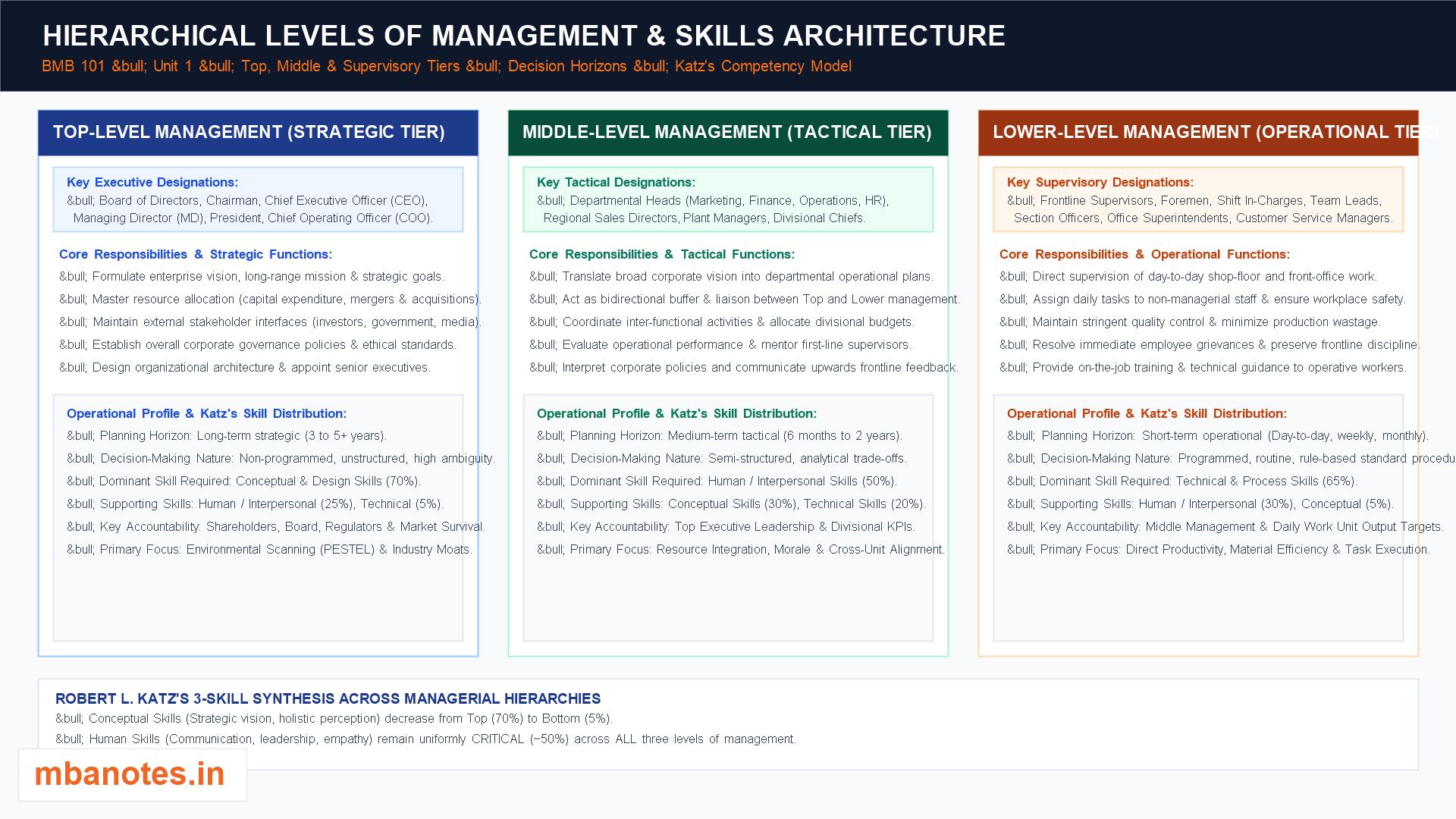
Conceptual Infographic: The 3-Tier Hierarchy & Skills Distribution Model
The diagram below synthesizes the organizational management hierarchy, detailing the designations, core responsibilities, decision horizons, and Robert L. Katz’s three-skill competency distribution across Top, Middle, and Supervisory tiers:
5. Managerial Skills Across Levels (Katz Model)
In his seminal Harvard Business Review article, “Skills of an Effective Administrator” (1955), Robert L. Katz established that effective management requires three essential competencies whose relative necessity varies across hierarchical tiers:
70% Relative Need
Conceptual Skills
The cognitive ability to see the organization as a holistic system, comprehend how diverse functions interact, and anticipate how external economic/regulatory changes impact long-term corporate destiny.
~50% Equal Need
Human / Interpersonal Skills
The capacity to work effectively with and through people, communicate clearly, resolve destructive conflicts, inspire loyalty, and practice empathetic leadership. Crucially, human skills remain equally indispensable across all three management levels.
65% Relative Need
Technical Skills
Proficiency in specific mechanics, engineering procedures, accounting methods, software tools, and machinery operations. Vital for supervisors who must guide and troubleshoot frontline operative work.
6. Comparison of Management Levels
| Analysis Parameter | Top-Level Management | Middle-Level Management | Lower / Supervisory Management |
|---|---|---|---|
| Primary Role | Strategic governance & policy creation | Tactical execution & departmental coordination | Operative supervision & task execution |
| Planning Horizon | Long-term (3 to 5+ years) | Medium-term (6 months to 2 years) | Short-term (Day-to-day, weekly, monthly) |
| Nature of Decisions | Non-programmed, unstructured, high risk | Semi-structured, analytical trade-offs | Programmed, routine, rule-based standard SOPs |
| Katz’s Dominant Skill | Conceptual Skills (~70%) | Human / Interpersonal Skills (~50%) | Technical Skills (~65%) |
| Typical Designations | CEO, MD, President, Board Members | HODs, Branch Managers, Plant Chiefs | Supervisors, Foremen, Line Leads, Superintendents |
| Span of Control | Narrow (3 to 8 direct report senior VPs) | Moderate (5 to 12 supervisors) | Wide (15 to 30+ operative workers) |
| Key Accountability | Shareholders, Board & External Regulators | Top Management Executives | Middle Departmental Managers |
| Primary Metric of Success | Shareholder return, market cap & revenue growth | Departmental budget targets & cross-unit KPIs | Daily output units, scrap minimization & safety zero-incidents |
💼 Mini Case Study: Tata Motors Nexon EV Rollout
Syllabus Application
Tata Motors set an ambitious goal to capture India’s nascent electric mobility market under aggressive cost and timeline constraints without building an expensive all-new EV factory.
Top Management (Board & CEO) formulated the strategic goal and capital allocation; Middle Management (Plant Heads & Functional Directors) converted directives into tactical plans by retooling existing ICE assembly lines for Ziptron EV powertrains; Lower Management (Shop-Floor Supervisors) enforced daily technical standards, battery safety checks, and assembly-line cycle times.
Section A: High-Scoring 2-Mark Model Definitions
“The hierarchical arrangement of managerial positions within an organization that defines the chain of command, authority boundaries, and decision-making responsibilities.”
“The tactical tier that functions as a bidirectional buffer, translating top-management strategic vision into departmental operational programs and supervising first-line managers.”
“The mental capacity to view the enterprise as an integrated whole, perceive inter-functional relationships, and formulate strategic decisions amidst environmental uncertainty.”
Section B & C: 10-Mark Analytical Question Blueprint
Exam Question: “Explain the different levels of management along with their key functions and responsibilities. Discuss Robert L. Katz’s skills framework across managerial hierarchies with suitable diagrams.”
- Introduction & Pyramid Diagram (2 Marks): Define management levels and sketch the clean 3-tier pyramid (Top, Middle, Lower).
- Three Levels Functional Breakdown (3 Marks): Detail designations, core functions, and planning horizons for each level.
- Robert L. Katz’s Skills Model (3 Marks): Draw Katz’s skill distribution diagram showing Conceptual (dominating Top), Technical (dominating Lower), and Human skills (equal across all). Emphasize why human skills are universally essential.
- Comparative Table (1 Mark): Present a 4-to-6 parameter comparison table (Horizon, Decision Nature, Accountability, Key Stressor).
- Conclusion & Case Example (1 Mark): Conclude with a real-world enterprise example (e.g. Tata Motors or Apple) demonstrating how strategic vision cascades into frontline execution.