

Management Practices from Past to Present
Evolution of Management:
Management evolved from informal ancient administration to a systematic scientific discipline, progressing through five paradigm shifts to match rising industrial complexity.
Emphasizes operational efficiency, standardized time-motion studies, functional specialization, and bureaucratic hierarchy.
Hawthorne Studies revealed that worker productivity is driven by social belonging, group norms, and managerial empathy.
Organizations operate as open systems. There is ‘no one best way’; management strategy must match environmental turbulence.
Driven by Agile sprints, Lean thinking, Peter Drucker’s knowledge worker autonomy, OKRs, and AI-enabled algorithmic collaboration.
1. Concept of Management
Management is the universal process of coordinating and integrating work activities so that they are completed efficiently and effectively with and through other people. While efficiency focuses on minimizing resource waste (“doing things right”), effectiveness focuses on goal attainment (“doing the right things”).
Management is both an art (requiring personal intuition, creativity, and judgment) and a science (grounded in systematic principles, empirical observation, and predictable causal relationships). Its evolution reflects humanity’s continuous effort to organize collective labor toward complex institutional objectives.
“To manage is to forecast and to plan, to organise, to command, to co-ordinate and to control.” — Henri Fayol (General and Industrial Management, 1916)
2. Classical Management Approaches
Born out of the Industrial Revolution, the Classical School sought to impose order, predictability, and efficiency upon newly emerging mass-production factories. It comprises three distinct theoretical branches:
Scientific Management
F.W. Taylor (Shop-Floor Level)Applied scientific methods to determine the “one best way” for each task. Introduced time and motion studies, differential piece-rate wage systems to incentivize maximum output, and functional foremanship separating planning from execution.
Administrative Theory
Henri Fayol (Top-Executive Level)Synthesized universal managerial principles. Codified the 5 managerial functions (POCCC: Planning, Organizing, Commanding, Coordinating, Controlling) and the 14 Principles of Management, including Scalar Chain and Unity of Command.
Bureaucratic Model
Max Weber (Organizational Structure)Proposed rational-legal authority over traditional or charismatic dominance. Emphasized clear jurisdictional competency, impersonal rule-governed decision making, written record-keeping, and merit-based career advancement.
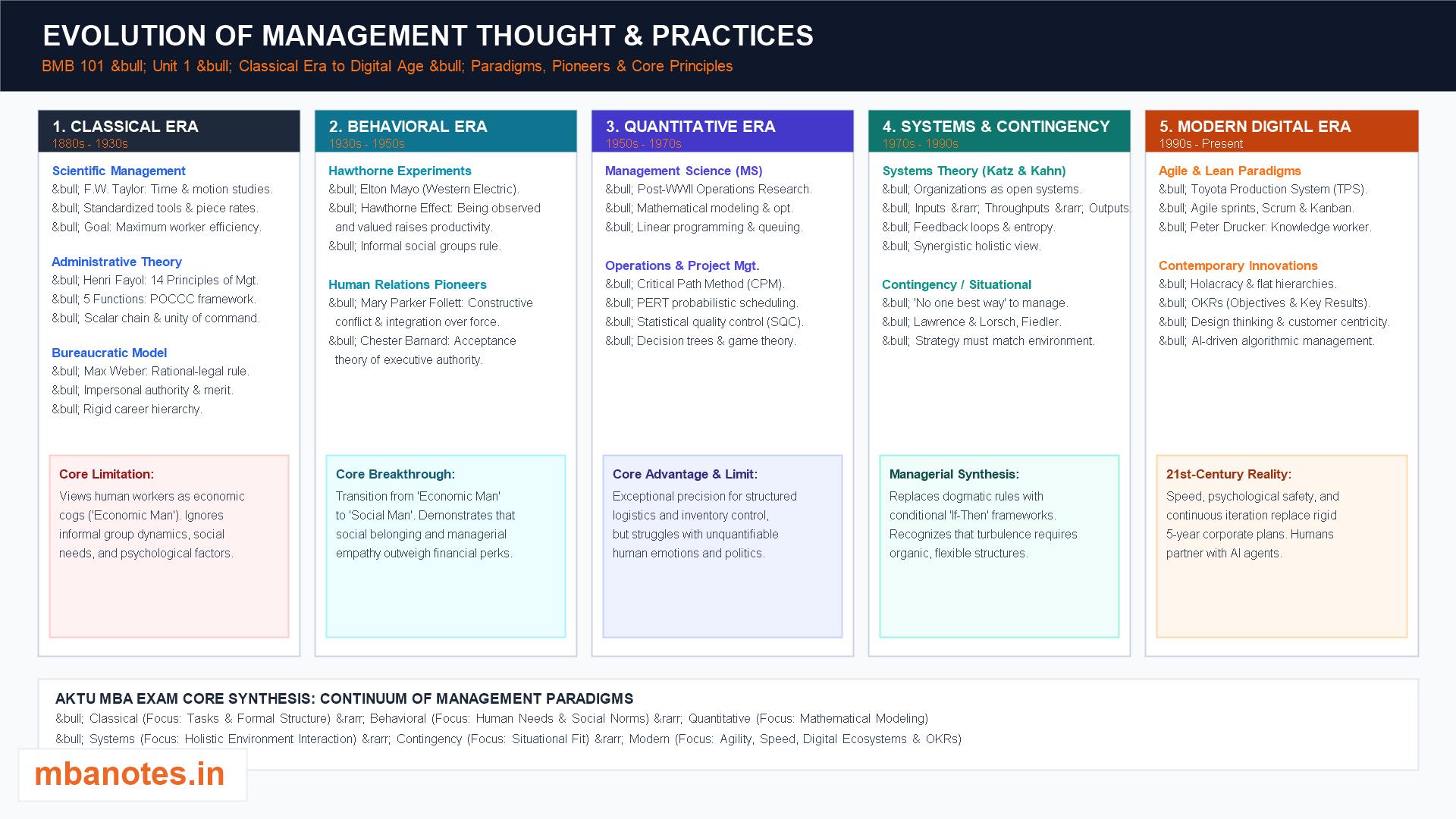
Conceptual Infographic: Chronological Evolution of Management Paradigms
The diagram below synthesizes the five major evolutionary epochs of management thought, illustrating the transition from task-mechanics to human relations, systems dynamics, and digital agility:
3. Neo-Classical & Human Relations Approach
The Great Depression and growing labor unrest highlighted the limitations of the mechanistic Classical model. Researchers recognized that worker motivation is deeply psychological and social:
Conducted by Elton Mayo and Fritz Roethlisberger at Western Electric’s Hawthorne Works in Chicago. Tested the impact of physical variables (lighting intensity, rest breaks, humidity) on assembly worker output.
Advocated “power with” rather than “power over” employees. Pioneered the concept of integration in conflict resolution, where both parties uncover creative win-win solutions without dominance or compromise.
Argued that authority does not flow mechanically from the top of the hierarchy; authority only exists when subordinates willingly accept orders within their “zone of indifference.”
4. Modern Management Approaches
Quantitative Management
Emerged from World War II military operations research. Employs linear programming, queuing theory, PERT/CPM project networks, and statistical simulation to optimize inventory, distribution logistics, and resource allocation.
Open Systems Theory
Conceptualized by Daniel Katz and Robert Kahn. Organizations are living open systems that import environmental inputs (capital, raw materials, labor), transform them through throughputs, and export outputs (goods, services), continually adapting via feedback loops.
Contingency Approach
Rejected universal dogmas. Formulated by Fred Fiedler, Paul Lawrence, and Jay Lorsch. Proposes that effective managerial action depends upon situational variables (technology, environmental turbulence, organizational size). “If this situational condition exists, then this managerial approach is optimal.”
5. Comparison of Management Approaches
| Management School | Key Pioneers | Primary Focus | View of Human Worker | Major Limitation |
|---|---|---|---|---|
| Scientific Management | F.W. Taylor, Gilbreths, Gantt | Job standardization & shop-floor efficiency | Economic Man (rational cog) | Monotony, burnout & de-skilling |
| Administrative Theory | Henri Fayol, Lyndall Urwick | Universal principles & top-management functions | Administrative functionary | Rigid rules, assumes stable environment |
| Bureaucratic Model | Max Weber | Impersonal legal rules & clear hierarchy | Rule-abiding career official | Red tape, goal displacement, slow change |
| Human Relations | Elton Mayo, Roethlisberger | Social dynamics, informal groups & morale | Social Man (driven by belonging) | Overlooked structural & economic factors |
| Contingency Approach | Fiedler, Lawrence & Lorsch | Situational fit between strategy & environment | Complex, adaptable individual | Lacks universal predictive simplicity |
| Modern Digital / Agile | Drucker, Deming, Ohno | Speed, continuous iteration, knowledge workers & AI | Empowered creative problem-solver | Cognitive overload, continuous ambiguity |
Post-WWII Toyota lacked the massive capital required to replicate Ford’s rigid mass-production assembly lines, facing severe material waste and high defect rates under classic piece-rate methods.
Taiichi Ohno blended Taylor’s Scientific time-and-motion rigor with Mayo’s Human Relations empowerment. Instead of treating line workers as passive cogs, Toyota installed the Andon Cord, allowing any operator to stop the line to resolve defects immediately, combined with Kaizen (continuous bottom-up improvement circles).
Exam Question: “Critically examine the evolution of management thought from classical to modern systems approach. Compare Taylor’s Scientific Management with Fayol’s Administrative Management.”
- Introduction (1.5 Marks): Define management and sketch the 5-era chronological evolutionary continuum.
- Taylor vs. Fayol Comparative Table (3.5 Marks): Compare across 6 distinct parameters: Level of authority (Shop-floor vs Top executive), Focus (Task efficiency vs Universal principles), Primary tool (Time-motion study vs 14 Principles), Unity of command (Fayol strictly upheld; Taylor divided via 8 functional foremen), Worker perspective, and Applicability.
- Human Relations Contribution (2.5 Marks): Detail Elton Mayo’s Hawthorne experiments and explain how the transition from “Economic Man” to “Social Man” reshaped industrial psychology.
- Modern Systems & Digital Era (1.5 Marks): Explain open systems feedback loops and contrast with modern Agile/OKR knowledge work.
- Conclusion (1 Mark): Summarize that modern executive success requires integrating classical discipline with behavioral empathy and situational contingency fit.
“These notes are really helpful and well-structured. They make it easy to understand the concepts and are perfect for exam preparation. Thank you for providing such valuable study material!”
Are you able to access notes of all semester?